TB-500 human studies: 0 direct studies found in our audit
By Peptide Care Index · Updated October 2026
Our October 2026 audit found 0 published human administration studies of the defined TB-500 fragment, Ac-LKKTETQ, among 38 PubMed records. Peptide Care Index also checked trial-registry matches. Human studies of related thymosin beta-4 products exist, but they test different molecules. The ledger below shows what each source can support.
What are the key TB-500 human-study facts?
- 0 direct fragment studies identified: Peptide Care Index's October 14, 2026 38-record PubMed screen found no original report documenting Ac-LKKTETQ administration to people.
- 38 records screened: 12 analytical or metabolism reports, 11 reviews or commentaries, 7 preclinical biology reports, and 8 unrelated matches. These are our classifications, not 38 human trials.
- 7 versus 43 amino acids: the TB-500 fragment identified in the 2012 analytical paper is shorter than the full-length thymosin beta-4 tested in the 2010 venous-ulcer trial.
- 72 dry-eye participants, no significant primary-endpoint differences: the 2015 RGN-259 trial reported benefits on some secondary measures. It did not test the TB-500 fragment.
- 44 amino acids, 54 and 30 participants: the 2021 NL005 report describes a recombinant thymosin beta-4 product and separate single-dose and multiple-dose groups. It is not a seven-residue TB-500 study.
- 80 is a planned count in a fictional example: NCT07487363's own record labels it fictional. It is excluded from this human-evidence audit.
Are there any TB-500 human studies?
Our targeted search found no published human administration study of Ac-LKKTETQ. It returned 38 PubMed records, which we read and classified. That is a finding about this search, not a claim that nobody has used a product labeled TB-500.
| Record category | Records | Why this is not direct human TB-500 evidence |
|---|---|---|
| Analytical or metabolism research | 12 | Chemical identification, detection methods, or metabolism in laboratory systems or animals; no documented fragment administration to people. |
| Reviews or commentaries | 11 | Discussion of evidence, rather than an original administered human cohort. |
| Preclinical biology | 7 | Animal experiments, cell experiments, or other work before human treatment studies. |
| Off-topic matches | 8 | Similar abbreviations or numbers, including tuberculosis and theobromine. |
| Total screened | 38 | 0 eligible direct fragment reports identified. |
Source: Peptide Care Index's October 14, 2026 screening ledger. Each row has a PMID, source URL, check date, and exclusion reason. The method gives the exact search.
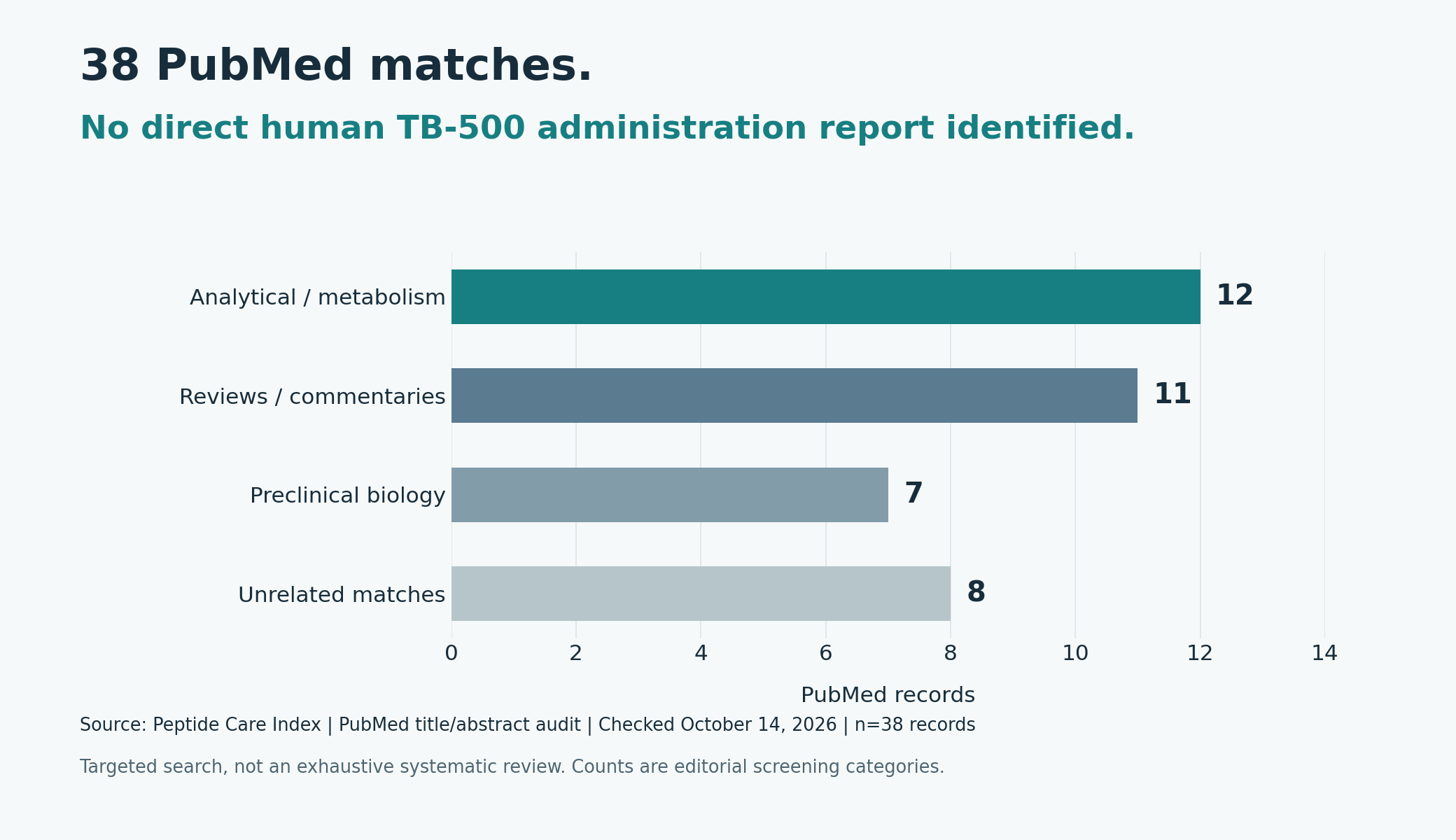
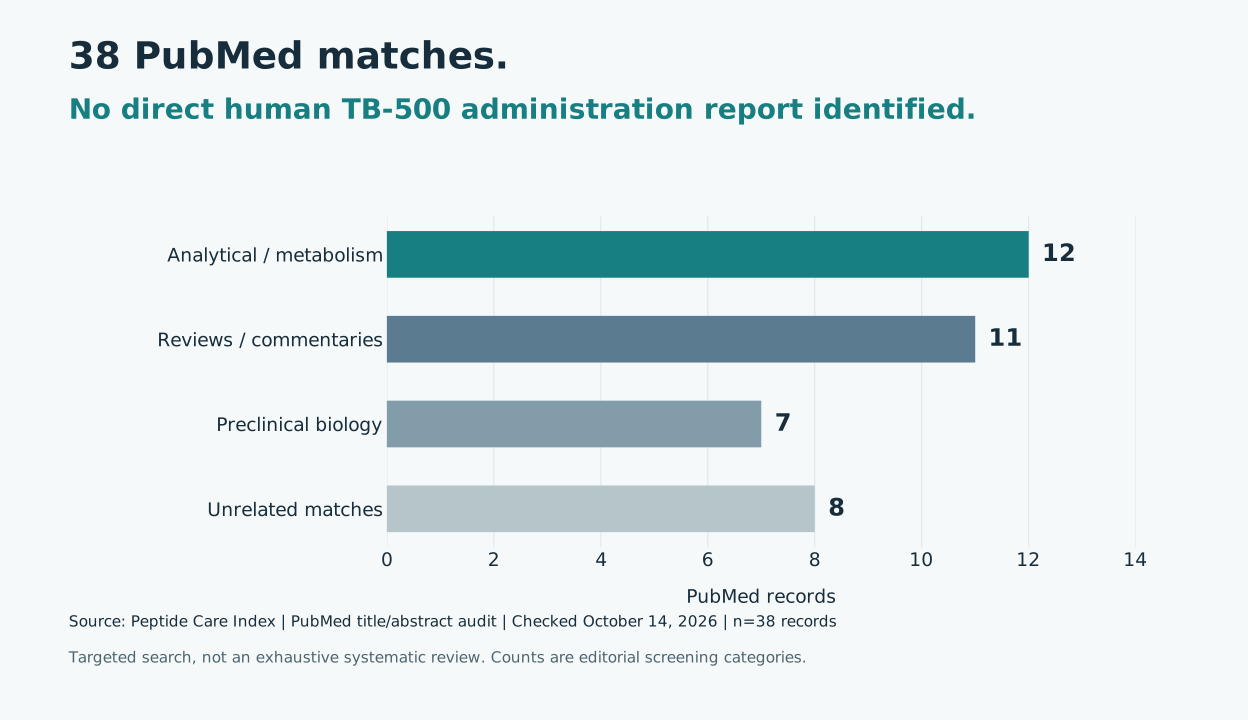
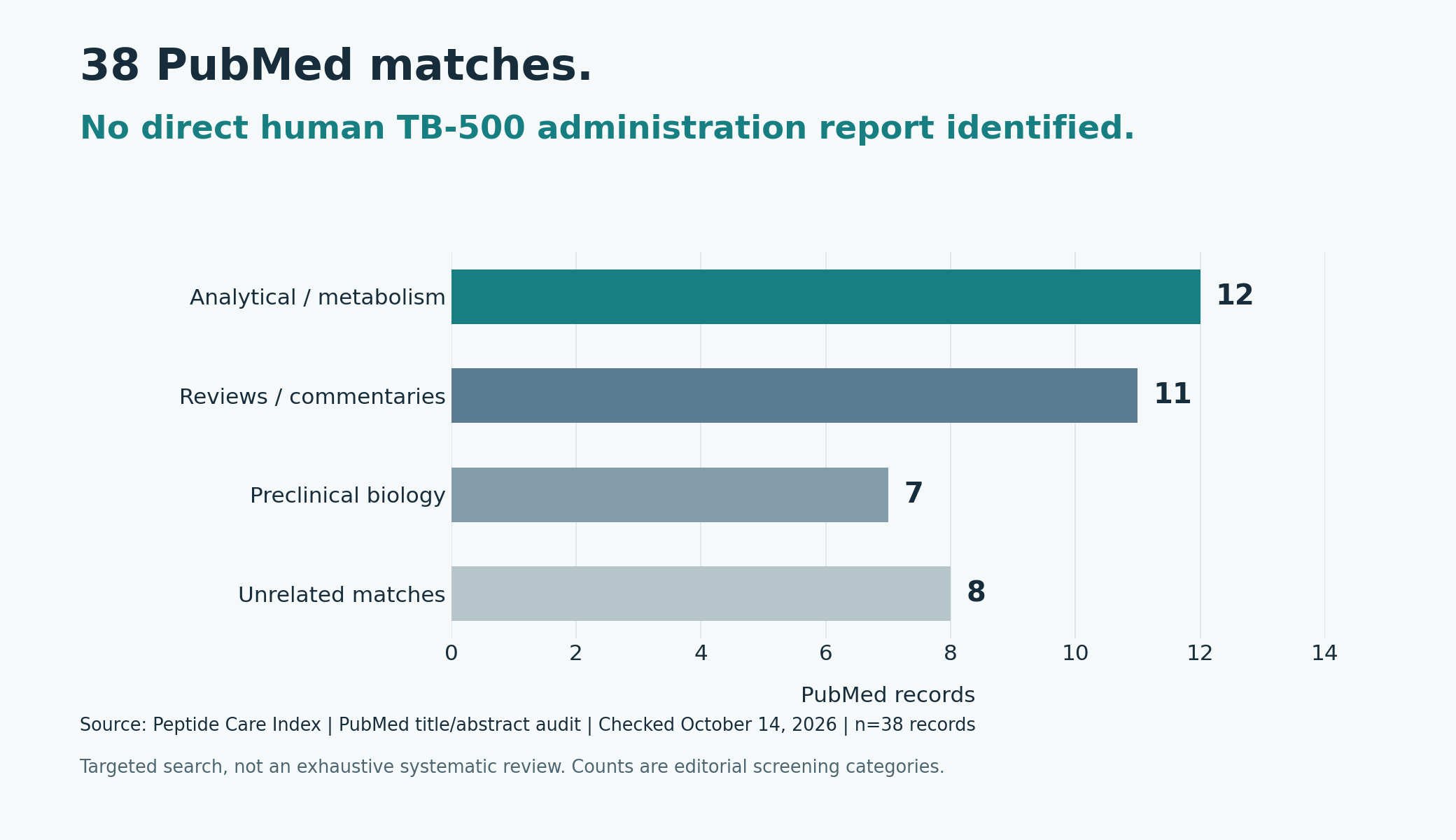 The 38 PubMed matches comprised 12 analytical or metabolism reports, 11 reviews or commentaries, 7 preclinical biology reports, and 8 off-topic matches; no direct human TB-500 administration report was identified.
Is TB-500 the same as thymosin beta-4?
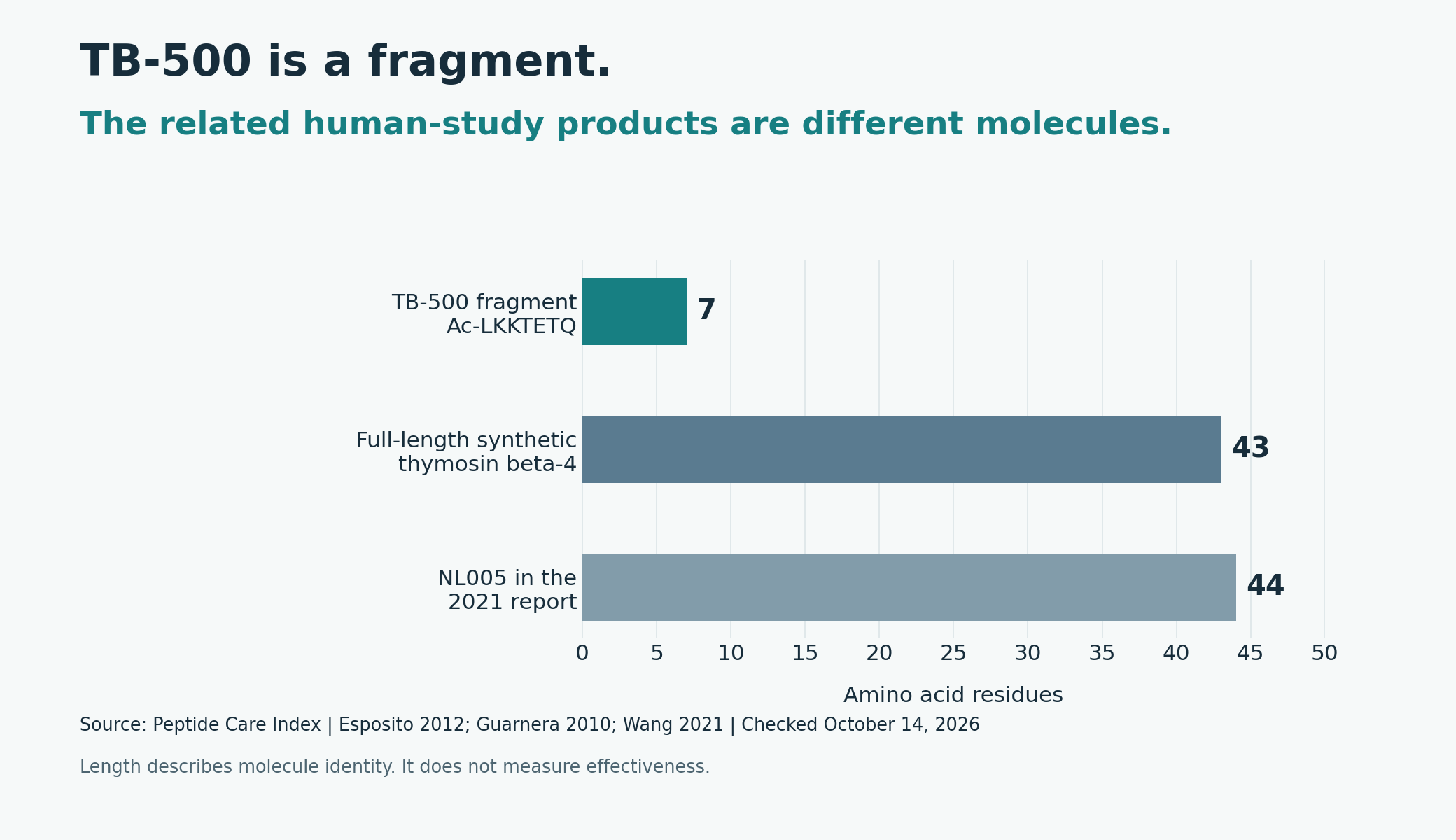
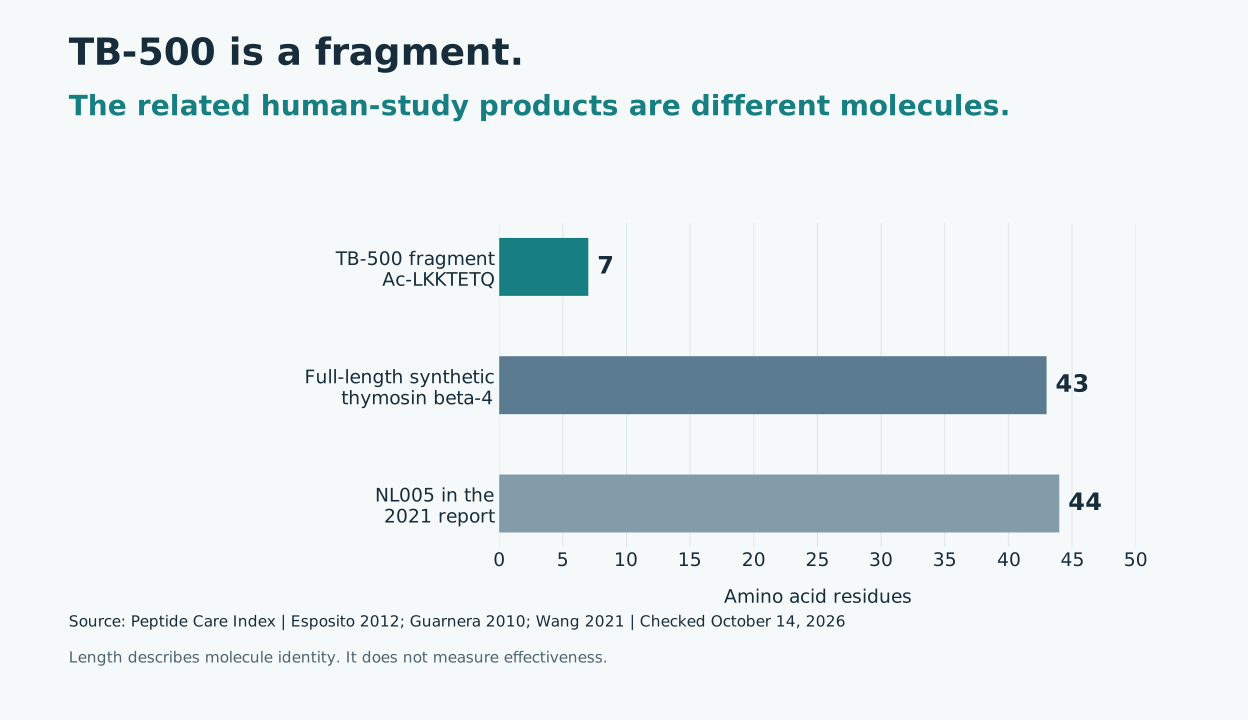
The defined TB-500 fragment has 7 amino acids; full-length thymosin beta-4 has 43. Amino acids are the building blocks in a peptide chain. A shorter piece of that chain is a different molecule, so a result from the whole peptide cannot simply be assigned to its fragment.
The letters LKKTETQ name the seven amino acids. Ac- marks an acetyl group attached at one end. The original chemical-identification paper found Ac-LKKTETQ in a TB-500 preparation. That paper identified a substance; it did not treat human patients. Primary identity study
| Name in the evidence | Amino acids | What the source establishes |
|---|---|---|
| TB-500 fragment, Ac-LKKTETQ | 7 | The acetylated 17–23 fragment identified in a TB-500 product. Esposito, 2012 |
| Full-length synthetic thymosin beta-4 | 43 | The whole peptide used in the human venous-ulcer trial. Guarnera, 2010 |
| NL005, recombinant human thymosin beta-4 | 44 | The product described in the 2021 healthy-volunteer study. Wang, 2021 |
Source: the linked primary reports, checked October 14, 2026. The 44-residue NL005 description is from that specific report; it does not redefine natural thymosin beta-4.
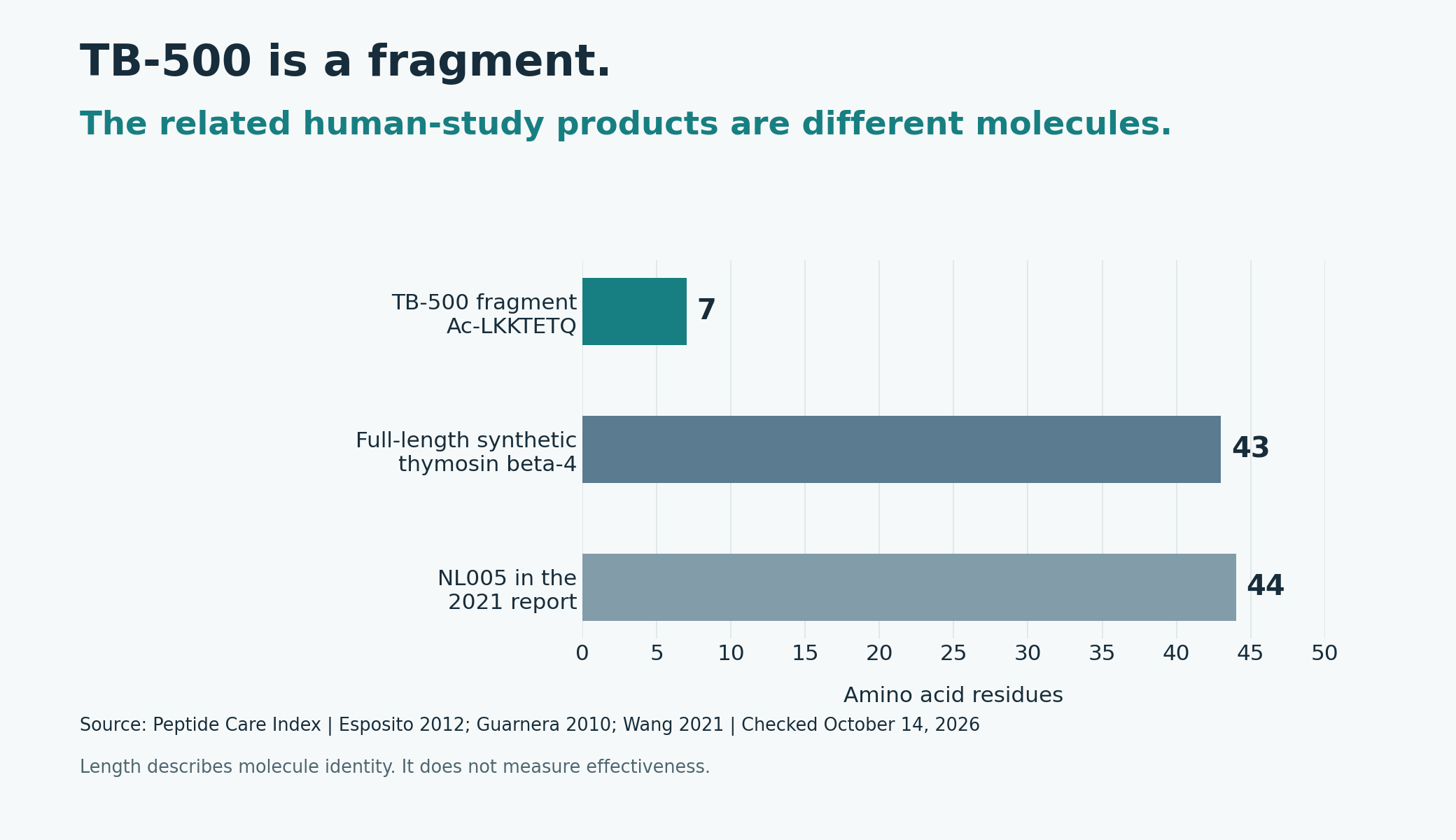 The defined TB-500 fragment has 7 amino acids, full-length synthetic thymosin beta-4 has 43, and the NL005 product described in the 2021 report has 44. These are different molecule descriptions, not a comparison of effectiveness.
An advertisement may use “TB-500” loosely. Check the molecule described in the cited paper, not just the name on the advertisement. Our peptide comparison chart separates the compounds and their evidence.
Which human thymosin beta-4 studies get cited for TB-500?
The eight selected reports below describe related thymosin beta-4 products, not confirmed Ac-LKKTETQ treatment. They include healthy-volunteer safety work, eye studies, a venous-ulcer study, and a heart-attack trial. Their participant counts belong to those studies and must not be presented as TB-500 fragment exposure counts.
| Report | People and design | Treatment and route | What the result supports |
|---|---|---|---|
| Ruff, 2010 | 40 healthy volunteers; randomized, placebo-controlled safety study | Synthetic thymosin beta-4; intravenous | No serious adverse events or dose-limiting toxicity reported in this study. It did not test injury recovery or the fragment. |
| Guarnera, 2010 | 73 patients; randomized, blinded, placebo-controlled venous-ulcer study | Full-length synthetic thymosin beta-4; topical gel | Exploratory healing findings and a safety profile comparable to placebo. The abstract does not establish a significant primary-endpoint win. |
| Dunn, 2010 | 9 patients; compassionate-use case series for nonhealing corneal defects | Thymosin beta-4; eye drops | Healing reported in patients with geographic defects; no change in punctate defects. No randomized control group. |
| Sosne, 2015, severe dry eye | 9 patients, 18 eyes; small randomized, placebo-controlled study | RGN-259; eye drops | Improvements in selected sign and symptom measures. Eighteen eyes does not mean eighteen patients. |
| Sosne and Ousler, 2015, CAE dry eye | 72 participants; randomized, placebo-controlled study | RGN-259; eye drops | Neither primary endpoint differed significantly; some secondary endpoints did. |
| Wang, 2021 | 54 single-dose and 30 multiple-dose participants; randomized, placebo-controlled safety work | NL005 recombinant product, described as 44 amino acids; intravenous | No serious adverse events or dose-limiting toxicity reported over the study observation. This is a different product from the fragment. |
| Sosne, online 2022 / 2023 volume, SEER-1 | 18 participants; randomized, placebo-controlled neurotrophic-keratopathy trial | RGN-259; eye drops | Primary healing comparison: 6 of 10 versus 1 of 8, p=0.0656. Later measures were favorable; the primary comparison did not meet the conventional 0.05 threshold. |
| Zhang, 2025, heart attack | 96 patients; randomized, blinded, placebo-controlled trial after artery-opening treatment | Recombinant human thymosin beta-4; route not stated in the accessed abstract | Overall infarct-area difference was not significant. An early-treatment subgroup of 43 had a favorable finding. A subgroup result is not overall trial success. |
Source: linked primary publications, checked October 14, 2026. Details, source-reading depth, publication dates, and the limits of each entry are in the related-human-study CSV. This is a selected map, not every thymosin beta-4 trial.
Do the eye studies prove TB-500 heals tendons?
No. The 72-person dry-eye study tested RGN-259 in the eye, and its main outcomes were not significantly different from placebo. Even a successful eye-drop trial would not establish that a different fragment, delivered by another route, repairs a human tendon. Primary dry-eye report
A primary endpoint is the main outcome a trial was designed to test. A secondary endpoint is an additional outcome. Both are worth reading, but they answer different questions. Keeping the main result beside favorable secondary results prevents a small study from sounding more conclusive than it was.
Did newer research fill the human tendon-healing gap?
The 2026 Achilles-tendon paper in our search studied rats, not people. It therefore adds animal evidence, rather than a human TB-500 treatment result. Its abstract also does not establish the exact sequence behind the TB-500 label. Primary 2026 report
The 2025 heart-attack paper adds human work on recombinant thymosin beta-4. Its overall infarct-area comparison was not significant; the favorable finding was in an early-treatment subgroup. It does not provide a human Ac-LKKTETQ tendon trial. Primary 2025 report
What about the BPC-157 plus TB4 knee-pain study?
The 2021 report followed up 16 patients, but only 4 received BPC-157 plus material called TB4. Three of those four reported improvement. The paper does not establish that the TB4 material was Ac-LKKTETQ, and the combination cannot reveal which peptide caused a change. Full primary report
This was a review of past treatment records, with telephone follow-up. It was not a randomized, placebo-controlled trial. Seventeen patient records were considered; sixteen people could be reached. There was no objective follow-up test confirming tissue repair.
So the defensible description is a small, uncontrolled BPC-157/TB4 combination report with unresolved TB4 identity. Calling it proof that the TB-500 fragment heals knees changes both the molecule and the strength of the evidence.
Does ClinicalTrials.gov list a TB-500 human trial?
The TB-500 search returned one record that describes itself as fictional. A registry title or an enrollment field alone is not evidence that real participants were treated. We also checked a knee-replacement trial sometimes placed in TB-500 evidence lists; it tested TB-402, an unrelated drug.
| Record | What the original record says | Why it is excluded |
|---|---|---|
| NCT07487363 | The official API summary begins: “This fictional study is an example of a ClinicalTrials.gov-style record.” Enrollment is 80, marked estimated; no results are posted. | The record identifies itself as an example. It does not document a real treated cohort. |
| NCT00793234 | The official API record names TB-402 and enoxaparin for clot prevention after knee replacement. | TB-402 is not TB-500 or thymosin beta-4. |
Source: official ClinicalTrials.gov records checked October 14, 2026. See the registry-exclusion CSV. Records can change; this table describes the checked versions.
Do not turn a planned enrollment into a count of people who received a drug. Do not turn a posted study design into a published treatment result. The molecule, actual enrollment, study status, and results each need their own check.
Does research using human blood count as a human study?
Human-derived samples can be studied without giving the substance to a person. WADA's TB-500 metabolism project used human liver preparations and plasma or serum in laboratory experiments. That is useful detection research, but it is not a clinical trial of benefits or safety. Original WADA project
In vitro means outside a living organism, such as in a dish. Ex vivo means working with material taken from an organism. “Human” in a paper's title can describe the source of a cell or sample. It does not, by itself, tell you that people received TB-500.
Do the human studies establish that TB-500 is safe?
The related-product studies do not establish the safety of the seven-residue fragment. For example, Ruff's 40-person intravenous study reported no serious adverse events or dose-limiting toxicity for synthetic thymosin beta-4. That observation belongs to that product, population, route, and study period. Ruff, 2010
Missing human evidence is not proof that a treatment is safe. It also cannot give a reliable human side-effect rate, a proven injury-recovery benefit, or a trial-based treatment schedule for the fragment. Those answers require evidence from the actual substance and use.
Is TB-500 FDA approved?
FDA's July 2026 briefing states that neither TB-500 free base nor TB-500 acetate is a component of an FDA-approved drug. The agency also did not identify clinical evidence supporting human TB-500 use in its review. A compounding review is a separate process from drug approval. FDA briefing, printed pages 7, 24, and 30–31
For the current forms and compounding-list distinctions, see our FDA peptide compounding list. The site's access overview explains how access claims differ from evidence and approval.
Is TB-500 prohibited in sport?
WADA's 2026 list prohibits thymosin beta-4 and its derivatives, including TB-500, in and out of competition. The entry is in section S2.3. This is an anti-doping rule, not a finding that TB-500 improves performance. Official 2026 Prohibited List
If you are checking a clinic's claim, Find My Peptide Path gives you questions about the actual substance, evidence, provider, and pharmacy. It is a research guide, not a treatment recommendation.
How we built this evidence audit
We screened 38 distinct PubMed records on October 14, 2026. We used the query below without date, language, or human filters. We read all returned titles and the 37 returned abstracts; the remaining record was an unrelated HIV article with no returned abstract.
"TB-500"[Title/Abstract] OR "TB500"[Title/Abstract]
OR "Ac-LKKTETQ"[Title/Abstract] OR "LKKTETQ"[Title/Abstract]
Run the same PubMed search. Results may change as PubMed adds or updates records.
An eligible report had to describe actual administration of Ac-LKKTETQ to human participants and establish the molecule's identity. A study did not need to show benefit to qualify. We excluded reviews, animal work, experiments in human-derived cells or samples, analytical methods without documented human fragment administration, and unrelated abbreviation matches.
We checked ClinicalTrials.gov separately with TB-500, Ac-LKKTETQ, and LKKTETQ. The first query returned the fictional-example record; the other two returned no records. We read the official API content, not just a search snippet. An additional cited knee-replacement record was checked and excluded because its drug was TB-402.
We then built a separate selected ledger of eight related-human publications using primary papers and their PubMed abstracts. This second ledger helps readers interpret common citations; its count is not a count of fragment trials. The CSV marks whether an entry was checked in full text or in the primary abstract.
We read the full 2015 CAE dry-eye paper, the 2021 NL005 paper, the SEER-1 paper, and the knee-pain report for the details that matter here. Other entries use the primary abstract at the depth recorded in the dataset. The July FDA briefing and original molecule-identification evidence were used to cross-check the substance definition.
No participants were recruited for this audit. No products were bought or tested. The publication's wider research rules are in our methodology.
What this audit can and cannot show
It shows what the stated search identified and why each match was kept out of direct human fragment evidence. The dated CSV makes those decisions open to review. It also shows which related-product human findings can be cited without changing the molecule or overstating the outcome.
This is a targeted evidence audit, not a systematic review of every global database. A report might use another name, mention the fragment only in its full text, remain unpublished, or be missing from PubMed. The selected related-study ledger is not an exhaustive tally of thymosin beta-4 trials.
We have not verified the contents of any reader's vial or a clinic's product. We do not infer a trial drug's identity from a marketing name. We do not pool different molecules, routes, diseases, eyes, people, or trial phases into one efficacy or safety number.
How to cite this page
Publication: Peptide Care Index
Title: TB-500 Human Studies: 0 Direct Studies Found in Our Audit
URL: https://peptidecareindex.com/research/tb-500-human-studies/
Evidence checked: October 14, 2026
Ready-to-copy citation:
Peptide Care Index. TB-500 Human Studies: 0 Direct Studies Found in Our Audit. Evidence audit checked October 14, 2026. https://peptidecareindex.com/research/tb-500-human-studies/
A sentence you can use:
Peptide Care Index's October 2026 screen of 38 PubMed records identified no original report documenting administration of the defined TB-500 fragment, Ac-LKKTETQ, to human participants.
Reuse: Our original classifications, summaries, and charts are available under CC BY 4.0; credit Peptide Care Index by name and preserve source attribution. Underlying publications and third-party material keep their own rights and terms.
Download the evidence and charts
- All 38 PubMed screening decisions — CSV
- Eight selected related-human-study reports — CSV
- Registry exclusions — CSV
- Search method — JSON
- PubMed screening chart — PNG · SVG
- Molecule-length chart — PNG · SVG
Frequently asked questions
Has TB-500 been tested in humans?
Our October 14, 2026 targeted search found 0 published reports documenting administration of the defined Ac-LKKTETQ fragment to human participants. Related thymosin beta-4 products have been tested in people. A product labeled TB-500 is not enough to establish that it matches either substance.
Are there randomized controlled trials of TB-500?
We identified no randomized human trial of the defined fragment in this audit. The randomized eye, ulcer, safety, and heart-attack studies in the ledger tested related thymosin beta-4 products. Those results should be described using the actual trial molecule and route.
Does the 2021 knee study prove the BPC-157 and TB-500 combination works?
No. Only 4 followed-up patients received BPC-157 plus material called TB4, and there was no placebo group. The paper does not establish Ac-LKKTETQ identity or separate the effect of either peptide.
Is the 80-person TB-500 cardiovascular trial real evidence?
At our October 14, 2026 check, NCT07487363 described itself as a fictional ClinicalTrials.gov-style example. Its enrollment of 80 was estimated and it had no posted results. We excluded it from the human-evidence count.
Do these studies provide a proven TB-500 dose for injury recovery?
No. The audit identified no direct human fragment-administration study from which a proven injury-recovery regimen could be taken. Doses used for a different thymosin beta-4 product or an eye-drop trial do not establish a schedule for the fragment.
Sources
All sources below were checked on October 14, 2026. Each study's year is its publication year, not the audit year.
- NCBI PubMed: the reproducible fragment search. Original PMID snapshot and editorial decisions are supplied with the downloads.
- Esposito et al., 2012. Chemical identification of the acetylated 17–23 fragment in TB-500. DOI: 10.1002/dta.1402.
- Ruff et al., 2010. Intravenous thymosin beta-4 safety study in healthy volunteers.
- Guarnera et al., 2010. Thymosin treatment of venous ulcers.
- Dunn et al., 2010. Compassionate treatment of nonhealing corneal defects.
- Sosne et al., 2015. Severe-dry-eye randomized trial.
- Sosne and Ousler, 2015. Dry-eye CAE randomized trial. DOI: 10.2147/OPTH.S80954.
- Wang et al., 2021. NL005 healthy-volunteer safety study. DOI: 10.1111/jcmm.16693.
- Sosne et al., published online December 28, 2022; 2023 journal volume. SEER-1 neurotrophic-keratopathy trial. DOI: 10.3390/ijms24010554.
- Zhang et al., 2025. Recombinant thymosin beta-4 in mice and patients after heart attack. DOI: 10.1093/cvr/cvaf223.
- Lee and Padgett, 2021. BPC-157 alone or with TB4 for knee pain, full report. PMID: 34324435.
- ClinicalTrials.gov NCT07487363, official API record.
- ClinicalTrials.gov NCT00793234, official API record.
- WADA's original TB-500 in-vitro/ex-vivo metabolism project.
- 2026 Achilles-tendon experiment in rats.
- FDA's July 2026 briefing on TB-500-related bulk drug substances.
- WADA 2026 Prohibited List, section S2.3.
What changed: October 14, 2026 — initial evidence audit and selected related-study ledger created.