Peptide comparison chart: 24 peptides, uses and human evidence
Peptide Care Index’s October 2026 peptide comparison chart matches 24 selected entries to their exact forms, studied uses, human evidence, and U.S. Food and Drug Administration (FDA) records. Some rows have approved products. Others have early studies or a safety notice, not a proven benefit. Use the table to see which evidence actually fits.
What are the key findings?
- Six entries have named FDA-approved product examples in Peptide Care Index’s October 2026 comparison: Wegovy, Zepbound, Saxenda, Egrifta WR, Vyleesi and Forzinity. This is a count of selected examples, not the share of all peptides that are approved. See the labels and limits.
- Seven versus 43 amino acids: FDA’s July 2026 TB-500 review concerns a seven-unit fragment, not full-length, 43-unit thymosin beta-4. Amino acids are the building blocks of peptides. 17
What does the peptide comparison chart show?
The chart covers 24 selected entries. It separates a use being discussed from a benefit shown in the checked source. Read across the whole row: an impressive result for a different form or condition cannot fill an evidence gap.
Find an entry in the chart
Use the name or alias, then narrow by topic, FDA-record category or evidence type. The complete comparison remains in the table below.
24 matching entries
| Peptide | Use or claim checked | What the checked human record shows | FDA/product record and the key limit |
|---|---|---|---|
| Semaglutide | Weight management | 13.7% mean weight reduction at 72 weeks in SURMOUNT-5; compare only with the tirzepatide arm of that trial. 9 10 | Approved example: Wegovy. The trial did not compare every current injection dose or tablet. 1 |
| Tirzepatide | Weight management; separate approved sleep-apnea use | 20.2% mean weight reduction at 72 weeks in the same trial; 751 people were randomized across both arms. 9 10 | Approved example: Zepbound. The result applies to the studied injection regimens. 2 |
| Liraglutide | Weight management | 8.4 kg mean weight loss versus 2.8 kg with placebo at 56 weeks; 3,731 adults randomized in the 2015 trial. 11 | Approved example: Saxenda. A separate trial, not a head-to-head comparison with the rows above. 3 |
| Tesamorelin | Excess abdominal fat in adults with HIV-related abnormal fat distribution | Approved use concerns excess abdominal fat in adults with HIV-related abnormal fat distribution, not general weight loss. 4 | Approved example: Egrifta WR. Not indicated for general weight-loss management. 4 |
| Bremelanotide / PT-141 | A defined low-desire disorder | The label covers a specific low-desire disorder in women before menopause—not men or general sexual performance. 5 | Approved example: Vyleesi. Not indicated for men or sexual-performance enhancement. 5 |
| Elamipretide / SS-31 | Muscle strength in Barth syndrome | Forzinity received accelerated approval for muscle strength in Barth syndrome at 30 kg or more; the original trial enrolled 12 people. 6 7 | Approved example: Forzinity. A narrow disease indication, with a required confirmatory trial. 6 7 |
| Sermorelin | Historical growth-hormone-related uses; current marketing often differs | Geref approvals were withdrawn in 2009. A later FDA finding about that withdrawal is not approval of today’s compounded products. 8 | Historical Geref record, not a current approval badge. Historical approval does not approve a compounded offer. 8 |
| Retatrutide | Weight management research | Published Phase 3 trial: 17.6%–25.0% mean weight reduction across the studied arms versus 3.9% placebo at 80 weeks; 2,339 adults randomized. 12 | FDA: not an approved-drug component. Investigational, despite published Phase 3 results. 13 |
| Cagrilintide | Weight management research | Developer-reported monotherapy subanalysis: 11.8% versus 2.3% placebo at 68 weeks if all adhered to treatment; not a CagriSema result. 14 | FDA: not an approved-drug component. A monotherapy subanalysis, not evidence for every combination. 13 |
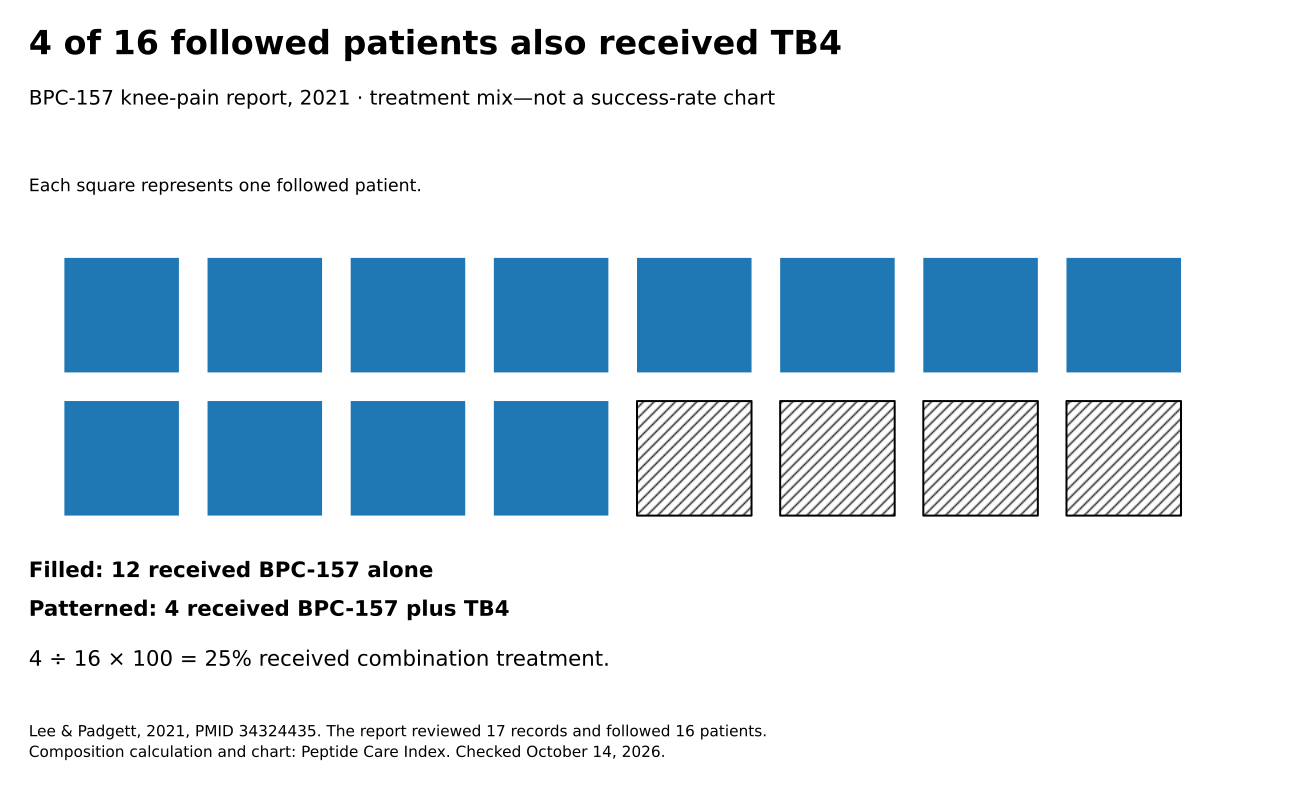
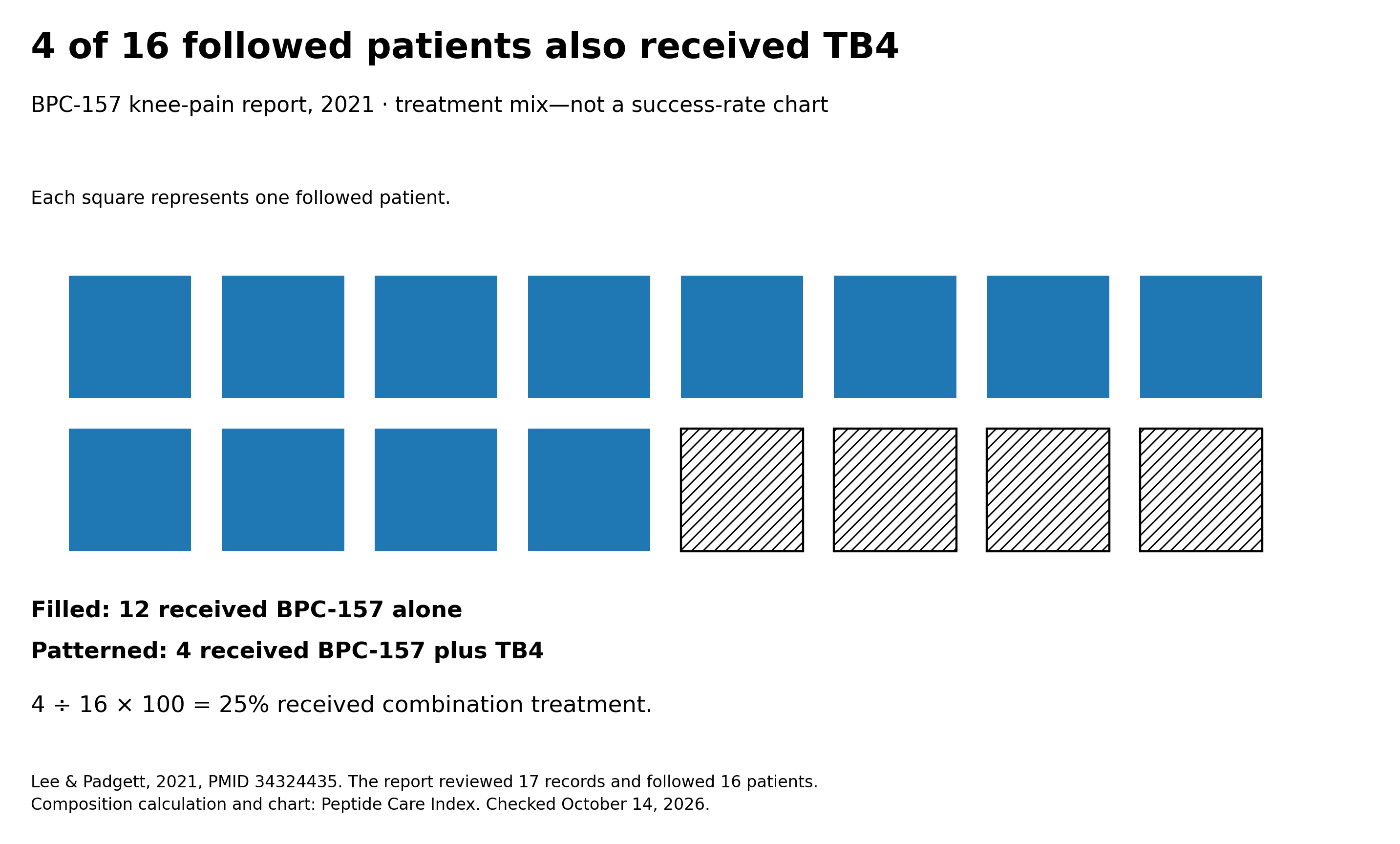
| BPC-157 | Knee pain; not established tendon healing | 14 of 16 followed patients reported improvement; four also received TB4. No control group and no proven healing rate. 15 | FDA 2026 review: no approved-drug component. Knee injections do not establish oral or tendon-healing benefits. 16 |
| TB-500 fragment | Wound-healing claims | The FDA briefing found no human exposure data for this exact fragment. Full-length thymosin beta-4 is a different row. 17 | FDA 2026 review: no approved-drug component. Do not borrow full-length thymosin beta-4 results. 17 |
| Full-length thymosin beta-4 | Poor healing of the eye’s clear front surface | Eye-drop trial: 6 of 10 versus 1 of 8 healed at four weeks; primary comparison was not statistically significant. 18 17 | This trial source does not establish product approval. Eye drops are not injected TB-500 or a sports-recovery treatment. |
| CJC-1295, long-acting study form | Growth-hormone and IGF-I responses | Studies with 42 and 24 healthy adults measured hormone responses, not a proven muscle-growth percentage. 20 19 | FDA 2024 review: no approved-drug component. The study form is not interchangeable with “without DAC” or blends. 19 |
| Ipamorelin | Recovery of bowel function after surgery | FDA describes 114 participants who received ipamorelin or placebo in an IV bowel-surgery trial; its primary efficacy result was not statistically significant. 21 | FDA 2024 review: no approved-drug component. The IV surgical study does not prove fitness or fat-loss benefits. 21 |
| AOD-9604 | Weight-loss claims | In FDA’s account of OPTIONS, 502 were randomized; the oral treatment did not beat placebo at the 12-week primary weight-loss endpoint. 22 | FDA 2024 review: no approved-drug component. The selected evidence concerns oral treatment, not injections. 22 |
| GHK-Cu, injectable scope | Injection safety; skin claims not fully reviewed | FDA reports limited human injection-safety data. This row does not review all GHK-Cu creams or assign a skin-benefit percentage. 23 | Safety notice only; no approval conclusion from this source. Topical and injectable evidence cannot be swapped. 23 |
| MOTS-c | Insulin sensitivity in prediabetes | The briefing found no human exposure data. A separate registry lists 120 planned participants and no posted results at our check. 24 25 | FDA 2026 review: no approved-drug component. Planned enrollment is not a measured treatment result. 24 |
| KPV | Wound-healing and inflammation claims | FDA’s briefing identified no human exposure data or clinical studies. There is no human treatment percentage to extract from that review. 26 | FDA 2026 review: no approved-drug component. No data identified is not a measured 0% benefit. 26 |
| LL-37 | Healing of hard-to-heal venous leg ulcers | The trial randomized 149 patients; 148 received treatment. It did not find a significant overall healing benefit. A favorable subgroup was found only in a later analysis. 27 | Trial plus FDA safety notice; neither establishes product approval. A post hoc subgroup does not replace the main result. 23 |
| Thymosin alpha-1 | Survival in adults with sepsis | TESTS randomized 1,106 adults and analyzed 1,089; it found no clear reduction in 28-day mortality from sepsis. 29 | FDA 2024 review: no approved-drug component. A sepsis result does not settle every immune-related use. 28 |
| Epitalon | Insomnia evidence; longevity claims not established by these records | FDA discussed human reports but did not establish insomnia effectiveness. Those findings do not demonstrate longer human life. 30 | FDA 2026 review: no approved-drug component. Melatonin or cell findings are not a human lifespan result. 30 |
| Semax | Specified neurologic conditions | Human nasal-route reports exist. FDA found the reviewed evidence insufficient for the neurologic conditions it evaluated. 31 | FDA 2026 review: no approved-drug component. The review had small-study and language limits. 31 |
| Selank | Safety information; anxiety/focus claims not fully reviewed | The checked FDA notice flags missing human safety information. It is not a full anxiety or focus evidence review. 23 | Safety notice only; no approval conclusion from this source. This notice is not a full efficacy review. 23 |
| DSIP / emideltide | Insomnia | Human IV sleep studies exist, but FDA described their findings as inconclusive and preliminary. 32 | FDA 2026 review: no approved-drug component. Older IV results cannot prove an under-the-skin sleep treatment. 32 |
Source: Peptide Care Index compilation of the linked primary reports, drug labels and FDA records. Checked October 14, 2026. Each study keeps its own year. The full CSV records route, population, denominator and source-reading depth. “FDA 2024/2026 review” means the finding in that dated document, not a complete new approval search.
Download the complete comparison CSV.
How should you read the evidence labels?
A randomized trial assigns people to groups by chance. A placebo is a comparison treatment without the tested active drug. An uncontrolled report has no comparison group, so it cannot show what would have happened without the treatment.
A biomarker is a body measurement, such as a hormone level. It is not automatically a benefit someone can feel. A post hoc analysis is an extra analysis chosen after the main study plan; it can suggest a question for another trial rather than settle it.
A study’s primary endpoint is its main planned outcome. Statistically significant means a result met the chosen statistical test’s cutoff; it does not show that a benefit is large or applies to another use. Phase 3 is a later stage of clinical testing, not a synonym for FDA approval.
“Not extracted” means we did not take a usable number from that source. It does not mean zero. “No human exposure data identified” is a finding within a source’s search, not a promise that every paper in every language was checked.
The same rule applies to FDA records. An approved product, a historical approval, a research paper and a safety notice answer different questions. FDA also states that compounded drugs are not FDA-approved. 34
Which entries have FDA-approved products?
Six entries have named approved-product examples in this chart. Each approval belongs to a finished product for defined uses and groups of people. A familiar ingredient name on another product does not transfer that approval. 1 2 3 4 5 6 34
Table 2. Approved examples and the boundary of each use
| Product | Peptide | Use relevant to this chart | Form in the checked record | Boundary that matters |
|---|---|---|---|---|
| Wegovy | Semaglutide | Weight management in label-defined groups | Injection and tablets, with form-specific indications | Forms, eligible groups and doses are not interchangeable; SURMOUNT-5 tested specified injections. 1 |
| Zepbound | Tirzepatide | Adult weight management; moderate-to-severe obstructive sleep apnea in adults with obesity | Injection | Sleep apnea means repeated breathing pauses during sleep; the approval is not for every person who snores. 2 |
| Saxenda | Liraglutide | Weight management in defined adult and pediatric groups | Injection | Read the applicable age, weight and health-condition requirements in the label. 3 |
| Egrifta WR | Tesamorelin | Excess abdominal fat in adults with HIV and lipodystrophy | Injection | Not indicated for general weight-loss management. Lipodystrophy means abnormal fat distribution. 4 |
| Vyleesi | Bremelanotide | Acquired, generalized low sexual desire causing distress in label-defined premenopausal women | Injection | Not indicated for men or sexual-performance enhancement; the label has further exclusions. 5 |
| Forzinity | Elamipretide | Muscle strength in Barth syndrome at a body weight of at least 30 kg | Injection | Accelerated approval for a rare disease, not general anti-aging care. A confirmatory trial is required. 6 7 |
Source: The linked product labels and FDA approval records, checked October 14, 2026. These are selected examples, not a complete inventory of approved peptide medicines.
Tesamorelin shows why the condition matters. A reduction in excess abdominal fat in someone with HIV-related fat changes is not a general weight-loss indication. Forzinity shows a different boundary: accelerated approval can rely on a measure expected to predict benefit while a further trial must confirm that benefit. 4 7
Forzinity’s knee-strength gains appeared in the open-label extension; its randomized part did not beat placebo on the primary endpoints. 6 FDA label, section 14.
For the separate question of what an advertised care route actually supports, read our peptide access overview.
What happened to sermorelin’s approval?
Geref’s approvals were withdrawn effective June 18, 2009. FDA determined in 2013 that the products were not withdrawn for safety or effectiveness reasons. That historical finding does not approve a current compounded sermorelin offer. 8 34
Table 3. Sermorelin’s historical record is not a current product badge
| Record | Date | What it establishes |
|---|---|---|
| Geref approvals withdrawn | June 18, 2009 | The historical approvals were withdrawn. |
| FDA safety/effectiveness withdrawal determination | March 4, 2013 | FDA said the withdrawal was not for safety or effectiveness reasons. It did not approve a new compounded anti-aging product. |
Source: FDA’s determination in the Federal Register. 8
What does BPC-157’s “87.5%” result actually measure?
The figure describes reported improvement in 14 of 16 followed patients in an uncontrolled knee-pain report published in 2021. Four of those patients also received TB4. It is not a BPC-157-only healing rate. 15
Table 4. The denominator behind the BPC-157 knee-pain figure
| Treatment reported | Patients followed | Patients reporting improvement |
|---|---|---|
| BPC-157 alone | 12 | 11 |
| BPC-157 plus TB4 | 4 | 3 |
| Combined follow-up group | 16 | 14 |
Source: Lee and Padgett, 2021. The first two rows sum to the third; they are not three independent groups. The report reviewed 17 records and reached 16 patients for follow-up. 15
Our arithmetic is simple: 14 ÷ 16 × 100 = 87.5%. But 4 ÷ 16 × 100 = 25% of the followed group received another peptide too. That second number describes treatment mix, not success.
A pain report is worth recording. It cannot tell us whether the treatment caused the change, whether a tendon healed, or whether a capsule would produce the same result. That is why the chart keeps the treatment group, outcome and route beside the number.
Do growth-hormone changes prove muscle gain?
No. The CJC-1295 studies summarized here involved 42 and 24 healthy adults in separate trials and measured hormone responses. They did not establish a muscle-building or strength benefit. 20 19
The papers measured growth hormone and IGF-I, insulin-like growth factor I, a hormone linked to growth. A higher reading is a blood-test result. It is not the same measurement as added muscle or a stronger lift.
The exact drug also matters. DAC means drug affinity complex, a modification used in the long-acting CJC formulation. “CJC without DAC” and a CJC/ipamorelin blend must not inherit that formulation’s trial results. FDA’s review distinguishes the forms. 19
Ipamorelin adds a route mismatch. FDA’s account of its bowel-surgery trial describes 114 participants across the ipamorelin and placebo groups and no statistically significant benefit on the primary meal-tolerance endpoint. The drug was given into a vein after surgery, not as an under-the-skin fitness treatment. 21
Does a registered MOTS-c study show that it works?
No. The MOTS-c registry record checked on October 14, 2026 lists 120 planned participants and no posted results. A study plan does not supply a measured treatment benefit. 25
Table 5. What the checked MOTS-c registry record actually says
| Field | Recorded value | How to read it |
|---|---|---|
| Record | NCT07505745 | A sponsor-submitted ClinicalTrials.gov record. |
| Estimated enrollment | 120 | Planned, not independently confirmed as enrolled or treated. |
| First posted | April 1, 2026 | The date the record was first posted. |
| Last update posted | April 1, 2026 | Not a promise that the study status was reconfirmed in October. |
| Results posted at our check | No | The checked API reports hasResults: false. |
| Question proposed | Insulin sensitivity in adults with prediabetes and overweight or obesity | How the body responds to insulin; no outcome is posted in this record. |
Source: ClinicalTrials.gov’s live record API, checked October 14, 2026. We did not independently verify the sponsor’s study conduct. 25
FDA’s earlier briefing said it had not identified human exposure data for MOTS-c. Keep that historical search finding and this separate registry record side by side; neither is an observed success rate. 24
Which peptide names and routes must not be mixed up?
FDA’s TB-500 review distinguishes a seven-amino-acid fragment from the full 43-amino-acid thymosin beta-4 molecule. Those are not two names for the same tested treatment. Route matters too: eye drops, creams, pills and injections do not automatically share evidence. 17
Table 6. Evidence swaps that this chart does not make
| Tempting shortcut | What must stay separate | Source |
|---|---|---|
| TB-500 equals all thymosin beta-4 | The FDA-defined fragment and the full-length molecule | 17 |
| An eye-drop trial proves injury injections work | Full-length RGN-259 applied to the eye and injected products for other tissues | 18 17 |
| Every “CJC” product has the same human data | The studied long-acting form, without-DAC forms and combination products | 20 19 |
| GHK-Cu skin-care results prove injection benefits | Topical uses and FDA’s narrower injectable-route safety notice | 23 |
| Oral AOD-9604 results settle injection claims | The oral OPTIONS trial and proposed injected products | 22 |
| Epitalon and epithalamin are interchangeable | A defined peptide and a different pineal extract discussed in the source review | 30 |
| A brand’s approval covers any product with that ingredient | The approved finished product and separately compounded products | 34 |
Source: Peptide Care Index’s matching rules, drawn from the cited primary records. Checked October 14, 2026. These are identity and scope distinctions, not comparative safety ratings.
The RGN-259 eye-drop trial is a useful test of careful reading. At four weeks, 6 of 10 treated patients healed versus 1 of 8 controls, but the primary comparison did not meet the usual statistical threshold (P = 0.0656). That result is neither proof that nothing happened nor proof of a general healing treatment. 18
LL-37 shows a different trap. Its venous-leg-ulcer trial randomized 149 patients, treated 148, and used 144 in the full analysis set. It found no significant overall healing benefit. A later subgroup analysis was more favorable, but that does not turn the full trial into a positive result. 27
When a clinic advertises a service, the evidence match and the bill are separate checks. Our comparison of published clinic terms covers the service and payment side, not proof that a peptide works.
Can weight-loss percentages be compared fairly?
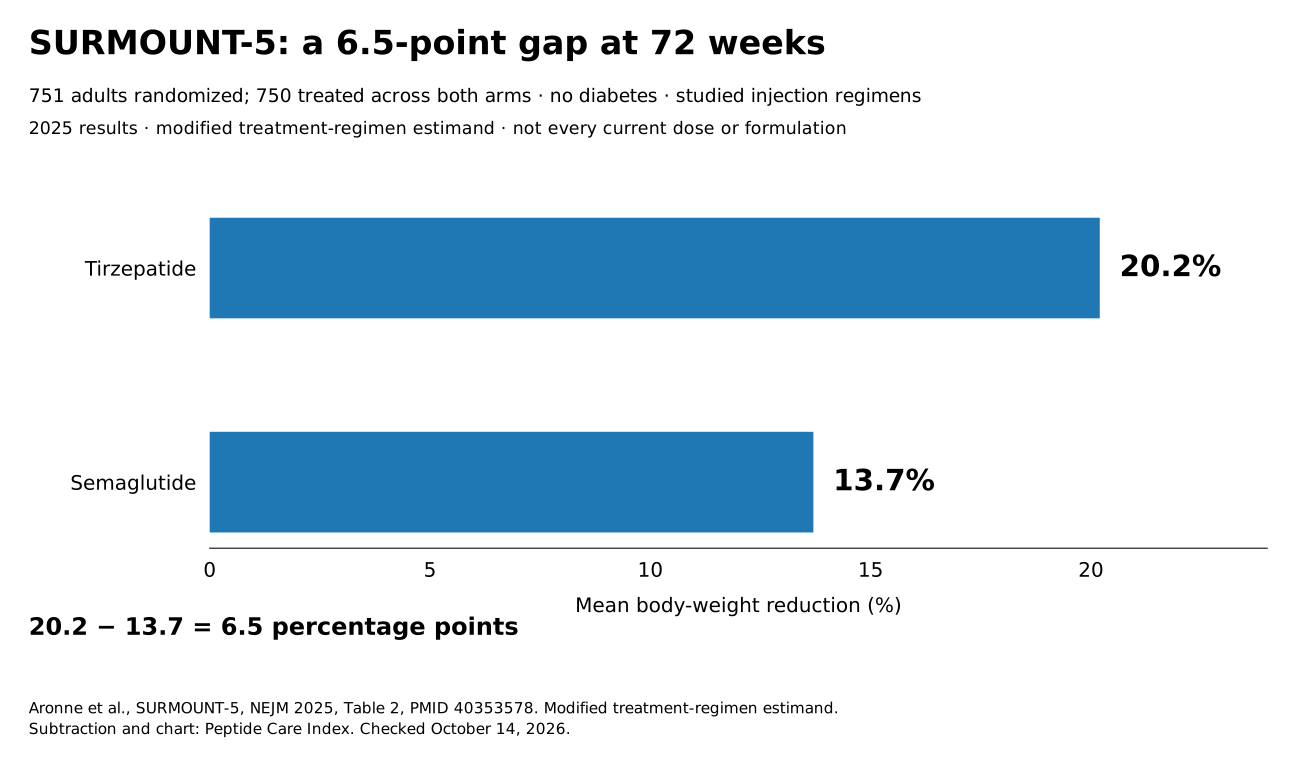
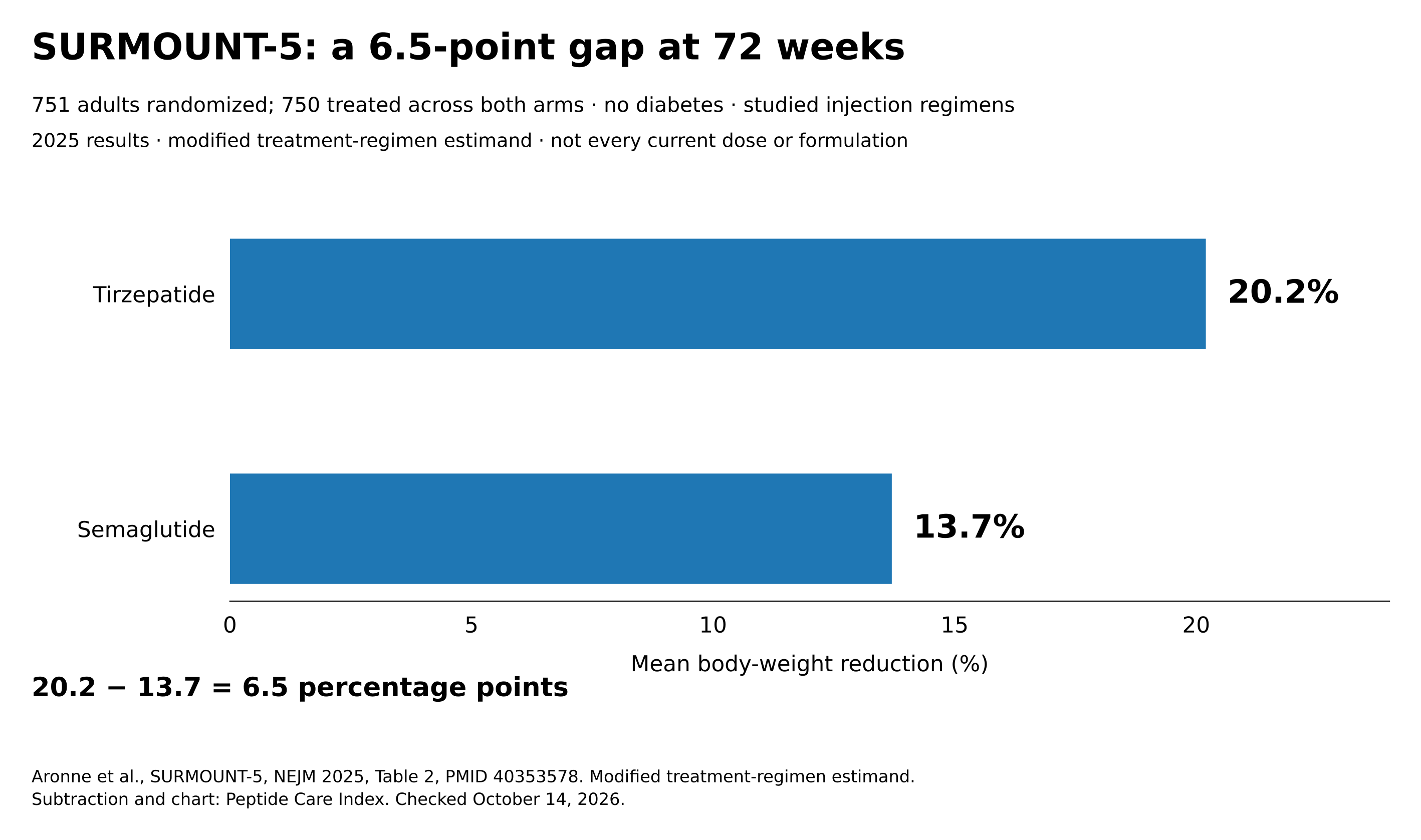
A direct trial provides a cleaner comparison than numbers from unrelated studies. SURMOUNT-5 reported 20.2% mean weight reduction with tirzepatide and 13.7% with semaglutide at 72 weeks. Peptide Care Index calculated a 6.5-percentage-point gap between those reported means. 9 10
Table 7. SURMOUNT-5: the same trial, population and follow-up period
| Studied treatment | Mean body-weight reduction | Follow-up |
|---|---|---|
| Tirzepatide injection regimen | 20.2% | 72 weeks |
| Semaglutide injection regimen | 13.7% | 72 weeks |
Source: Aronne et al., 2025, and the trial producer’s May 11, 2025 report. The open-label trial, in which people knew which drug they received, randomized 751 adults across both arms, without diabetes, who met its weight-related entry criteria. These are modified treatment-regimen estimates from specified injection regimens—not every current dose or formulation. Of the 751 randomized participants, 750 received at least one dose and entered the efficacy and safety analyses. 9 10
20.2 − 13.7 = 6.5 percentage points. Percentage points subtract percentages directly. The gap is not “6.5% more weight loss,” and it is not a forecast of what one person will lose.
Where does retatrutide fit after its Phase 3 results?
Retatrutide has a published Phase 3 trial, not just a Phase 2 headline. The September 2026 TRIUMPH-1 paper reports 2,339 randomized adults and 17.6% to 25.0% mean weight reduction across its three retatrutide arms at 80 weeks. FDA’s checked page still says retatrutide is not a component of an approved drug. 12 13
Table 8. TRIUMPH-1 results under the treatment-regimen analysis
| Trial arm | Mean body-weight reduction at 80 weeks |
|---|---|
| Lowest studied retatrutide arm | 17.6% |
| Middle studied retatrutide arm | 23.7% |
| Highest studied retatrutide arm | 25.0% |
| Placebo | 3.9% |
Source: Jastreboff et al., September 29, 2026. The 2,339 total spans all trial arms. These are reported mean reductions, not the paper’s separately modeled between-group contrasts. The arm labels describe the study, not a dosing guide. 12
A treatment-regimen estimand is the effect the analysis aims to estimate under the assigned treatment plan, handling events such as stopping treatment according to its stated rules. A different analysis can ask what might happen if everyone stayed on treatment. Do not strip that label from the number—or add these bars to a different trial’s chart. 12 10
Is a cagrilintide result the same as a CagriSema result?
No. CagriSema combines cagrilintide with semaglutide. Novo Nordisk’s report of a cagrilintide-only subanalysis gives 11.8% mean weight reduction versus 2.3% with placebo at 68 weeks under an analysis assuming all adhered to treatment. It is not the combination’s result. 14
Table 9. Cagrilintide alone: the reported analysis and its limit
| Reported group | Mean weight reduction | Follow-up | Analysis condition |
|---|---|---|---|
| Cagrilintide alone | 11.8% | 68 weeks | Assuming all adhered to treatment |
| Placebo | 2.3% | 68 weeks | Same stated analysis |
Source: Novo Nordisk’s 2025 annual report, describing a REDEFINE 1 monotherapy subanalysis. This is a trial-developer report, not a new independent analysis of participant data. FDA’s checked page says cagrilintide is not a component of an approved drug. 14 13
The liraglutide result in the main chart has a different unit again: kilograms at 56 weeks. Keep the study, unit, people and timepoint beside every value. A single “best peptide” leaderboard would erase those differences.
What did FDA’s seven-peptide review find about human data?
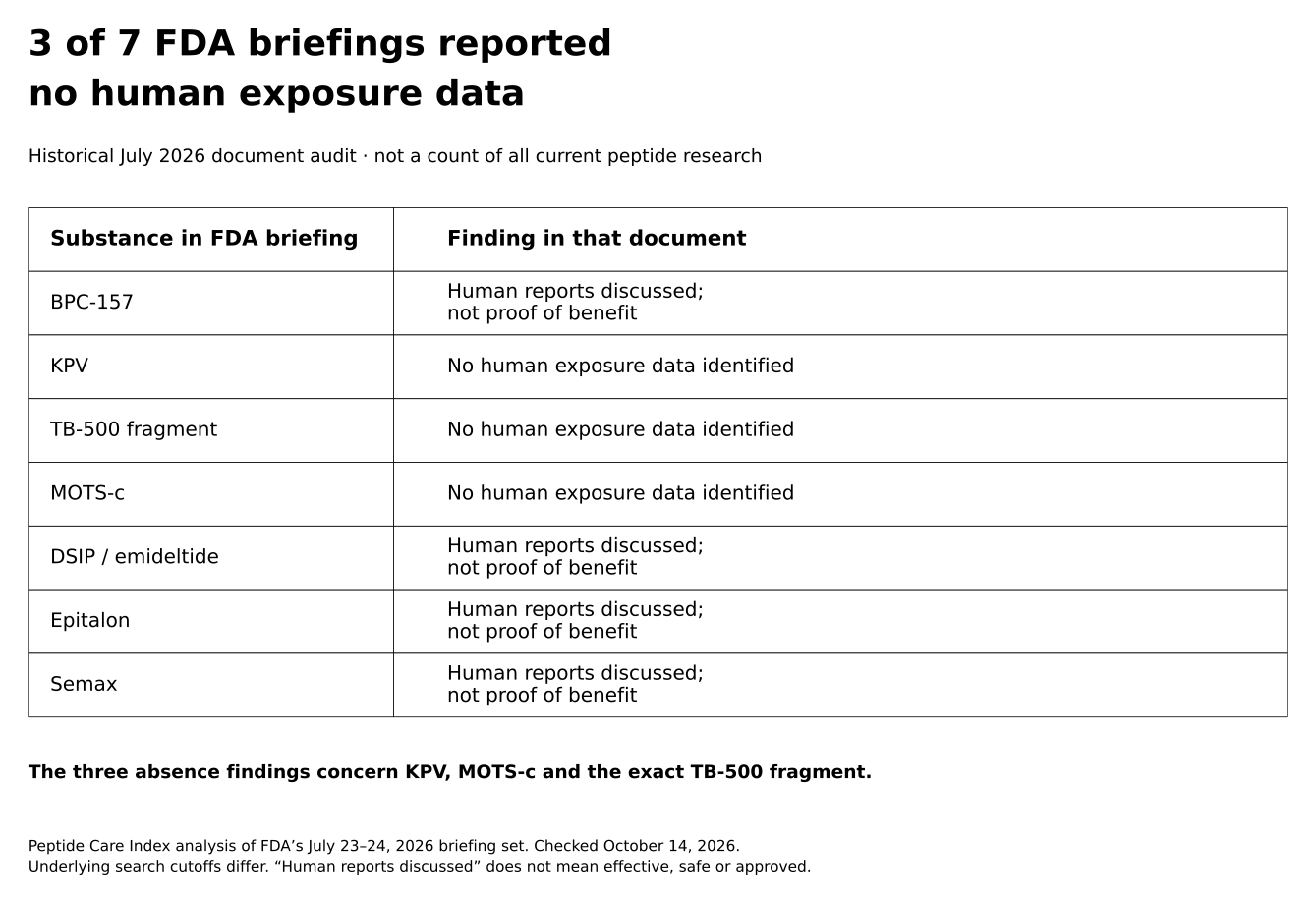
FDA’s July 2026 briefings identified no human exposure data for KPV, MOTS-c and the exact TB-500 fragment. Peptide Care Index counted 3 of 7 substance-specific briefings with that explicit finding. This is a historical document audit, not a new search of all human research through October. 33 26 24 17
Table 10. The complete seven-document FDA comparison
| Compound in the briefing set | What the reviewed document says | Counted as an explicit no-human-exposure finding? |
|---|---|---|
| BPC-157 | Human reports discussed; they do not establish a general clinical benefit. 16 | No |
| KPV | No clinical studies or human exposure data identified. 26 | Yes |
| TB-500 fragment | No human exposure data identified for the exact fragment. 17 | Yes |
| MOTS-c | No clinical studies or human exposure data identified. 24 | Yes |
| DSIP / emideltide | Human IV studies discussed; insomnia findings described as inconclusive. 32 | No |
| Epitalon | Human-use material discussed; insomnia benefit not established. 30 | No |
| Semax | Human nasal-route reports discussed; reviewed evidence insufficient. 31 | No |
Source: The seven substance-specific FDA briefings listed for the July 23–24, 2026 meeting. Underlying searches have different cutoffs. We checked the documents on October 14, 2026. “No” in the final column does not mean effective, safe or approved. 33
The TB-500 briefing also notes two reports about BPC-157/TB-500 blends without safety assessments. Our count follows its explicit clinical-safety finding, not a claim that nobody had used products sold under that name. 17
The count is three “Yes” rows out of seven documents. Salts and free-base forms are not counted as separate peptides. We did not choose seven compounds to make the result look large; the meeting’s briefing set defines the group.
An advisory briefing is not a final drug approval or a final compounding-list decision. This table reports the evidence statements in those documents, not the outcome of a legal access check. 33 34
What changed in this edition?
This October 2026 edition includes 24 entries, the September 2026 retatrutide paper, current checked product records, and the full seven-document FDA audit. Older studies retain their actual years. A new check date does not turn a 2021 case report into 2026 clinical data.
What changed: First edition assembled on October 14, 2026, with form-matched rows, the BPC-157 denominator check, the direct-trial comparison and free source-linked data.
How did we build this comparison?
Peptide Care Index assembled 24 selected entries from named primary reports, official product labels, FDA reviews and one sponsor-submitted registry record. We checked the included sources on October 14, 2026. Our added work is the joined comparison, the exact-form checks, the fixed-cohort FDA audit and the open arithmetic.
What did we include—and leave out?
The selection covers weight management, condition-specific approved care, growth-hormone claims, recovery, skin, sleep and other common peptide-comparison topics. It is a reference set, not every peptide, a representative market sample, a treatment shortlist or a systematic review of all studies.
We left out collagen supplements, nonpeptide drugs, branded mixtures as standalone entries, and many established peptide medicines outside this page’s scope. Closely related substances stay separate when the evidence does: the TB-500 fragment and full-length thymosin beta-4 have different rows.
How deeply did we read each source?
We read the relevant drug-label and FDA-review sections and selected original trial abstracts. We also inspected the source pages containing the key FDA tables and identity figure. The CSV records reading depth so an abstract, a regulator’s trial summary and a full paper are not silently treated as the same thing.
For SURMOUNT-5, the detailed values, analysis label and denominators were checked in the original full paper’s methods, results and Table 2, alongside the trial producer’s report. For cagrilintide, the selected result comes from the developer’s annual report. Those are primary producer sources, but they are not independent of the companies running the trials.
We did not read every full journal article, pool patient-level data, run a clinical trial, survey users, test products, or complete a fresh census of every FDA approval. A safety notice alone cannot settle all efficacy claims for that substance.
How can you reproduce the findings?
Download the comparison and calculations files. Open the exact source URL in a row, then follow its stored locator. Match the form, route, condition, outcome and timepoint before copying a number.
Keep the denominator too. The same SURMOUNT-5 trial appears in two peptide rows: 751 were randomized and 750 received treatment and entered the analyses. Adding the rows would double-count people. CJC’s 42 and 24 are separate studies. MOTS-c’s 120 is planned enrollment, and AOD-9604’s 502 randomized participants are distinct from its 536 enrolled participants.
For the FDA audit, start with the meeting’s seven substance-specific briefings and mark only explicit no-human-exposure findings for the exact substance. A zero flag means that this absence finding was not assigned; it never means zero risk, zero benefit or an approval.
The calculation file records every original numerical finding, its inputs and its limit. The source-reading details let a reviewer repeat the check without guessing which document or population we meant.
What can’t this chart tell you?
The chart cannot choose a treatment, rank safety, set a dose or confirm that a particular product can be supplied to you. It also cannot establish a vial’s identity, purity or sterility. A source match is a way to read evidence, not a substitute for care from a qualified clinician.
No clinician, pharmacist or regulatory specialist is credited with reviewing this edition. The organizational byline identifies the publication, as explained on our About page. These findings should be read within the source limits shown, not as a medical endorsement.
For a BPC-157, TB-500 or sermorelin offer you are already checking, Find My Peptide Path is a free way to review access sources and prepare questions about the provider, pharmacy and fees. It does not choose a treatment for you.
How can you cite or reuse this page?
Cite Peptide Care Index for the assembled comparison and the calculations it adds. For a clinical result, keep the original study or agency record in the source trail. Each table entry has a permanent fragment, so a citation can point to the exact row.
Copyable page citation
Peptide Care Index. “Peptide comparison chart: 24 peptides, uses and human evidence.” October 2026 edition. Updated October 2026. https://peptidecareindex.com/research/peptide-comparison-chart/.
Copyable calculation citation
Peptide Care Index calculated a 6.5-percentage-point gap between the reported 20.2% and 13.7% mean weight reductions in SURMOUNT-5 at 72 weeks. Source: Aronne et al., 2025, and Lilly’s May 11, 2025 trial report. https://peptidecareindex.com/research/peptide-comparison-chart/#weight-comparison.
You may reuse our original tables, calculations and chart designs with credit to Peptide Care Index. Underlying source material keeps its own rights, terms and attribution. This permission does not cover a journal’s figures or another publisher’s text.
Where can you download the chart and data?
The full comparison has 24 rows. All four CSV files below include source and check-date fields, and the three charts are available as PNG and SVG images. No account, form or email is needed.
Complete 24-entry comparison · Seven-document FDA audit · Clinical chart values · Calculations and limits
Chart images: BPC-157 treatment mix, PNG / SVG · SURMOUNT-5 comparison, PNG / SVG · FDA briefing audit, PNG / SVG.
What do the data columns mean?
The comparison file keeps one selected peptide/form entry per row. Participant counts are text when a single number would lose meaning: 42;24 denotes separate CJC studies, while 1106;1089 separates the TESTS randomized and analyzed populations. Empty participant counts mean no suitable count was extracted, not zero participants.
The FDA file codes the bounded historical audit. The chart-data file holds the exact clinical values used in the images. The calculation file gives the reproducible math, including why a number must not be read as an overall effectiveness or approval rate.
What else should you know before comparing peptides?
What are the top five peptides to take?
There is no sound five-peptide list for everyone. The six approved examples in this chart have different uses and eligibility rules; the research entries have different evidence gaps. A clinician should assess a defined medical need, not start with a universal stack. 1 2 3 4 5 6
Are BPC-157 and TB-500 FDA-approved?
FDA’s 2026 evaluations state that the evaluated BPC-157 forms and TB-500 fragment were not components of approved drugs. The TB-500 finding is about that exact fragment. Advisory discussion is not product approval, and it does not by itself establish that a clinic can supply a particular product. 16 17 33
Which peptide has the strongest weight-loss evidence?
The question needs a named comparison. SURMOUNT-5 directly compared tirzepatide and semaglutide, while the retatrutide and cagrilintide results here come from different trials and analysis rules. Use the direct comparison where it fits; do not rank all entries by their largest reported percentage. 9 10 12 14
Does “no significant benefit” mean a peptide can never work?
No. It means that study did not establish a clear difference on the stated outcome under its design and analysis. The LL-37 study’s overall result and later subgroup are an example: the subgroup can raise a question, but it does not replace the original overall finding. 27
Is GHK-Cu skin care the same as GHK-Cu injection?
No. FDA’s safety statement used here concerns injectable routes and limited human information for that use. This chart does not transfer topical findings to injections or claim it has reviewed every skin-care study. 23
Is this a dosing, stacking or injection guide?
No. It is a source-linked evidence chart. It gives no mixing instructions, treatment schedules or dose recommendations, and its lookup does not assess whether a treatment is right for you.
Which sources support this chart?
These are the exact records used for the included findings. All were checked October 14, 2026. Their observation, publication and review dates remain separate from our check date. PDF page references below count physical pages from the beginning of the file.
Wegovy prescribing information. Period: Label displayed at check. Locator: Indications and Usage; form-specific clinical studies. Reading depth: Current label text. Checked October 14, 2026.
Zepbound prescribing information. Period: Label displayed at check. Locator: Indications and Usage. Reading depth: Current label text. Checked October 14, 2026.
Saxenda prescribing information. Period: Label displayed at check. Locator: Indications and Usage; Clinical Studies. Reading depth: Current label text. Checked October 14, 2026.
Egrifta WR prescribing information. Period: 2025 original FDA label; current DailyMed label updated July 29, 2026. Locator: sections 1 and 2.1. Reading depth: current label and original FDA label relevant sections read. Current DailyMed label. Checked October 14, 2026.
Vyleesi prescribing information. Period: Label displayed at check. Locator: Indications and Usage; Limitations of Use. Reading depth: Current label text. Checked October 14, 2026.
FDA Drug Trials Snapshot: Forzinity. Period: Original approval: 2025-09-19. Locator: Drug purpose; participants; trial design; benefits and results. Reading depth: FDA snapshot and clinical-studies section of the FDA label read. Checked October 14, 2026.
FDA accelerated approval of Forzinity. Period: 2025-09-19. Locator: Indication; accelerated-approval basis; required confirmatory trial. Reading depth: FDA announcement read. Checked October 14, 2026.
FDA determination concerning historical Geref approvals. Period: 2013-03-04 determination; 2009-06-18 withdrawal. Locator: Supplementary Information. Reading depth: Official Federal Register text. Checked October 14, 2026.
Aronne et al. Tirzepatide as Compared with Semaglutide for the Treatment of Obesity. Period: 2025 report; 72 weeks. Locator: Statistical Analysis, Participants and Table 2; PDF pages 3–4 and 7; PMID 40353578; DOI 10.1056/NEJMoa2416394. Reading depth: original full paper methods, results and Table 2 read. Original full paper. Checked October 14, 2026.
Lilly: SURMOUNT-5 publication results. Period: 2025-05-11; 72-week results. Locator: 20.2% and 13.7%; treatment-regimen estimand; About SURMOUNT-5. Exact modified treatment-regimen label checked in source 9. Reading depth: Original trial sponsor report read; not independent of sponsor. Checked October 14, 2026.
Pi-Sunyer et al. Liraglutide in weight management. Period: 2015 report; 56 weeks. Locator: Abstract: 3731; 8.4 kg and 2.8 kg. Reading depth: Primary abstract passages retrieved; full article not read. Checked October 14, 2026.
Jastreboff et al. Retatrutide, a Triple Hormone Receptor Agonist, for Treatment of Obesity. Period: 2026-09-29; 80 weeks. Locator: Abstract: methods and results; treatment-regimen estimand. Reading depth: Original published abstract read. Checked October 14, 2026.
FDA concerns with unapproved GLP-1 drugs used for weight loss. Period: Current page checked 2026-10-14. Locator: Retatrutide and cagrilintide subsection. Reading depth: Current FDA page read. Checked October 14, 2026.
Novo Nordisk Annual Report 2025: Innovation and therapeutic focus. Period: 2025 annual report; REDEFINE 1 at 68 weeks. Locator: Cagrilintide monotherapy subanalysis; if all adhered to treatment. Reading depth: Trial developer annual report read; not full subanalysis paper. Checked October 14, 2026.
Lee and Padgett. Intra-Articular Injection of BPC 157 for Multiple Types of Knee Pain. Period: 2021 publication; records from 2019-2020. Locator: Abstract: records, follow-up and separate treatment groups. Reading depth: Original abstract read. Checked October 14, 2026.
FDA BPC-157 briefing for July 2026 advisory meeting. Period: July 2026 briefing set. Locator: PDF page 9; human evidence discussion, pages 26-29. Reading depth: Relevant FDA text and evidence passages read. Checked October 14, 2026.
FDA TB-500 briefing for July 2026 advisory meeting. Period: July 2026 briefing set. Locator: PDF pages 7, 23-25 and 31; exact fragment identity, clinical-safety absence statement and blended-product reports. Reading depth: Relevant FDA text; identity figure and evidence pages visually inspected. Checked October 14, 2026.
Sosne et al. RGN-259 eye-drop trial in neurotrophic keratopathy. Period: 2022 online publication; 2023 journal volume; 4-week endpoint. Locator: section 2.1 and Table 2 in the full original report. Reading depth: full original report participant and primary-endpoint sections read. Checked October 14, 2026.
FDA CJC-1295-related bulk drug substance evaluation. Period: 2024 evaluation. Locator: Identity section; PDF pages 37-38, trial summaries. Reading depth: FDA trial-summary table visually inspected. Checked October 14, 2026.
Teichman et al. CJC-1295 studies in healthy adults. Period: 2006 publication. Locator: Abstract: hormone endpoints and two trials. Reading depth: Original abstract read. Checked October 14, 2026.
FDA ipamorelin evaluation. Period: 2024 evaluation; 2014 trial report. Locator: PDF pages 26-27; treated population and primary efficacy result. Reading depth: FDA review of trial; relevant table visually inspected; original article not fully read. Checked October 14, 2026.
FDA AOD-9604-related bulk drug substance evaluation. Period: 2024 evaluation; OPTIONS study record from 2007. Locator: PDF page 25: 536 enrolled, 502 randomized, week-12 primary endpoint. Reading depth: FDA summary of company trial records; relevant table visually inspected. Checked October 14, 2026.
FDA: Certain bulk drug substances that may present significant safety risks. Period: Current page checked 2026-10-14; individual entry dates differ. Locator: GHK-Cu injectable, Selank and LL-37 entries. Reading depth: Exact FDA entries read; not a complete efficacy review or approval census. Checked October 14, 2026.
FDA MOTS-c briefing for July 2026 advisory meeting. Period: July 2026 briefing set. Locator: PDF pages 7 and 29; clinical studies assessing safety. Reading depth: Relevant FDA text and page 29 visually inspected. Checked October 14, 2026.
ClinicalTrials.gov NCT07505745, sponsor-submitted MOTS-c study record. Period: First and last update posted 2026-04-01; checked 2026-10-14. Locator: enrollmentInfo: count 120, type ESTIMATED; hasResults false; status and posting fields. Reading depth: Live registry API record read; study conduct not independently verified. Checked October 14, 2026.
FDA KPV briefing for July 2026 advisory meeting. Period: July 2026 briefing set. Locator: PDF pages 7 and 26; clinical studies assessing safety. Reading depth: Relevant FDA text and page 26 visually inspected. Checked October 14, 2026.
Mahlapuu et al. LL-37 for hard-to-heal venous leg ulcers. Period: 2021 publication; 13-week treatment phase. Locator: full original report sections 3.1 and 3.5, Table 4; 149 randomized, 148 treated, 144 full analysis set. Reading depth: full primary paper participant disposition and overall/post hoc findings read. Checked October 14, 2026.
FDA thymosin alpha-1 evaluation. Period: 2024 evaluation. Locator: Approval-record statement; concluding evaluation of nominated conditions. Reading depth: FDA evaluation passages read. Checked October 14, 2026.
Wu et al. TESTS trial: corrected original report. Period: January 15, 2025 publication; corrected May 30, 2025; trial conducted 2016-2020. Locator: abstract, patient flow and primary conclusion; correction notice. Reading depth: corrected full primary paper and correction read; no hazard ratio or P value reproduced. Checked October 14, 2026.
FDA epitalon briefing for July 2026 advisory meeting. Period: July 2026 briefing set. Locator: identity section; PDF page 22 human-use summary; pages 26–28 insomnia evidence; pages 40–41 conclusions. Reading depth: Relevant FDA text; conclusion page visually inspected. Checked October 14, 2026.
FDA Semax briefing for July 2026 advisory meeting. Period: July 2026 briefing set. Locator: Human evidence and excluded-language limits; PDF page 29. Reading depth: Relevant FDA text; evidence page visually inspected. Checked October 14, 2026.
FDA emideltide briefing for July 2026 advisory meeting. Period: July 2026 briefing set. Locator: Human intravenous insomnia studies; PDF pages 31–32. Reading depth: Relevant FDA text; evidence page visually inspected. Checked October 14, 2026.
FDA July 23-24, 2026 Pharmacy Compounding Advisory Committee meeting. Period: Meeting: 2026-07-23 to 2026-07-24. Locator: Agenda and seven substance-specific FDA briefing links. Reading depth: Official meeting page and briefing inventory. Checked October 14, 2026.
FDA: Compounding and the FDA, questions and answers. Period: Current page checked 2026-10-14. Locator: Are compounded drugs approved by FDA?. Reading depth: FDA explanation read. Checked October 14, 2026.
Peptide Care Index Research is the research and reference section of peptidecareindex.com.