FDA peptide compounding list: 26 records checked
By Peptide Care Index · Updated October 2026
There is no single FDA peptide compounding list that means “approved.” Peptide Care Index’s October 2026 cross-check found none of the seven peptide families on FDA’s July agenda in the final 503A list, current through October 9, 2026. Use the 26-record table below to check names, routes, and each program separately. FDA approval explanation; July agenda; final 503A list.
What are the key FDA peptide compounding facts?
- 0 of 7 July-agenda families matched the final 503A list, in Peptide Care Index’s October 14, 2026 check; the code was current through October 9. FDA agenda; code.
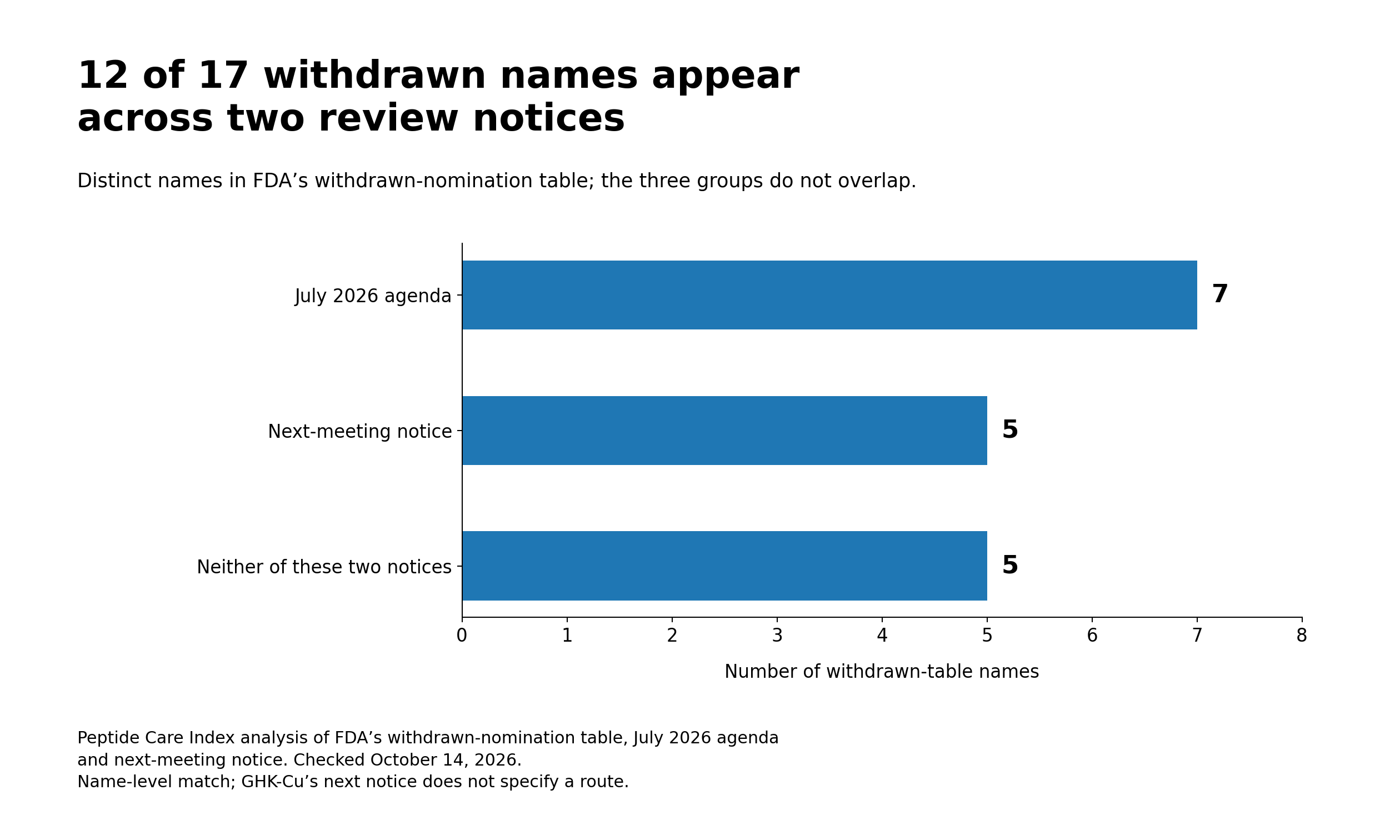
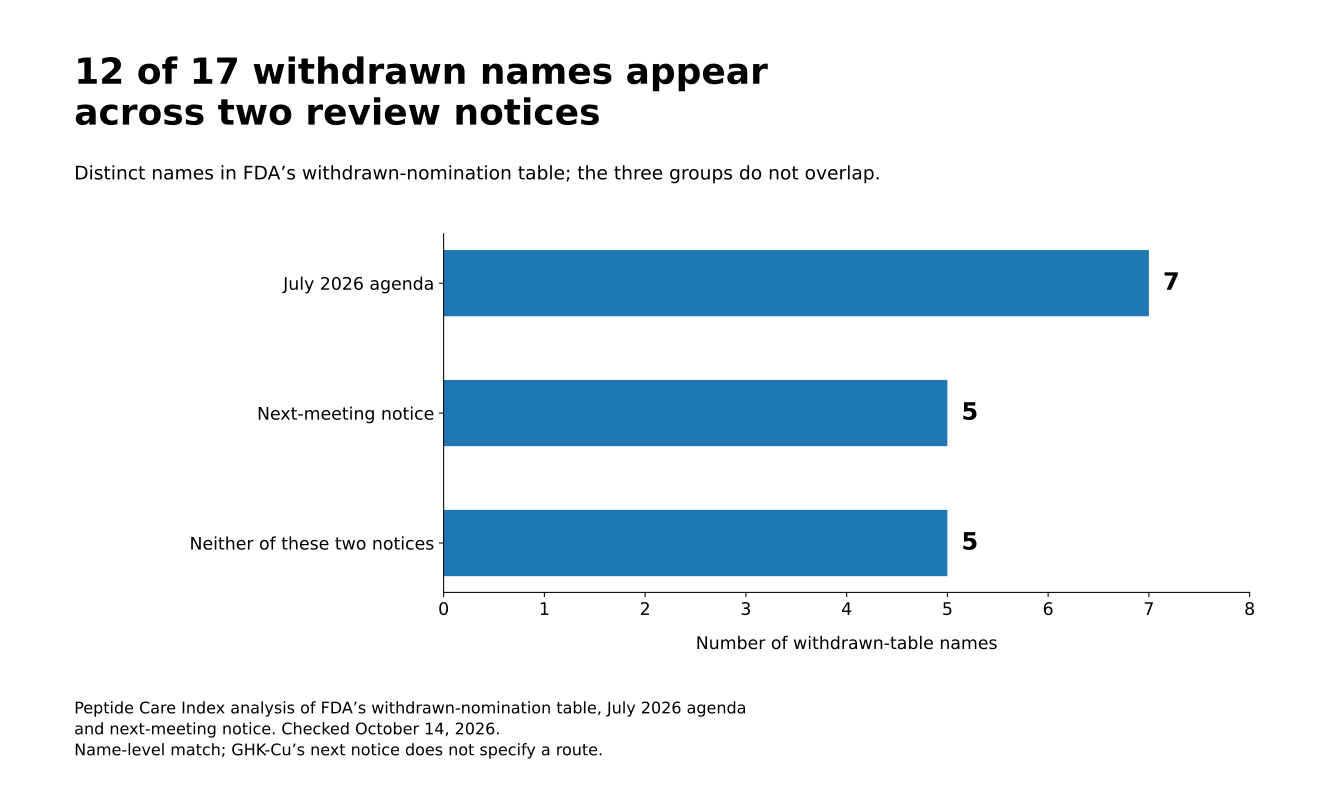
- 12 of 17 withdrawn names matched review notices, in Peptide Care Index’s October 14, 2026 name-level comparison: seven July names and five next-meeting names. GHK-Cu’s match is not route-specific. FDA tables; July; next notice.
- 1 name appears in both FDA safety tables: ipamorelin acetate, with a withdrawn nomination and an active 503B Category 2 entry, checked October 14, 2026. FDA tables.
- 2 names need separate route rows here: GHK-Cu and GHRP-2, based on FDA’s category documents checked October 14, 2026. 503A PDF; 503B PDF.
Find a peptide · Which list? · July review · Withdrawn names · Route limits · Method · Downloads
What does FDA list for each peptide?
The table checks 26 selected substance and route records, covering 24 name groups. 503A and 503B are different U.S. compounding frameworks; keep their columns separate. “No entry” means no matching entry in the document checked—not a legal verdict.
Category 1: under evaluation. Category 2: significant safety concerns. Category 3: not enough supporting information in the nomination. FDA’s definitions. A “withdrawn” entry concerns a nomination, not withdrawal of an approved medicine.
Source versions: 503A PDF, May 14, 2026; 503B PDF, March 21, 2025. Every source link below goes to FDA.
Showing 26 matching records in this reference.
Not included in this selected reference.
| Substance / route | 503A category | 503B category | FDA safety-page record | Sources | Checked |
|---|---|---|---|---|---|
| Alanyl-L-glutamineCandidate only—not a product match | Category 1 | No entry | No entry for this record/route | 503A · 503B · Safety | 2026-10-14 |
| AOD-9604Candidate only—not a product match | No entry | No entry | Withdrawn nomination | 503A · 503B · Safety | 2026-10-14 |
| BPC-157Candidate only—not a product match | No entry | No entry | Withdrawn nomination | 503A · 503B · Safety | 2026-10-14 |
| Cathelicidin LL-37Candidate only—not a product match | No entry | No entry | Withdrawn nomination | 503A · 503B · Safety | 2026-10-14 |
| CJC-1295Candidate only—not a product match | No entry | No entry | Withdrawn nomination | 503A · 503B · Safety | 2026-10-14 |
| Dihexa acetateCandidate only—not a product match | No entry | No entry | Withdrawn nomination | 503A · 503B · Safety | 2026-10-14 |
| Emideltide (DSIP)Candidate only—not a product match | No entry | No entry | Withdrawn nomination | 503A · 503B · Safety | 2026-10-14 |
| EpitalonCandidate only—not a product match | No entry | No entry | Withdrawn nomination | 503A · 503B · Safety | 2026-10-14 |
| GHK-Cu — excluding injectionsCandidate only—not a product match | Category 1 | No entry | No entry for this record/route | 503A · 503B · Safety | 2026-10-14 |
| GHK-Cu — injectionsCandidate only—not a product match | No entry | No entry | Withdrawn nomination | 503A · 503B · Safety | 2026-10-14 |
| GHRP-2 — injections and nasal useCandidate only—not a product match | Category 3 | Category 2 | Active 503B Category 2 | 503A · 503B · Safety | 2026-10-14 |
| GHRP-2 — other routesCandidate only—not a product match | Category 3 | Category 1 | No entry for this record/route | 503A · 503B · Safety | 2026-10-14 |
| GHRP-6Candidate only—not a product match | Category 3 | Category 2 | Active 503B Category 2 | 503A · 503B · Safety | 2026-10-14 |
| GlutathioneCandidate only—not a product match | Category 1 | Category 1 | No entry for this record/route | 503A · 503B · Safety | 2026-10-14 |
| Ipamorelin acetateCandidate only—not a product match | No entry | Category 2 | Withdrawn and active 503B Category 2 | 503A · 503B · Safety | 2026-10-14 |
| Kisspeptin-10Candidate only—not a product match | Category 2 | No entry | Active 503A Category 2 | 503A · 503B · Safety | 2026-10-14 |
| KPVCandidate only—not a product match | No entry | No entry | Withdrawn nomination | 503A · 503B · Safety | 2026-10-14 |
| Melanotan IICandidate only—not a product match | No entry | No entry | Withdrawn nomination | 503A · 503B · Safety | 2026-10-14 |
| MOTs-CCandidate only—not a product match | No entry | No entry | Withdrawn nomination | 503A · 503B · Safety | 2026-10-14 |
| PEG-MGF (pegylated mechano growth factor)Candidate only—not a product match | No entry | No entry | Withdrawn nomination | 503A · 503B · Safety | 2026-10-14 |
| Selank acetate (TP-7)Candidate only—not a product match | No entry | No entry | Withdrawn nomination | 503A · 503B · Safety | 2026-10-14 |
| SemaxCandidate only—not a product match | No entry | No entry | Withdrawn nomination | 503A · 503B · Safety | 2026-10-14 |
| Sermorelin acetateCandidate only—not a product match | No entry | Category 1† | No entry for this record/route | 503A · 503B · Safety | 2026-10-14 |
| TB-500 — LKKTETQ fragmentCandidate only—not a product match | No entry | No entry | Withdrawn nomination | 503A · 503B · Safety | 2026-10-14 |
| Thymosin-alpha 1Candidate only—not a product match | No entry | Category 3 | Withdrawn nomination | 503A · 503B · Safety | 2026-10-14 |
| Vasoactive intestinal peptide (VIP)Candidate only—not a product match | Category 1 | No entry | No entry for this record/route | 503A · 503B · Safety | 2026-10-14 |
Source: Peptide Care Index compilation of the FDA 503A categories, May 14, 2026, FDA 503B categories, March 21, 2025, and FDA safety and withdrawn-nomination tables. Every row was checked October 14, 2026. “No entry” in the safety column is also limited to the named record and route.
† FDA marks sermorelin acetate as a component of an FDA-approved drug in the 503B document. The marker does not make a compounded sermorelin product FDA-approved. FDA entry, p. 6; marker definition, p. 3; FDA compounding explanation.
None of these selected records matched the two final included-substance lists inspected. That does not rule out other qualifying pathways. The final 503A code was current through October 9, 2026; the 503B included-list page is dated August 21, 2023. Both were checked October 14, 2026.
Download all 26 records as a CSV. Each record includes its exact source location, route limits and document version.
Which FDA list should I check?
Start with the compounding program and the exact ingredient. 503A covers compounding by state-licensed pharmacists and physicians; 503B covers facilities registered with FDA as outsourcing facilities. Three interim categories are not the same as a final bulks list. A bulk drug substance is an active ingredient used to make a compounded drug; a nomination asks FDA to consider that ingredient for a list. FDA 503A explanation; FDA 503B explanation.
| Record | What it tells you | What it does not establish |
|---|---|---|
| Final 503A bulks list | Which ingredients are included in §216.23(a) | Every possible bulk-ingredient pathway, or approval of the compounded product |
| Final 503B clinical-need list | Which ingredients are included through that pathway | Every shortage or interim-policy question |
| Category 1 | The ingredient is under evaluation and may fall within the stated conditional interim policy | Blanket permission for every product, route or pharmacy |
| Category 2 | FDA identified significant safety concerns; the Category 1 policy does not cover it | Permission just because a review is pending |
| Category 3 | The nomination lacked enough support for evaluation; the Category 1 policy does not cover it | A conclusion that the ingredient is safe |
| Withdrawn nomination | A nomination was withdrawn | A new Category 1 entry, clearance, or withdrawal of an approved drug |
| Advisory agenda or recommendation | A review topic or nonbinding advice | A final rule or drug approval |
Source: FDA 503A framework, FDA 503B framework, final 503A regulation, FDA safety tables and FDA advisory-committee explanation. Checked October 14, 2026.
How does 503A work?
FDA’s bulk-ingredient conditions follow an order. First, check for an applicable drug-quality standard in the United States Pharmacopeia (USP) or National Formulary (NF), called a monograph. When one exists, the substance must meet it and the relevant compounding requirements. When no such monograph exists, the next question is whether the substance is a component of an FDA-approved drug. If neither applies, the final 503A bulks-list pathway is relevant. Other conditions still apply. FDA’s exact conditions.
That is why “not on the final list” alone cannot settle every ingredient’s status. The peptide access overview shows how to separate an advertised offer from the records behind it.
How is 503B different?
For registered outsourcing facilities, FDA describes a clinical-need list and a separate shortage pathway. The shortage condition concerns the relevant drug being on FDA’s shortage list at the time of compounding, distribution and dispensing. FDA also describes an interim policy for certain nominated substances. These routes have conditions; they are not the 503A rules under a different name. FDA’s 503B framework.
A real contrast in this reference is GHRP-6: Category 3 in the 503A PDF, Category 2 in the 503B PDF. Both can be accurate because they are different records. FDA 503A PDF, p. 4; FDA 503B PDF, p. 8.
Why can a nomination have no category entry?
FDA says it does not intend to place substances nominated on or after January 7, 2025 into Categories 1, 2 or 3 under these interim policies. A search of the category PDFs is therefore not a search of every possible nomination. “No entry” tells you what this document shows. It does not fill in the legal answer. FDA 503A policy; FDA 503B policy.
Did July’s review put these peptides on the final 503A list?
The list check found no matches for the seven July-agenda families. The agenda names 14 forms—one free base and one acetate for each family—but none appears in the included-substance list inspected. This comparison uses the code version current through October 9, 2026, checked October 14. FDA agenda; 21 CFR 216.23(a).
| Peptide family | Forms on FDA agenda | Agenda date | Found in final 503A list checked? |
|---|---|---|---|
| BPC-157 | Free base; acetate | 2026-07-23 | No |
| KPV | Free base; acetate | 2026-07-23 | No |
| TB-500 fragment | Free base; acetate | 2026-07-23 | No |
| MOTs-C | Free base; acetate | 2026-07-23 | No |
| Emideltide (DSIP) | Free base; acetate | 2026-07-24 | No |
| Semax | Free base; acetate | 2026-07-24 | No |
| Epitalon | Free base; acetate | 2026-07-24 | No |
Source: Peptide Care Index comparison of the FDA July 23–24, 2026 agenda and 21 CFR 216.23(a). Checked October 14, 2026; code current through October 9, 2026. “No” means no named match in that list, not a finding about every compounding pathway.
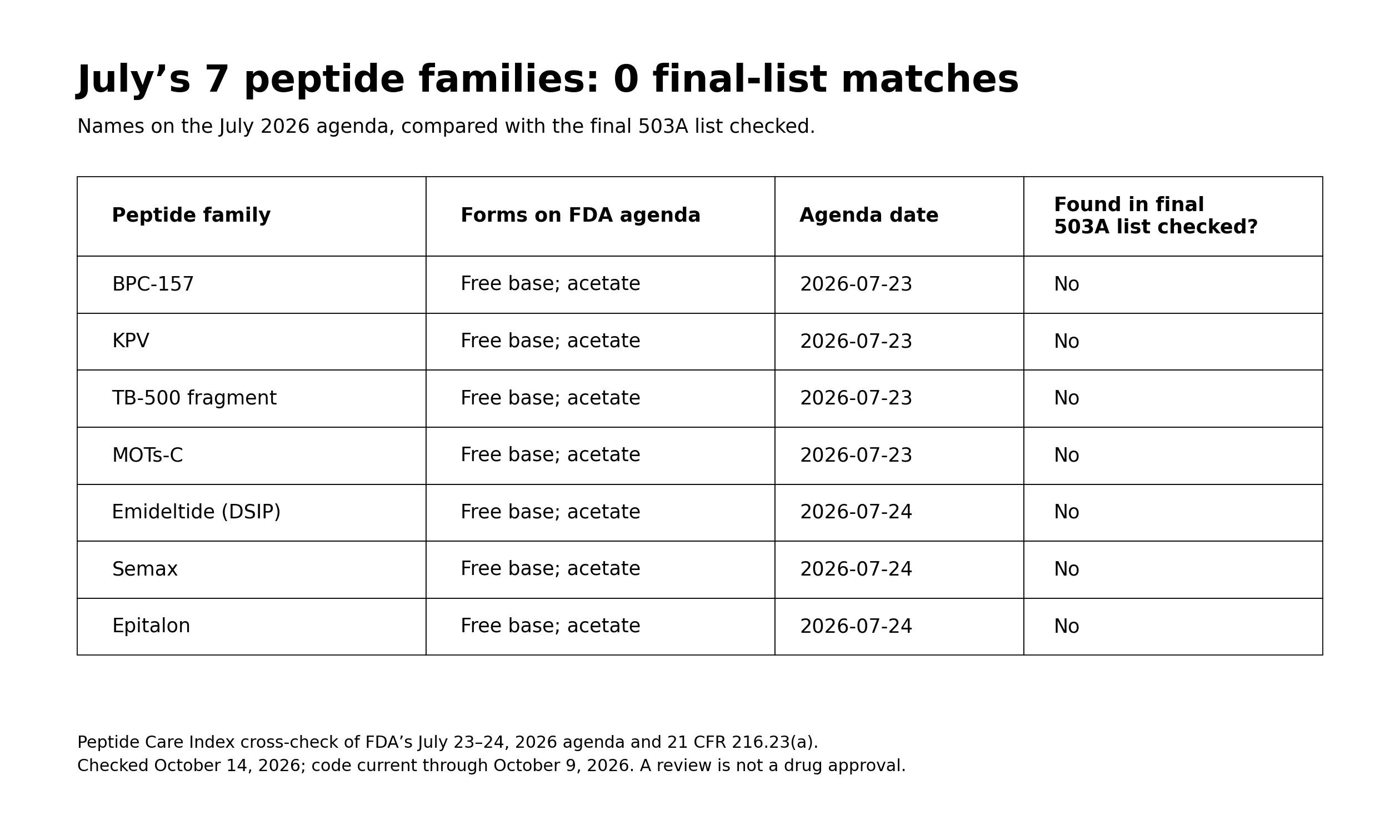
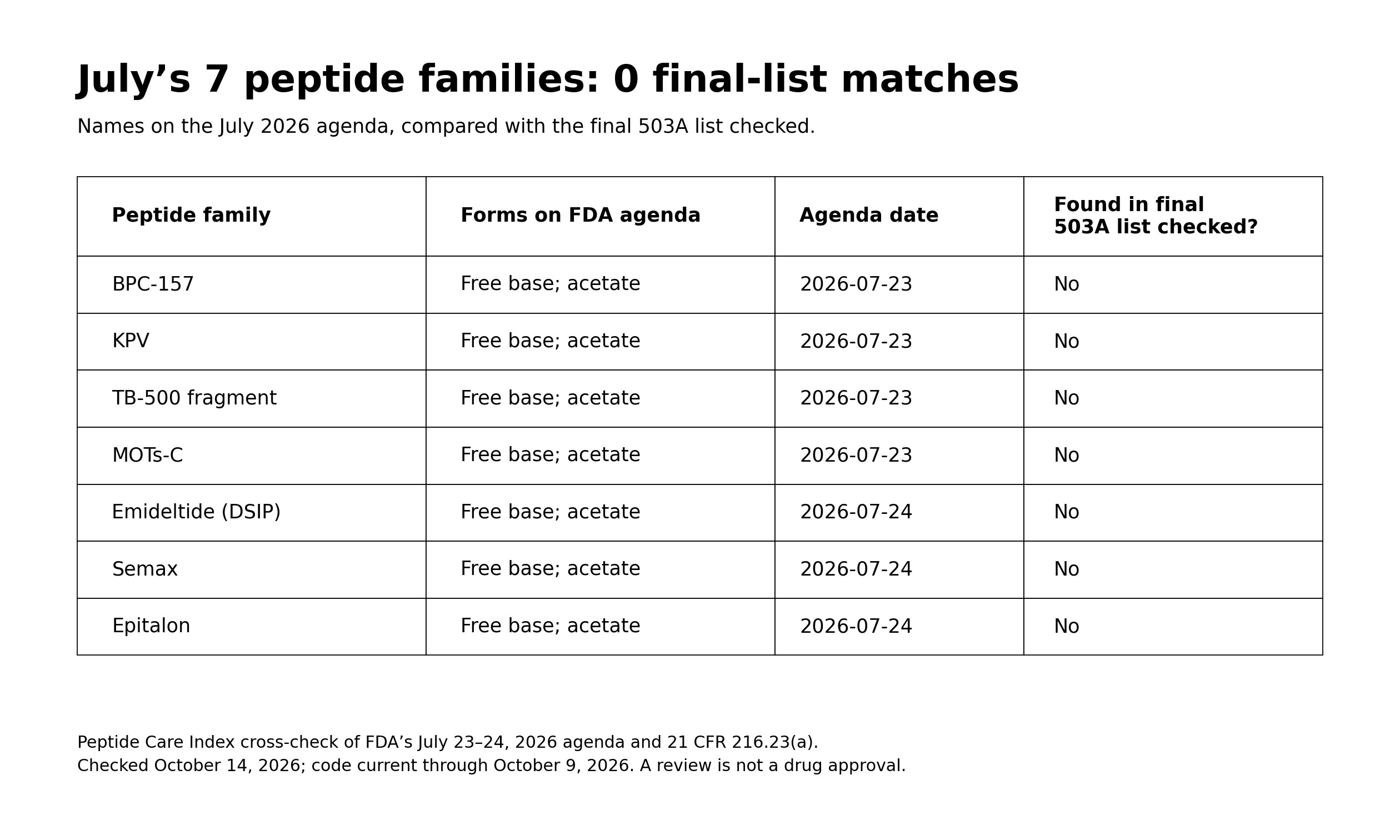
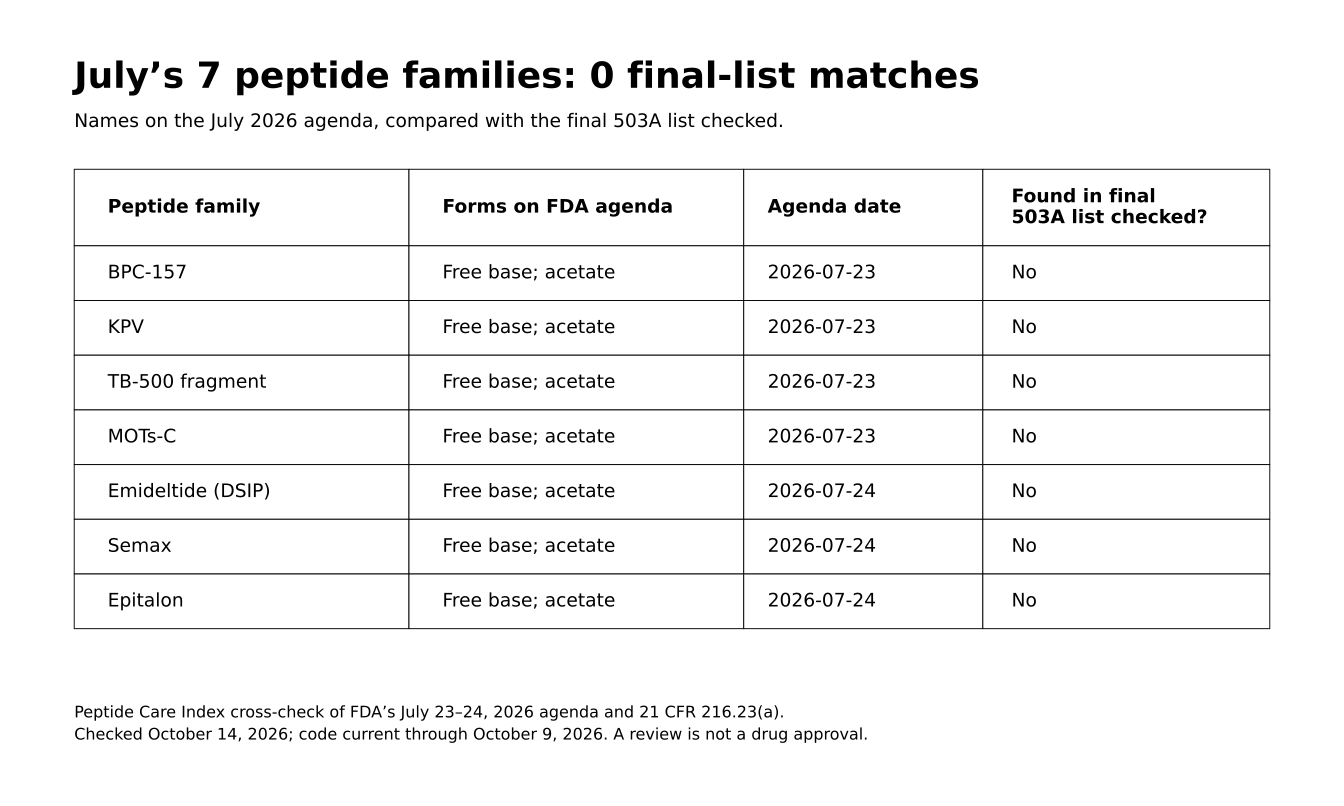
Here, free base means the unsalted form, and acetate names the salt form FDA evaluated. Counting both gives 7 × 2 = 14 forms, not fourteen separate peptide families or approvals. FDA’s BPC-157 briefing treats its free base and acetate as distinct bulk substances. FDA BPC-157 briefing, pp. 8–9.
Does a report that “six peptides were approved” mean drug approval?
No. A recommendation by an advisory committee and approval of a drug are different actions. FDA describes its committee’s advice as nonbinding; this reference reports the seven-family agenda and the final-list check, not an independently verified vote tally. The official meeting page links the recordings and materials.
For a claim about a vote, check the exact motion, substance, form and proposed use. For a claim about a final listing, check the final rule or included list. The headline alone cannot do both jobs.
Which peptide nominations were withdrawn?
FDA’s withdrawn-nomination table contains 17 named substance entries. Peptide Care Index’s cross-check found 12 of those names across the July agenda and the announced next-meeting notice. This is a count of names in records—not a count of individual nomination submissions or a safety rate. FDA withdrawn table; July agenda; next-meeting notice.
| Withdrawn-table entry | July agenda | Next-meeting notice | Sources | Checked |
|---|---|---|---|---|
| AOD-9604 | Not named | Not named | Safety · July · Next notice | 2026-10-14 |
| BPC-157 | Yes | Not named | Safety · July · Next notice | 2026-10-14 |
| Cathelicidin LL-37 | Not named | Yes | Safety · July · Next notice | 2026-10-14 |
| CJC-1295 | Not named | Not named | Safety · July · Next notice | 2026-10-14 |
| Dihexa acetate | Not named | Yes | Safety · July · Next notice | 2026-10-14 |
| Emideltide (DSIP) | Yes | Not named | Safety · July · Next notice | 2026-10-14 |
| Epitalon | Yes | Not named | Safety · July · Next notice | 2026-10-14 |
| GHK-Cu — injections | Not named | Name match; route unspecified | Safety · July · Next notice | 2026-10-14 |
| Ipamorelin acetate | Not named | Not named | Safety · July · Next notice | 2026-10-14 |
| KPV | Yes | Not named | Safety · July · Next notice | 2026-10-14 |
| Melanotan II | Not named | Yes | Safety · July · Next notice | 2026-10-14 |
| MOTs-C | Yes | Not named | Safety · July · Next notice | 2026-10-14 |
| PEG-MGF (pegylated mechano growth factor) | Not named | Yes | Safety · July · Next notice | 2026-10-14 |
| Selank acetate (TP-7) | Not named | Not named | Safety · July · Next notice | 2026-10-14 |
| Semax | Yes | Not named | Safety · July · Next notice | 2026-10-14 |
| TB-500 — LKKTETQ fragment | Yes | Not named | Safety · July · Next notice | 2026-10-14 |
| Thymosin-alpha 1 | Not named | Not named | Safety · July · Next notice | 2026-10-14 |
Source: Peptide Care Index name-level join of FDA’s complete withdrawn-nomination table, the July agenda and the next-meeting notice. Checked October 14, 2026. The next notice names GHK-Cu without a route. “Not named” refers only to the notice in that column, not every review FDA has ever held.
| Match within the 17-entry withdrawn table | Number of names |
|---|---|
| July 2026 agenda | 7 |
| Next-meeting notice | 5 |
| Neither of these two notices | 5 |
Source: The name-matching table above. 7 + 5 + 5 = 17; the first two groups have no names in common, so 7 + 5 = 12 names match a notice. Underlying sources: FDA safety table, July agenda and next notice, checked October 14, 2026.
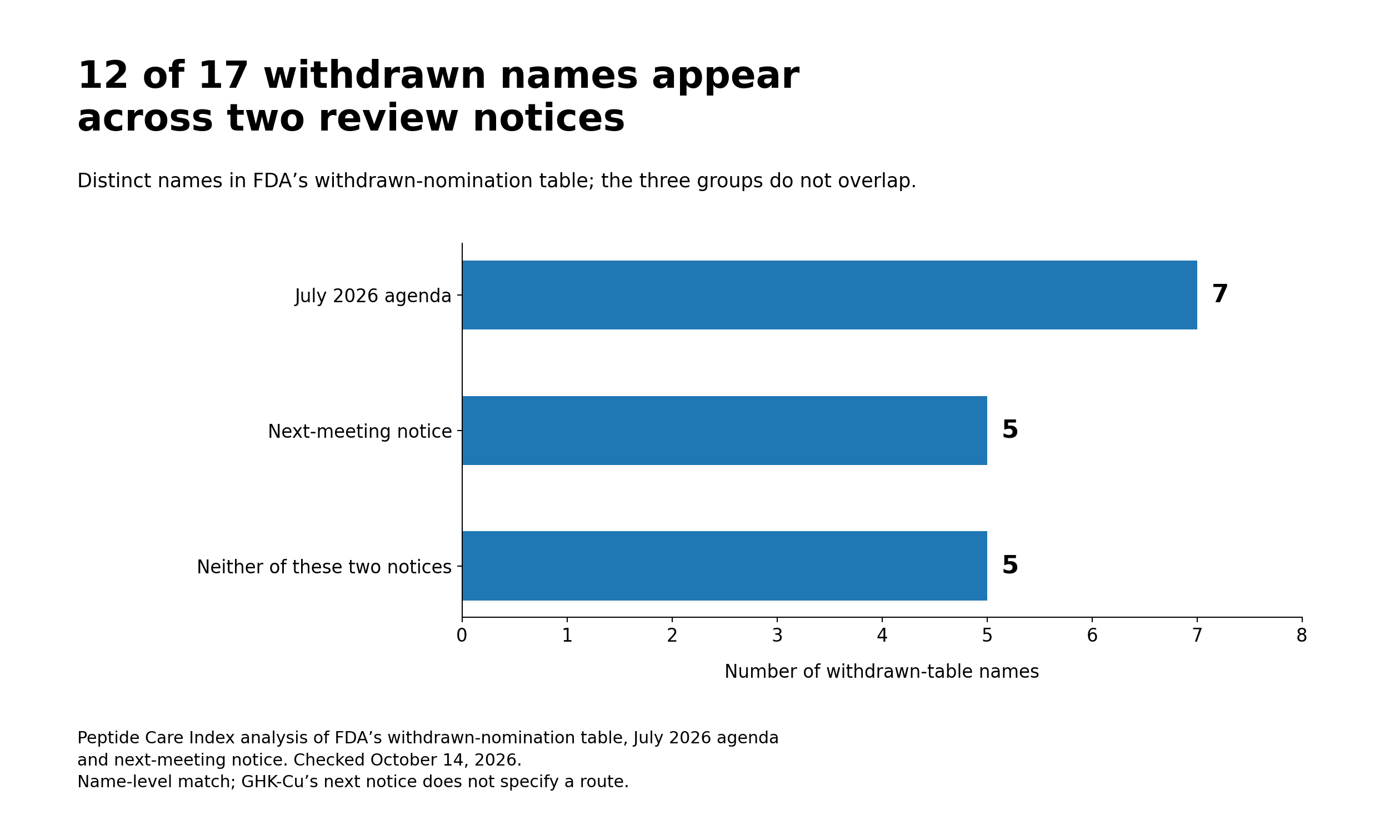
Does “withdrawn” mean a peptide is cleared?
No. It means a nomination was withdrawn. FDA still publishes safety information for these 17 entries, and withdrawal is not a new Category 1 listing. Read the withdrawal record and the category record together. FDA safety page; FDA category definitions.
Why does ipamorelin acetate appear in both tables?
FDA explicitly says ipamorelin acetate remains in Category 2 under the 503B interim policy, even though it also appears in the withdrawn table. It is one substance with two recorded facts. Removing the active 503B entry from a summary would change the answer. FDA’s ipamorelin rows; 503B PDF, p. 8.
When does the route or chemical form change the answer?
GHK-Cu and GHRP-2 each need two route records in this reference. A route is how a drug is given, such as an injection or nasal spray. A category entry that excludes a route cannot be used as the category answer for that route. FDA 503A PDF; FDA 503B PDF.
| Substance and route | 503A category record | 503B category record | Source |
|---|---|---|---|
| GHK-Cu, excluding injections | Category 1 | No matching entry | 503A, pp. 1–2; 503B PDF |
| GHK-Cu, injections | No matching entry; separate withdrawn safety entry | No matching entry | 503A PDF; safety table; 503B PDF |
| GHRP-2, injections or nasal use | Category 3 | Category 2 | 503A, p. 4; 503B, p. 8 |
| GHRP-2, other routes | Category 3 | Category 1 | 503A, p. 4; 503B, p. 5 |
Source: FDA’s 503A document dated May 14, 2026, 503B document dated March 21, 2025, and safety table. Checked October 14, 2026. The GHRP-2 route split comes from 503B; its 503A entry has no route qualifier.
Say a clinic puts “GHK-Cu: Category 1” next to an injection offer. That statement leaves out the exclusion in the source. Ask for the record that addresses the injection, not a broader label beside it.
What changed for GHK-Cu in May 2026?
FDA’s May 14 PDF explains that one nominator clarified on May 5, 2026 that it meant to withdraw only injectable GHK-Cu. The document restores the Category 1 entry for GHK-Cu excluding injections, after an April 22 removal. This was a route-specific correction, not a clearance for every GHK-Cu product. FDA’s change note, p. 1.
Do BPC-157 free base and acetate have the same record?
FDA evaluated two BPC-157 forms: free base and acetate. Its 2026 staff briefing states that neither has an applicable USP/NF drug-substance monograph and neither is a component of an FDA-approved drug. That is the statement in the dated briefing; a clinic’s use of the shorter name does not establish which form it offers. FDA BPC-157 briefing, pp. 8–9.
Is TB-500 the same record as full-length thymosin beta-4?
No. FDA’s TB-500 briefing describes a seven-amino-acid fragment, compared with 43 amino acids in full-length thymosin beta-4. Amino acids are the building blocks in these chains. The reference here follows the named LKKTETQ fragment, not every product sold under a broader thymosin beta-4 name. FDA fragment description, p. 8; full-length comparison, p. 25; FDA safety row.
Which selected peptides appear in Category 1?
This reference includes four examples in FDA’s 503A Category 1 document. They are selected examples, not every ingredient that may qualify for compounding. Category 1 means the ingredient is under evaluation and must be read with the interim policy’s conditions. FDA Category 1 entries; FDA policy.
| Selected 503A Category 1 example | Exact scope to keep | Source |
|---|---|---|
| Alanyl-L-glutamine | This named ingredient, not plain L-glutamine | FDA PDF, p. 2 |
| GHK-Cu | Excludes injectable routes | FDA PDF, pp. 1–2 |
| Glutathione | Named Category 1 entry | FDA PDF, p. 2 |
| Vasoactive intestinal peptide (VIP) | Named Category 1 entry | FDA PDF, p. 2 |
Source: FDA’s 503A category document, dated May 14, 2026; checked October 14, 2026. These four records do not form an approved-treatment list.
Why is sermorelin acetate included separately?
Sermorelin acetate has a 503B Category 1 entry with an approved-drug-component footnote. FDA’s marker refers to the ingredient’s relationship to an approved drug; it is not approval of a pharmacy’s compounded product. This reference does not decide sermorelin’s ingredient-specific 503A eligibility. FDA 503B PDF, pp. 3 and 6; FDA compounding explanation.
What is FDA reviewing next?
FDA’s next-meeting notice names five substances: cathelicidin LL-37, GHK-Cu, dihexa acetate, melanotan II and PEG-MGF. It says the meeting will take place before the end of February 2027; the exact time and location were not set when checked October 14, 2026. That is a review window, not an approval deadline. FDA’s notice.
The notice does not specify a GHK-Cu route. The current route limits remain visible in this reference rather than being replaced with a broad “under review” badge.
A revised category document, safety table or final listing can change a row. An agenda alone changes the review field—not every other field at once.
What should I check before paying a clinic?
Ask for the exact substance, chemical form, route and dispensing pharmacy, then ask which source supports the advertised compounding pathway. These records do not establish whether a particular clinic’s product meets every requirement. Take care questions to a licensed clinician and specific compounding questions to the pharmacist or a qualified regulatory professional. FDA’s compounding explanation.
Use the questions to ask before booking to check an offer. Once the access claim is clear, compare published provider terms to understand the payment arrangement.
For help checking a clinic’s claim before paying, use Find My Peptide Path. It gives you access summaries for BPC-157, TB-500 and sermorelin, plus questions about the pharmacy and fees, without a signup.
How did we build this reference?
Peptide Care Index checked the linked FDA records and the final 503A code on October 14, 2026. We joined names across documents, kept route differences separate and counted the defined groups. The result is a 26-record source comparison, not a survey or clinical study.
What did we include?
We started with every named row in FDA’s withdrawn-nomination table. We added GHRP-2, GHRP-6 and kisspeptin-10 from the active safety table; the route counterparts needed for GHK-Cu and GHRP-2; selected Category 1 examples; and sermorelin acetate, which the publication already covers.
The count is 17 withdrawn rows + 3 other active safety rows + 2 route counterparts + 3 further Category 1 examples + 1 sermorelin record = 26. The three further examples are alanyl-L-glutamine, glutathione and VIP; noninjectable GHK-Cu is counted in the route-counterpart group, not again. Underlying safety table; 503A entries; 503B entries.
The collection covers 24 name groups because GHK-Cu and GHRP-2 each have an extra route row. It includes dihexa acetate to preserve the full withdrawn table; “peptide-related” does not mean we classify every entry as chemically a peptide. This is not every peptide medicine or every nominated substance.
How were names and counts matched?
Names, common abbreviations and punctuation helped locate records. We then kept the FDA wording and the exact scope. A free base is not silently replaced by a salt; TB-500’s fragment is not full-length thymosin beta-4; PEG-MGF is not unpegylated MGF.
For the July result, we counted the seven agenda families and checked their fourteen named forms against the complete included list in §216.23(a). For the withdrawn-name result, we first limited the data to the 17 withdrawn rows, then matched the two notices. That prevents the noninjectable GHK-Cu counterpart from adding a second future-notice match.
Which dates belong to the sources?
A recent check does not turn an older document into newly published data. The dates below stay separate in the download.
| Record | Source’s date or coverage | Our check |
|---|---|---|
| 503A category PDF | Updated May 14, 2026 | October 14, 2026 |
| 503B category PDF | Updated March 21, 2025 | October 14, 2026 |
| Final 503A code | Displayed current through October 9, 2026 | October 14, 2026 |
| Final 503B included-list page | Content dated August 21, 2023 | October 14, 2026 |
| Safety and withdrawn tables | Live tables; no withdrawal date supplied for each row | October 14, 2026 |
| July agenda | July 23–24, 2026 meeting scope | October 14, 2026 |
| Next-meeting notice | Before the end of February 2027; exact date not set | October 14, 2026 |
Source: 503A PDF, 503B PDF, eCFR, 503B included list, safety tables, July agenda and next notice.
What did the checks cover?
We read the category documents, their headings and relevant PDF page images; inspected both safety tables and the complete final included lists; and checked both meeting notices. BPC-157 and TB-500 also received checks against the specific FDA briefing passages cited here. That extra identity check is not a full clinical review of all entries.
The work used AI assistance. No clinician, pharmacist or regulatory specialist is credited as a reviewer of this page. Our research method and editorial standards explain the difference between checking a source and providing expert review.
What can this table not tell me?
The table does not measure treatment success, how often harm occurs, or how many people use a peptide. It cannot confirm a product’s contents, a pharmacy’s license, state-law compliance or a person’s eligibility. An entry absent from one list does not rule out every other legal pathway. FDA’s 503A conditions; FDA’s 503B conditions.
The firm finding is narrower: this named record appeared—or did not appear—in the stated source version. A later source change can change that finding. Use the row’s primary links to check the record before relying on a time-sensitive status.
How can I cite or reuse this page?
Use the page’s check date and the exact name or finding you rely on. Credit Peptide Care Index for this compilation and its calculations, and FDA for the underlying records. Each source link lets a reader inspect the original.
Ready-to-copy page citation
Peptide Care Index. “FDA peptide compounding list: 26 records checked.” October 2026 edition. Sources checked October 14, 2026. https://peptidecareindex.com/research/fda-peptide-compounding-list/
For a single entry, add its exact name, route and source-document date. For example:
Peptide Care Index. “GHRP-2 — injections and nasal use.” FDA List Cross-Check. FDA category documents dated May 14, 2026 (503A) and March 21, 2025 (503B); checked October 14, 2026. https://peptidecareindex.com/research/fda-peptide-compounding-list/#ghrp-2-injectable-nasal
Reuse: You may reuse our original table organization, calculations and chart designs with Peptide Care Index credit; no hyperlink is required. This page-specific permission replaces the general content-use link condition for these original contributions. This permission covers those original contributions, not third-party material. Keep the FDA source attribution, source dates and any underlying source terms.
Can I download the table and charts?
Yes. The free CSV contains all 26 records, including source URLs, source locations, route notes and check dates. The charts carry their own source lines. No account or email is needed.
Download the July review comparison as a PNG or SVG, and the withdrawn-name review comparison as a PNG or SVG.




What else do readers ask about peptide compounding?
Are compounded peptides FDA-approved?
No. FDA does not approve compounded drugs or verify their safety, effectiveness and quality before marketing. A category entry—or an ingredient used in an approved medicine—does not make a compounded preparation FDA-approved. FDA’s answer.
Is BPC-157 back in Category 1?
BPC-157 has no matching entry in the 503A Category 1 document checked for this edition, dated May 14, 2026. It appears in FDA’s withdrawn-nomination table. Neither an agenda appearance nor withdrawal supplies a new Category 1 entry. FDA 503A PDF; FDA withdrawn table.
Is ipamorelin acetate still Category 2?
Yes, under 503B in the document checked, dated March 21, 2025. It also appears in the withdrawn table, while the reviewed 503A category PDF has no matching entry. Keep the program name beside the category. FDA 503B PDF; FDA safety tables; FDA 503A PDF.
Does GHK-Cu’s Category 1 entry cover injections?
No. The 503A entry expressly excludes injectable routes. Injectable GHK-Cu has a separate entry in the withdrawn-nomination table; the noninjectable category cannot be copied onto it. FDA 503A PDF; FDA safety table.
Where are semaglutide and tirzepatide in this table?
They are outside this selected dataset. Those drugs need a separate check of FDA’s policies on shortages and products that are essentially copies of approved drugs. Use FDA’s GLP-1 compounding policy page, rather than treating this table as a list of every peptide medicine.
Where can I get the official FDA list PDFs?
FDA publishes the 503A category PDF and the 503B category PDF separately. The final 503A included list is in 21 CFR 216.23(a). Our CSV brings the selected records together; it does not replace those sources.
Which sources support these findings?
The sources below are the original FDA and federal-code records used in this reference. Each was checked October 14, 2026. Document dates and the code’s coverage date are shown separately; a meeting document is not a final decision.
- FDA — Bulk Drug Substances Used in Compounding Under Section 503A of the FD&C Act. Open the source. Locations: opening ingredient conditions, “Interim Policy,” category definitions and the January 7, 2025 nomination cutoff. Checked October 14, 2026.
- FDA — Bulk Drug Substances Nominated for Use in Compounding Under Section 503A. Open the PDF. Updated May 14, 2026. Pages 1–2: GHK-Cu correction and Category 1; page 3: Category 2; pages 4–7: Category 3. Negative entries were checked against the complete category lists. Checked October 14, 2026.
- Electronic Code of Federal Regulations — 21 CFR 216.23. Open the source. Paragraph (a): complete included-substance list; paragraph (d): approval/endorsement distinction. Displayed current through October 9, 2026. Checked October 14, 2026.
- FDA — Certain Bulk Drug Substances for Use in Compounding that May Present Significant Safety Risks. Open the source. Locations: both complete tables, including all 17 withdrawn entries and ipamorelin acetate’s explicit overlap. Individual withdrawal dates are not supplied in the withdrawn table. Checked October 14, 2026.
- FDA — Bulk Drug Substances Used in Compounding Under Section 503B of the FD&C Act. Open the source. Locations: clinical-need list, shortage condition, interim policy and the January 7, 2025 nomination cutoff. Checked October 14, 2026.
- FDA — Bulk Drug Substances Nominated for Use in Compounding Under Section 503B. Open the PDF. Updated March 21, 2025. Page 3: approved-component marker; page 5: GHRP-2 other routes and glutathione; page 6: sermorelin acetate; page 8: relevant Category 2 entries; page 15: thymosin alpha-1 in Category 3. Negative entries were checked against the complete category lists. Checked October 14, 2026.
- FDA — July 23–24, 2026 Pharmacy Compounding Advisory Committee meeting. Open the source. Locations: Agenda, Event Materials, recordings and advisory-committee explanation. Supports review scope and nonbinding status, not independently transcribed vote tallies. Checked October 14, 2026.
- FDA — Announced further meeting of the Pharmacy Compounding Advisory Committee. Open the source. Locations: meeting window, five-name agenda, time and location. The notice says before the end of February 2027 and does not specify a GHK-Cu route. Checked October 14, 2026.
- FDA — Compounding and the FDA: Questions and Answers. Open the source. Location: “Are compounded drugs approved by FDA?” and the roles of pharmacists, physicians and outsourcing facilities. Checked October 14, 2026.
- FDA — BPC-157 briefing for the July 2026 advisory meeting. Open the PDF. Pages 8–9: free-base and acetate distinction, monograph status and approved-drug-component statement. This is staff analysis prepared for a meeting, not a final action. Relevant passages checked October 14, 2026.
- FDA — TB-500 briefing for the July 2026 advisory meeting. Open the PDF. Pages 7–8: forms and fragment identity; page 25: seven-amino-acid fragment versus the 43-amino-acid full-length peptide. This is staff analysis, not a final action. Relevant passages and figure checked October 14, 2026.
- FDA — 503B Bulk Drug Substances List. Open the source. Complete “Bulk Drug Substances Included on the 503B Bulks List” table. Page content dated August 21, 2023. This final-list check does not resolve separate shortage or interim-policy conditions. Checked October 14, 2026.
- FDA — FDA Clarifies Policies for Compounders as National GLP-1 Supply Begins to Stabilize. Open the source. Used only to direct readers to the separate GLP-1 shortage/copy-policy questions, not to add an unrecorded status for semaglutide or tirzepatide. Checked October 14, 2026.