Peptide half life chart: 21 human values, with sources
By Peptide Care Index · Updated October 2026
Semaglutide’s labeled half-life is about one week; tirzepatide’s is about five days. This peptide half life chart covers 32 selected records, including 21 numeric human values, in Peptide Care Index’s October 2026 review. The tables keep each route, formulation, and source attached—and explain why the other 11 records need a different answer.
What are the key peptide half-life facts?
- About five days: tirzepatide’s elimination half-life in the Mounjaro prescribing information, revised August 2026. 3
- 21 numeric human records out of 32 selected records: Peptide Care Index’s October 2026 register contains 15 numeric U.S. label records and 6 human-study or archived official records. The other 11 are 2 depot-profile records and 9 evidence-gap or unresolved records. This describes this collection, not all peptides. Download the register.
What does the peptide half life chart show?
The medicine table contains 17 formulation records from prescribing information. Fifteen supply a numeric human half-life. Two describe depot exposure without a single half-life for that formulation. A depot releases medicine slowly from an injection site.
Read the exact row. Subcutaneous (SC) means under the skin. Intravenous (IV) means into a vein. Intramuscular means into a muscle. A number from one route, product, or population does not automatically describe another. PK means pharmacokinetics: how a substance enters, moves through, and leaves the body. PD means pharmacodynamics: what it does to the body.
Interactive index
Find a record in the selected reference
Filter the complete record tables below. All 32 selected records are in the initial page; filters only change which rows are shown.
Showing 32 of 32 selected records.
Filtering runs in this page. Search text is not saved.
| Peptide and exact formulation | Human half-life | Route | Endpoint and source | Record details |
|---|---|---|---|---|
| Semaglutide — Ozempic injection | About 1 week | Subcutaneous | Elimination. 1 | Record details and copyReported value: About 1 week Exact formulation: Ozempic injection Route: Subcutaneous Population: Patients with type 2 diabetes Endpoint: Elimination Source: Exact source · S01 source entry Source section: 12.3 Pharmacokinetics — Elimination Source date: Label revision: 05/2026 (cover). Checked: 2026-10-14 Qualification: Approximately 1 week; label separately describes circulation presence about 5 weeks after last dose. |
| Semaglutide — Rybelsus / Ozempic tablets | About 1 week | Oral | Elimination. 2 | Record details and copyReported value: About 1 week Exact formulation: Rybelsus / Ozempic tablets Route: Oral Population: Patients with type 2 diabetes Endpoint: Elimination Source: Exact source · S02 source entry Source section: 12.3 Pharmacokinetics — Elimination Source date: Label revision: 1/2026 (cover). Checked: 2026-10-14 Qualification: Current file covers Rybelsus and Ozempic tablets; oral dosing does not imply a shorter systemic half-life. |
| Tirzepatide — Mounjaro | About 5 days | Subcutaneous | Elimination. 3 | Record details and copyReported value: About 5 days Exact formulation: Mounjaro Route: Subcutaneous Population: PK similar in healthy subjects and patients with type 2 diabetes Endpoint: Elimination Source: Exact source · S03 source entry Source section: 12.3 Pharmacokinetics — Elimination Source date: Label revision: 08/2026 (cover). Checked: 2026-10-14 Qualification: Approximate estimate. |
| Liraglutide — Victoza | About 13 hours | Subcutaneous | Elimination. 4 | Record details and copyReported value: About 13 hours Exact formulation: Victoza Route: Subcutaneous Population: Human single-dose PK; subgroup not specified for estimate sentence Endpoint: Elimination Source: Exact source · S04 source entry Source section: 12.3 Pharmacokinetics — Elimination Source date: Label revision: 10/2025 (cover). Checked: 2026-10-14 Qualification: Approximate estimate. |
| Dulaglutide — Trulicity | About 5 days | Subcutaneous | Elimination. 5 | Record details and copyReported value: About 5 days Exact formulation: Trulicity Route: Subcutaneous Population: PK similar in healthy subjects and patients with type 2 diabetes Endpoint: Elimination Source: Exact source · S05 source entry Source section: 12.3 Pharmacokinetics — Elimination Source date: Label revision: 03/2026 (cover). Checked: 2026-10-14 Qualification: Approximate estimate. A GLP-1 analogue fused to modified human IgG4 Fc; larger biologic. |
| Exenatide — Byetta immediate release | 2.4 hours | Subcutaneous | Mean terminal. 6 | Record details and copyReported value: 2.4 hours Exact formulation: Byetta immediate release Route: Subcutaneous Population: Human PK; absorption section describes type 2 diabetes patients Endpoint: Mean terminal Source: Exact source · S06 source entry Source section: 12.3 Pharmacokinetics — Metabolism and Elimination Source date: Label revision September 2025; DailyMed effective date September 2, 2025. Checked: 2026-10-14 Qualification: Label says independent of dose. Concentration measurability for about 10 hours is a separate observation. |
| Exenatide — Bydureon BCise extended release | No single depot value in cited label | Subcutaneous depot | No single formulation half-life supplied. 7 | Record details and copyReported value: No single depot value in cited label Exact formulation: Bydureon BCise extended release Route: Subcutaneous depot Population: Adults with type 2 diabetes in PK description Endpoint: No single formulation half-life supplied Source: Exact source · S07 source entry Source section: 12.3 Pharmacokinetics — Absorption / Elimination Source date: Label revision: 5/2025; DailyMed update May 28, 2025. Checked: 2026-10-14 Qualification: Do not import 2.4 h from Byetta. About 10 weeks after stopping, plasma concentrations generally below 20 pg/mL; this is not half-life. Current DailyMed record lists marketing end 2025-10-31; do not claim current availability. |
| Lixisenatide — Adlyxin | About 3 hours | Subcutaneous | Mean terminal. 8 | Record details and copyReported value: About 3 hours Exact formulation: Adlyxin Route: Subcutaneous Population: After multiple doses in patients with type 2 diabetes Endpoint: Mean terminal Source: Exact source · S08 source entry Source section: 12.3 Pharmacokinetics — Elimination Source date: Label revision June 2022. Checked: 2026-10-14 Qualification: Approximate estimate. Current manufacturer-hosted PDF checked; no current availability claim. |
| Pramlintide — Symlin | About 48 minutes | Subcutaneous | Label summary half-life. 9 | Record details and copyReported value: About 48 minutes Exact formulation: Symlin Route: Subcutaneous Population: Healthy individuals Endpoint: Label summary half-life Source: Exact source · S09 source entry Source section: 12.3 Pharmacokinetics — Metabolism and Elimination / Table 5 Source date: Label revision: 12/2019 (highlights). Checked: 2026-10-14 Qualification: Approximate summary estimate. Table 5 elimination values are 55,49,51,48 min for 30,60,90,120 mcg single SC doses respectively; not a confidence interval. |
| Teriparatide — Forteo | About 1 hour | Subcutaneous | Serum half-life. 10 | Record details and copyReported value: About 1 hour Exact formulation: Forteo Route: Subcutaneous Population: Human PK; 20 mcg dose context Endpoint: Serum half-life Source: Exact source · S10 source entry Source section: 12.3 Pharmacokinetics — Elimination Source date: Label revision: 08/2026 (cover). Checked: 2026-10-14 Qualification: Approximate estimate. Severe renal impairment increased half-life in small subgroup. |
| Abaloparatide — Tymlos | About 1 hour | Subcutaneous | Mean label half-life. 11 | Record details and copyReported value: About 1 hour Exact formulation: Tymlos Route: Subcutaneous Population: Human label PK; absorption bioavailability studied in healthy women at 80 mcg Endpoint: Mean label half-life Source: Exact source · S11 source entry Source section: 12.3 Pharmacokinetics — Elimination / Excretion Source date: Label revision: 8/2026 (highlights). Checked: 2026-10-14 Qualification: Approximate estimate; label sentence says mean (SD), but no numeric SD is provided. |
| Tesamorelin — Egrifta SV (2 mg/vial) | 8 minutes | Subcutaneous | Mean elimination. 12 | Record details and copyReported value: 8 minutes Exact formulation: Egrifta SV (2 mg/vial) Route: Subcutaneous Population: Healthy subjects after single 1.4 mg dose Endpoint: Mean elimination Source: Exact source · S12 source entry Source section: 12.3 Pharmacokinetics — Elimination Source date: Highlights revised February 2024; DailyMed updated July 29, 2026. Checked: 2026-10-14 Qualification: Formulation specific; not generic 30 min; different from original Egrifta 1 mg/vial. |
| Tesamorelin — Egrifta WR (11.6 mg/vial) | 11 minutes | Subcutaneous | Mean elimination. 13 | Record details and copyReported value: 11 minutes Exact formulation: Egrifta WR (11.6 mg/vial) Route: Subcutaneous Population: Healthy subjects after single 1.28 mg dose Endpoint: Mean elimination Source: Exact source · S13 source entry Source section: 12.3 Pharmacokinetics — Elimination Source date: Highlights revised March 2025; DailyMed updated July 29, 2026. Checked: 2026-10-14 Qualification: WR and SV not substitutable. Weekly preparation does not mean weekly injection or week-long half-life. |
| Bremelanotide — Vyleesi (PT-141) | About 2.7 hours; range 1.9–4.0 | Subcutaneous | Mean terminal. 14 | Record details and copyReported value: About 2.7 hours; range 1.9–4.0 Exact formulation: Vyleesi (PT-141) Route: Subcutaneous Population: Single SC administration; estimate sentence does not isolate subgroup Endpoint: Mean terminal Source: Exact source · S14 source entry Source section: 12.3 Pharmacokinetics — Elimination Source date: Label revision: 03/2024 (cover). Checked: 2026-10-14 Qualification: Approximate mean with reported range. Not evidence for every nasal or research preparation. |
| Octreotide — Sandostatin immediate-release injection | 1.7–1.9 hours | Subcutaneous / intravenous | Apparent plasma elimination. 15 | Record details and copyReported value: 1.7–1.9 hours Exact formulation: Sandostatin immediate-release injection Route: Subcutaneous / intravenous Population: Healthy volunteer / human label PK Endpoint: Apparent plasma elimination Source: Exact source · S15 source entry Source section: 12.3 Pharmacokinetics — Elimination Source date: Highlights revised July 2024; DailyMed effective July 22, 2026; record-end revision July 2026. Checked: 2026-10-14 Qualification: Preserve range. Up-to-12 h duration of action is distinct. Renal/hepatic impairment and age can alter half-life. |
| Octreotide — Sandostatin LAR Depot | No single depot value in cited label | Intramuscular depot | No single depot half-life supplied. 16 | Record details and copyReported value: No single depot value in cited label Exact formulation: Sandostatin LAR Depot Route: Intramuscular depot Population: Healthy volunteers / acromegaly patients Endpoint: No single depot half-life supplied Source: Exact source · S16 source entry Source section: 12.3 Pharmacokinetics — Sandostatin Injection / Sandostatin LAR Depot Source date: Highlights revised July 2024; DailyMed effective December 22, 2025; record-end revision December 2025. Checked: 2026-10-14 Qualification: Label 1.7 h comes from immediate-release data. LAR profile governed by microsphere release: plateau at 2–3 weeks, not a 2–3 week half-life. |
| Lanreotide — Somatuline Depot | 23–30 days | Deep subcutaneous depot | Sustained-release formulation half-life. 17 | Record details and copyReported value: 23–30 days Exact formulation: Somatuline Depot Route: Deep subcutaneous depot Population: Healthy subjects after single 60,90,120 mg doses Endpoint: Sustained-release formulation half-life Source: Exact source · S17 source entry Source section: 12.3 Pharmacokinetics — Pharmacokinetics Source date: Highlights revised July 2024; DailyMed effective October 11, 2024; record-end revision October 2024. Checked: 2026-10-14 Qualification: Preserve 23–30 day range. Not applicable to immediate-release or different lanreotide formulations. |
Sources: linked prescribing information, section 12.3. All checked October 14, 2026. Original label revisions are listed under sources and in the CSV. These are reference formulations; inclusion does not establish current commercial availability.
These rows describe different endpoints and populations. Dulaglutide is a peptide-based fusion biologic. Lanreotide’s row describes a sustained-release formulation. This table is a time reference, not a comparison of effectiveness.
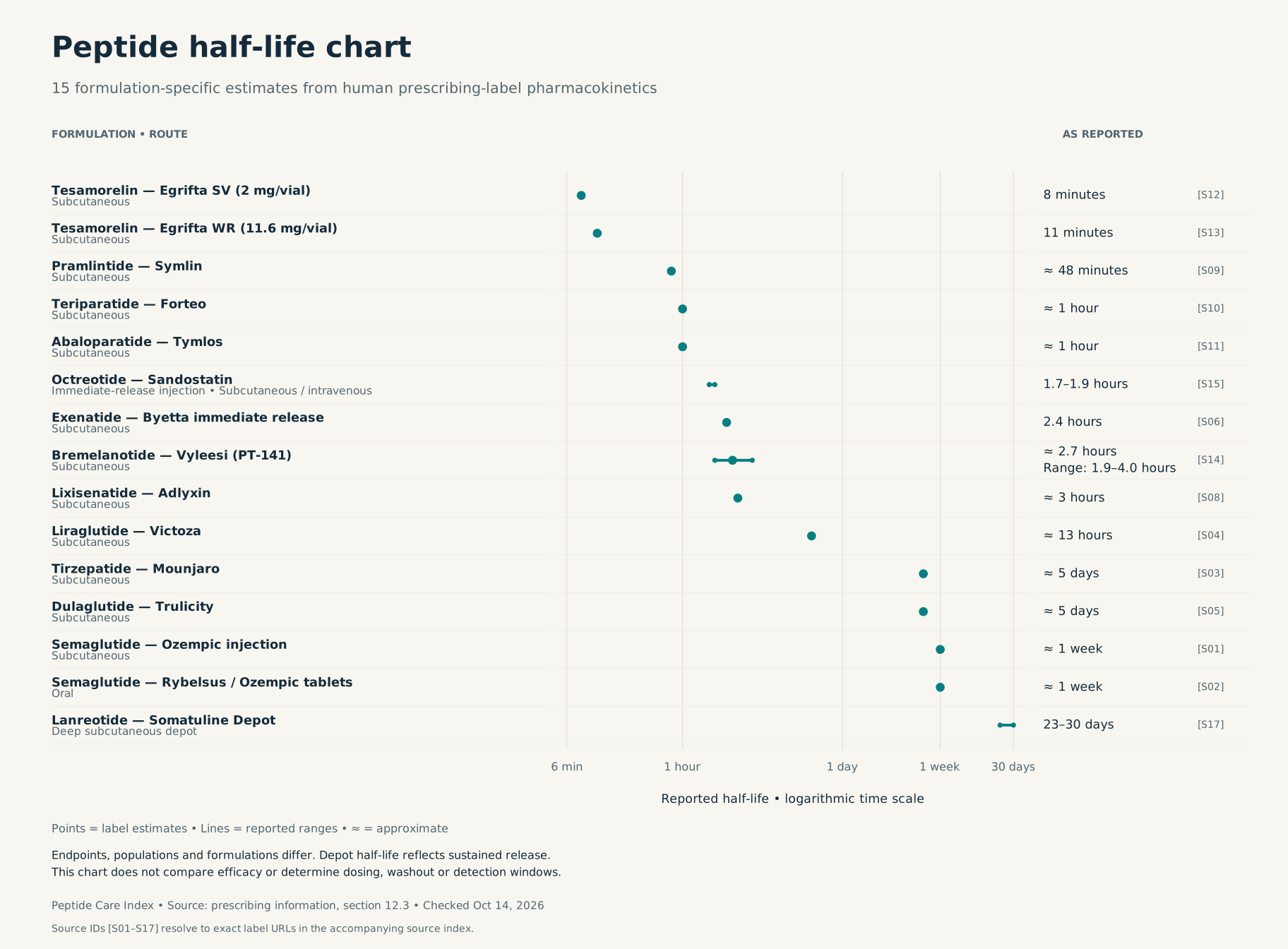
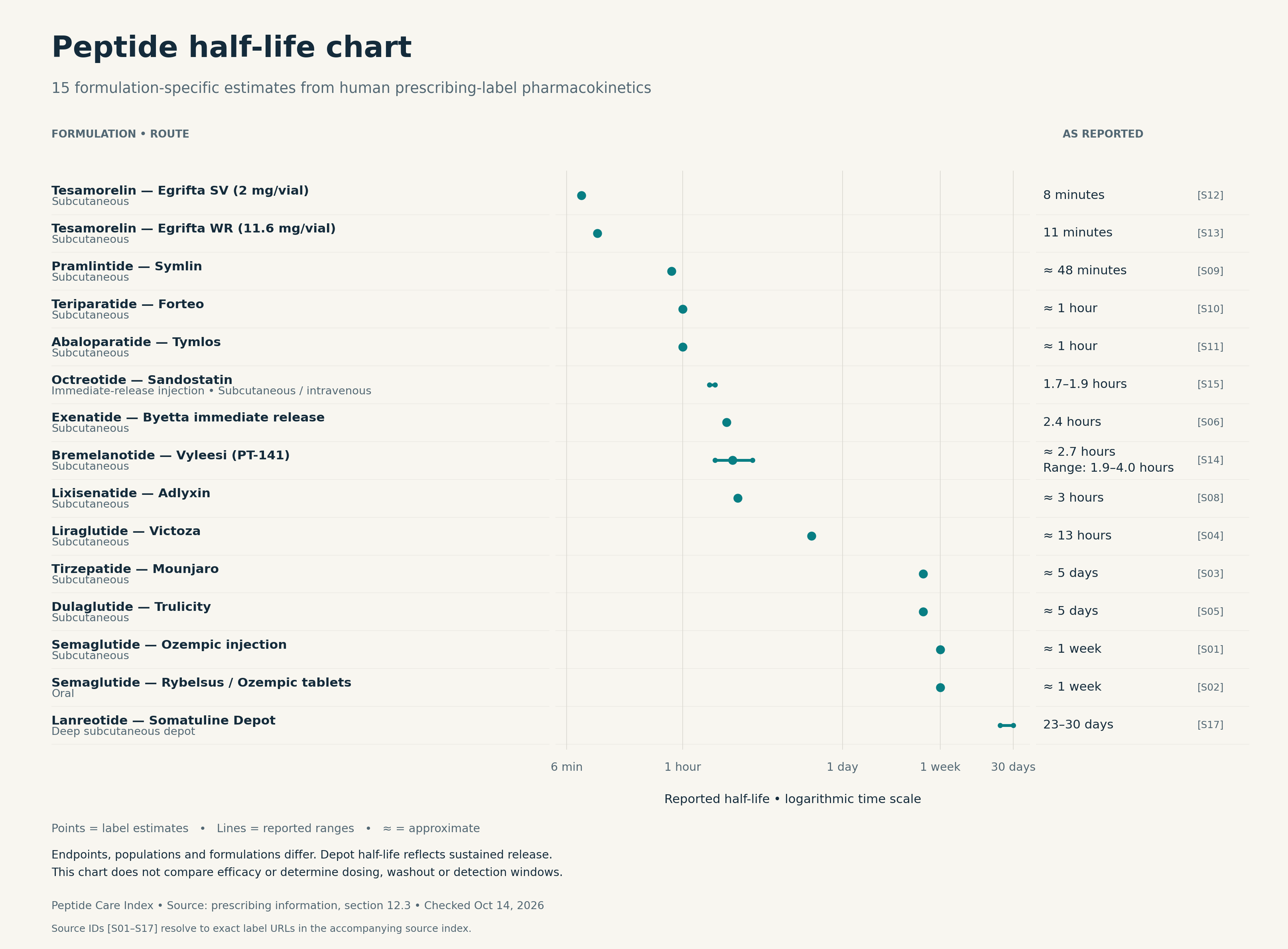
The time axis is logarithmic: equal gaps represent equal multiples of time. Range lines preserve the source ranges. Range-only records have no invented midpoint. Download PNG · Download SVG · Chart source index
Which research peptides have measured human half-lives?
Six additional records have numeric human values in original studies or archived official product information. Most of these measurements used an intravenous route. They do not establish the half-life of a subcutaneous clinic blend or a product sold under the same name.
| Peptide or study product | Human half-life | Route and population | Source and limit | Record details |
|---|---|---|---|---|
| CJC-1295 with DAC | Estimated 5.8–8.1 days | subcutaneous; Healthy adults age 21–61 | 2006. DAC form only; not no-DAC. 18 | Record details and copyReported value: Estimated 5.8–8.1 days Exact formulation: DAC form; salt unspecified Route: subcutaneous Population: Healthy adults age 21–61 Endpoint: Estimated half-life Source: Exact source · R01 source entry · Additional source Source section: 2006; JCEM 91:799–805; original abstract Results. Source date: 2006; JCEM 91:799–805; original abstract Results. Checked: 2026-10-14 Qualification: DAC-GRF form confirmed by FDA 2024 review; salt unspecified. Not transferable to no-DAC. |
| Ipamorelin | Terminal half-life 2 hours | intravenous 15-minute infusion; Healthy men, 8 at each of 5 dose levels | 1999. 15-minute infusion; does not establish SC blend PK. 19 | Record details and copyReported value: Terminal half-life 2 hours Exact formulation: Study compound Route: intravenous 15-minute infusion Population: 8 healthy male subjects at each of 5 escalating dose levels Endpoint: Terminal Source: Exact source · R02 source entry Source section: 1999; Pharmaceutical Research 16:1412–1416; original abstract Methods and Results. Source date: 1999; Pharmaceutical Research 16:1412–1416; original abstract Methods and Results. Checked: 2026-10-14 Qualification: Terminal drug half-life; GH peak at 0.67h is separate PD. Does not establish SC blend PK. |
| GHRP-2 (pralmorelin) | 0.55 ± 0.14 hours (about 33 minutes) | Intravenous injection; 10 prepubertal children with short stature | 1998. Terminal beta phase; mean ± standard deviation. 20 | Record details and copyReported value: 0.55 ± 0.14 hours (about 33 minutes) Exact formulation: Study compound Route: Intravenous injection Population: 10 prepubertal short-stature children; mean age 7.7 ± 2.4 years Endpoint: Terminal beta Source: Exact source · R03 source entry Source section: 1998; JCEM 83:1168–1172; original abstract, terminal beta half-life. Source date: 1998; JCEM 83:1168–1172; original abstract, terminal beta half-life. Checked: 2026-10-14 Qualification: Mean ± SD; children, not an adult SC estimate. Study used a single 1 microgram/kg IV dose over 1 minute. Drug half-life is distinct from growth-hormone half-life. |
| GHRP-6 | 2.5 ± 1.1 hours (elimination) | Intravenous bolus; 9 healthy men | 2013. Terminal elimination; ± as reported across 3 dose levels. High IV study exposures. 21 | Record details and copyReported value: 2.5 ± 1.1 hours (elimination) Exact formulation: Study compound Route: Intravenous bolus Population: 9 healthy men; averaged across 100,200,400 μg/kg dose levels Endpoint: Terminal elimination Source: Exact source · R04 source entry · Additional source Source section: 2013 issue; online 2012; original abstract, distribution and elimination parameters. Source date: 2013 issue; online 2012; original abstract, distribution and elimination parameters. Checked: 2026-10-14 Qualification: Plus/minus figures as reported, averaged across 100, 200 and 400 microgram/kg IV dose levels in nine healthy men; unusually high study exposures. The full paper uses a standard-deviation convention, but this aggregate is not a pooled individual-patient range. Separate distribution half-life: 7.6 ± 1.9 minutes. Not a SC estimate. Secondary endpoint: Distribution — 7.6 minutes |
| Sermorelin (GEREF 50) | Plasma half-life 6–7 minutes | intravenous; Population not detailed in PK section | 2004 text, printed 2006. Historical IV diagnostic product; not a compounded SC estimate. 22 | Record details and copyReported value: Plasma half-life 6–7 minutes Exact formulation: GEREF 50 archived diagnostic product Route: intravenous Population: Historical diagnostic product; population not detailed in SmPC PK section Endpoint: Plasma Source: Exact source · R05 source entry Source section: Text revised May 2004, printed July 13, 2006; section 5.2. Source date: Text revised May 2004, printed July 13, 2006; section 5.2. Checked: 2026-10-14 Qualification: Archived official Irish Medicines Board SmPC; 11–12min vendor claim not selected. GH peak/effect duration differs. |
| Recombinant thymosin beta-4 NL005 | 0.5–2.084 hours across single-dose cohorts | Intravenous injection; Healthy Chinese adults | 2021, Table 4. Range across cohort estimates, not individual people; not TB-500. 23 | Record details and copyReported value: 0.5–2.084 hours across single-dose cohorts Exact formulation: 44-amino-acid recombinant investigational product Route: Intravenous injection Population: Healthy Chinese adults; single-dose cohorts from Table 4 Endpoint: Plasma half-life (noncompartmental analysis) Source: Exact source · R06 source entry · Additional source Source section: Introduction (44-aa identity), Methods 2.3/2.4, Table 4 and Discussion Source date: 2021 Checked: 2026-10-14 Qualification: This range spans Table 4 dose-cohort estimates, not the range across individual patients. NL005 is recombinant 44-aa product, distinct from natural 43-aa thymosin beta-4 and the 7-aa TB-500 fragment. No SC half-life is established by this study. Half-life values vary by dose without monotonically increasing across every single-dose cohort. Not interchangeable with arbitrary research products. |
Sources: original study abstracts for CJC-1295, ipamorelin, GHRP-2 and GHRP-6; archived official product information for GEREF 50; full study and Table 4 for NL005. All checked October 14, 2026. A study year is the year of that evidence, not the date we checked it.
GHRP-2’s ± figure is its reported standard deviation, a measure of spread. GHRP-6’s ± figures are kept as reported with their averaging across three dose levels. These are not minimum-to-maximum ranges across individual people. For GHRP-2, the editor’s unit conversion is 0.55 × 60 = 33 minutes. 20 21
GHRP-6 illustrates why the endpoint matters. The same intravenous study reported a 7.6 ± 1.9-minute distribution half-life and a 2.5 ± 1.1-hour elimination half-life. Distribution describes the early movement out of plasma; elimination describes the later decline. The two numbers answer different questions. 21
Which popular peptides still lack a usable human number?
Nine selected records remain nonnumeric in this register. Some have official reviews that did not identify human pharmacokinetic data. Others have an unresolved source trail or a limit in our own search. Not verified here does not mean zero half-life, no biological activity, or proof that no paper exists anywhere.
| Peptide or named form | What the reviewed evidence supports | Why no human number is shown | Record details |
|---|---|---|---|
| BPC-157 | Human elimination half-life not established here | Animal PK and human enema concentration reports do not supply a usable human elimination estimate. 25 | Record details and copyReported value: Human elimination half-life not established by reviewed records Exact formulation: Identity/route-specific evidence record Route: Human elimination value unresolved; reviewed animal IV/IM Population: Rat/beagle PK is not human PK Endpoint: No route-specific human value selected Source: Exact source · R08 source entry · Additional source Source section: Staff evaluation May 11, 2026; Human Safety, Pharmacokinetic Data (PDF page 40). Source date: Staff evaluation May 11, 2026; Human Safety, Pharmacokinetic Data (PDF page 40). Checked: 2026-10-14 Qualification: The cited FDA review reports human rectal-enema plasma measurements mostly below quantification and no human PK for oral, SC, nasal or transdermal administration. The 2022 animal half-lives do not establish a human elimination value. |
| TB-500 (Ac-LKKTETQ fragment) | FDA did not identify human PK/PD for the reviewed TB-500 fragment | Full-length thymosin beta-4 and NL005 are different substances. 26 | Record details and copyReported value: Human half-life not identified for this fragment Exact formulation: Identity/route-specific evidence record Route: No qualifying human administration PK selected Population: Analytical identification and equine data are not human PK Endpoint: No route-specific human value selected Source: Exact source · R09 source entry · Additional source Source section: July 2026 advisory-meeting briefing; chemical identity and Human Safety, Pharmacokinetic Data. Source date: July 2026 advisory-meeting briefing; chemical identity and Human Safety, Pharmacokinetic Data. Checked: 2026-10-14 Qualification: FDA reviewed the seven-amino-acid Ac-LKKTETQ fragment, not full-length thymosin beta-4. The cited FDA review did not identify human PK/PD studies for free base or acetate via any route. |
| MOTS-c | FDA did not identify clinical PK data in its 2026 review | Human-serum experiments are in vitro, not clinical clearance studies. 27 | Record details and copyReported value: Human PK half-life not identified in reviewed sources Exact formulation: Identity/route-specific evidence record Route: No qualifying route-specific human half-life selected Population: Human serum degradation is in vitro Endpoint: No route-specific human value selected Source: Exact source · R10 source entry Source section: July 2026 advisory-meeting briefing; Human Safety, Pharmacokinetic Data. Source date: July 2026 advisory-meeting briefing; Human Safety, Pharmacokinetic Data. Checked: 2026-10-14 Qualification: FDA did not identify clinical studies providing PK for MOTS-c-related BDSs. CB4211 is a distinct analog; endogenous biomarker changes not administered peptide clearance. |
| KPV | FDA did not identify human PK/PD via any route in its 2026 review | No human half-life can be extracted from that review. 28 | Record details and copyReported value: Human PK half-life not identified Exact formulation: Identity/route-specific evidence record Route: Any route in cited FDA review Population: No human administration PK identified by FDA Endpoint: No route-specific human value selected Source: Exact source · R11 source entry Source section: Staff evaluation May 12, 2026; Human Safety, Pharmacokinetic Data. Source date: Staff evaluation May 12, 2026; Human Safety, Pharmacokinetic Data. Checked: 2026-10-14 Qualification: FDA brief dated May 12 2026, July PCAC: no clinical human PK/PD via any route. Do not infer a number from size. |
| AOD-9604 | FDA did not identify human PK/PD via any route in its 2024 review | Animal or test-tube degradation figures cannot fill a human cell. 29 | Record details and copyReported value: Human PK half-life not identified Exact formulation: Identity/route-specific evidence record Route: Any route in cited FDA review Population: Animal/in-vitro results not human PK Endpoint: No route-specific human value selected Source: Exact source · R12 source entry Source section: Staff evaluation November 5, 2024; Human Safety, Pharmacokinetic Data. Source date: Staff evaluation November 5, 2024; Human Safety, Pharmacokinetic Data. Checked: 2026-10-14 Qualification: Brief dated Nov 5 2024; FDA found no clinical human PK/PD any route. ~3min IV pigs, ~4min rat blood in vitro are not human. Human trial participation is not PK measurement. |
| Epitalon | FDA did not identify PK data for the reviewed forms in 2026 | Keep epitalon separate from other similarly named preparations. 30 | Record details and copyReported value: Human PK half-life not identified Exact formulation: Identity/route-specific evidence record Route: No qualifying route-specific human PK selected Population: Free base and acetate evaluated Endpoint: No route-specific human value selected Source: Exact source · R13 source entry Source section: July 2026 advisory-meeting briefing; Human Safety, Pharmacokinetic Data. Source date: July 2026 advisory-meeting briefing; Human Safety, Pharmacokinetic Data. Checked: 2026-10-14 Qualification: FDA found no PK data for free base or acetate. Epitalon and Epithalamin are distinct. |
| GHK-Cu | No route-specific human elimination value verified in our search | This is a search limit. The FDA safety page is not evidence that no PK study exists. 31 | Record details and copyReported value: No route-specific human elimination half-life verified in this audit Exact formulation: Identity/route-specific evidence record Route: Topical and systemic must be kept separate Population: No qualifying primary human PK half-life retrieved in targeted searches Endpoint: No route-specific human value selected Source: Exact source · R14 source entry Source section: Injectable GHK-Cu entry; safety context only, not a pharmacokinetic measurement. Source date: Injectable GHK-Cu entry; safety context only, not a pharmacokinetic measurement. Checked: 2026-10-14 Qualification: No route-specific human elimination half-life verified in our targeted primary-source search. FDA link supplies safety context only and does not prove absence of PK studies. Topical GHK-Cu, injectable GHK-Cu, free GHK and endogenous measurements are not interchangeable. |
| Modified GRF(1–29) / CJC-1295 no DAC | No verified human value for the specified no-DAC form in reviewed sources | The 5.8–8.1-day study belongs to the DAC form. 32 | Record details and copyReported value: Human half-life not verified for the specified no-DAC compound Exact formulation: Identity/route-specific evidence record Route: No qualifying human no-DAC PK selected Population: Human CJC numerical evidence reviewed was DAC form Endpoint: No route-specific human value selected Source: Exact source · R15 source entry Source section: December 2024 advisory-meeting briefing; chemical identities and human clinical-data sections. Source date: December 2024 advisory-meeting briefing; chemical identities and human clinical-data sections. Checked: 2026-10-14 Qualification: FDA separates no-DAC free base/acetate from DAC moiety. 30min not verified in human source reviewed. 5.8–8.1d belongs to DAC form. |
| DSIP (emideltide) | Route-specific in vivo human estimate remains unresolved in this audit | FDA summarizes 8 minutes, but the measurement trail needs clarification; no SC PK was identified. 33 | Record details and copyReported value: Route-specific in vivo human estimate not verified in this audit Exact formulation: Identity/route-specific evidence record Route: No verified SC PK; IV source attribution unresolved Population: Animal IV and human serum in vitro data identified Endpoint: No route-specific human value selected Source: Exact source · R16 source entry · Additional source Source section: Staff evaluation May 11, 2026; nonclinical PK (PDF page 45) and human PK summary (PDF page 50). Source date: Staff evaluation May 11, 2026; nonclinical PK (PDF page 45) and human PK summary (PDF page 50). Checked: 2026-10-14 Qualification: FDA summarizes an 8-minute plasma half-life on PDF page 50, but the referenced nonclinical section on page 45 describes animals and human serum in vitro. We could not verify the underlying route-specific in vivo human measurement. FDA also reports no SC PK information. This is an unresolved source trail, not a finding that FDA is wrong. |
Sources: exact linked FDA records and our targeted primary-source search; checked October 14, 2026. Agency review dates and our check date are separate.
Human safety or treatment studies alone cannot fill a half-life cell. A study must measure the administered substance over time and report the relevant PK estimate. Similarly, in vitro means outside a living body, such as in a tube of human serum. It is not a measurement after a person receives the substance.
Why do BPC-157, TB-500 and CJC-1295 charts disagree?
The name on a chart may hide a change in species, chemical identity, route, or measured endpoint. Those changes can make two numbers look comparable when they describe different things. The source record is how you tell them apart.
BPC-157: animal half-life is not human half-life
The 2022 BPC-157 pharmacokinetic paper measured rats and beagle dogs. It reported half-lives below 30 minutes for the tested intravenous and intramuscular conditions. That is animal evidence, not a measured half-life in people. 24
FDA’s 2026 review discusses human rectal-enema studies in which plasma concentrations were undetected or mostly below the assay’s quantification limit. It found no human PK data for oral, subcutaneous, nasal, or transdermal administration in its review. Those records do not establish a usable human elimination half-life. 25
Stability in gastric fluid answers a different question from clearance in human blood. For the route-specific evidence, see BPC-157 capsules and oral research. For approval and access claims, see what FDA records say about BPC-157.
TB-500: keep the fragment separate from thymosin beta-4
FDA’s reviewed TB-500 substance is the seven-amino-acid Ac-LKKTETQ fragment. Full-length natural thymosin beta-4 contains 43 amino acids. Amino acids are the building blocks of peptides. A parent-peptide study cannot supply the fragment’s half-life. 26
The human NL005 study in Table 2 concerns a 44-amino-acid recombinant product. Its 0.5–2.084-hour span is the range across single-dose cohort estimates in Table 4. It is useful human research for that exact product, not a TB-500 number. 23
CJC-1295: the DAC modification changes the identity
The 2006 human study’s 5.8–8.1 days belongs to the long-acting DAC form. FDA’s review distinguishes that form from no-DAC forms and identifies the studied compound as DAC-GRF. DAC is commonly called the drug affinity complex. 18 32
Keep “CJC-1295 with DAC” and “modified GRF(1–29)/no DAC” in separate rows. The reviewed evidence does not support transferring the long-acting study number to a no-DAC product—or to an ipamorelin blend.
DSIP: show the source limit instead of hiding it
FDA’s 2026 DSIP briefing summarizes an 8-minute plasma half-life in its human-safety section. The section it points to describes animal findings and human-serum experiments outside the body. We did not verify a route-specific, in vivo human measurement behind that estimate in this audit. 33
The briefing also reports no PK information for the proposed subcutaneous route. We therefore keep the chart cell unresolved rather than treating the summary as a measured human SC value. That records a limit in the source trail; it does not establish that FDA’s summary is wrong.
Why can two formulations have different answers?
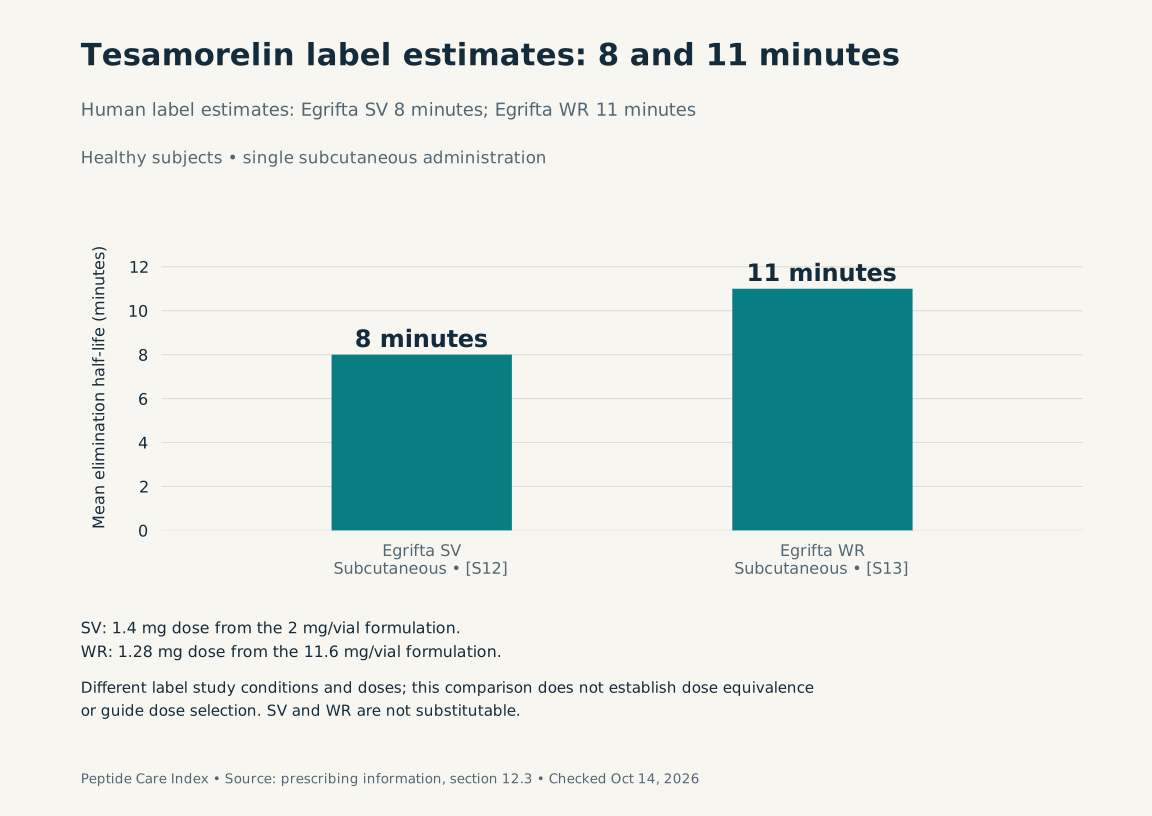
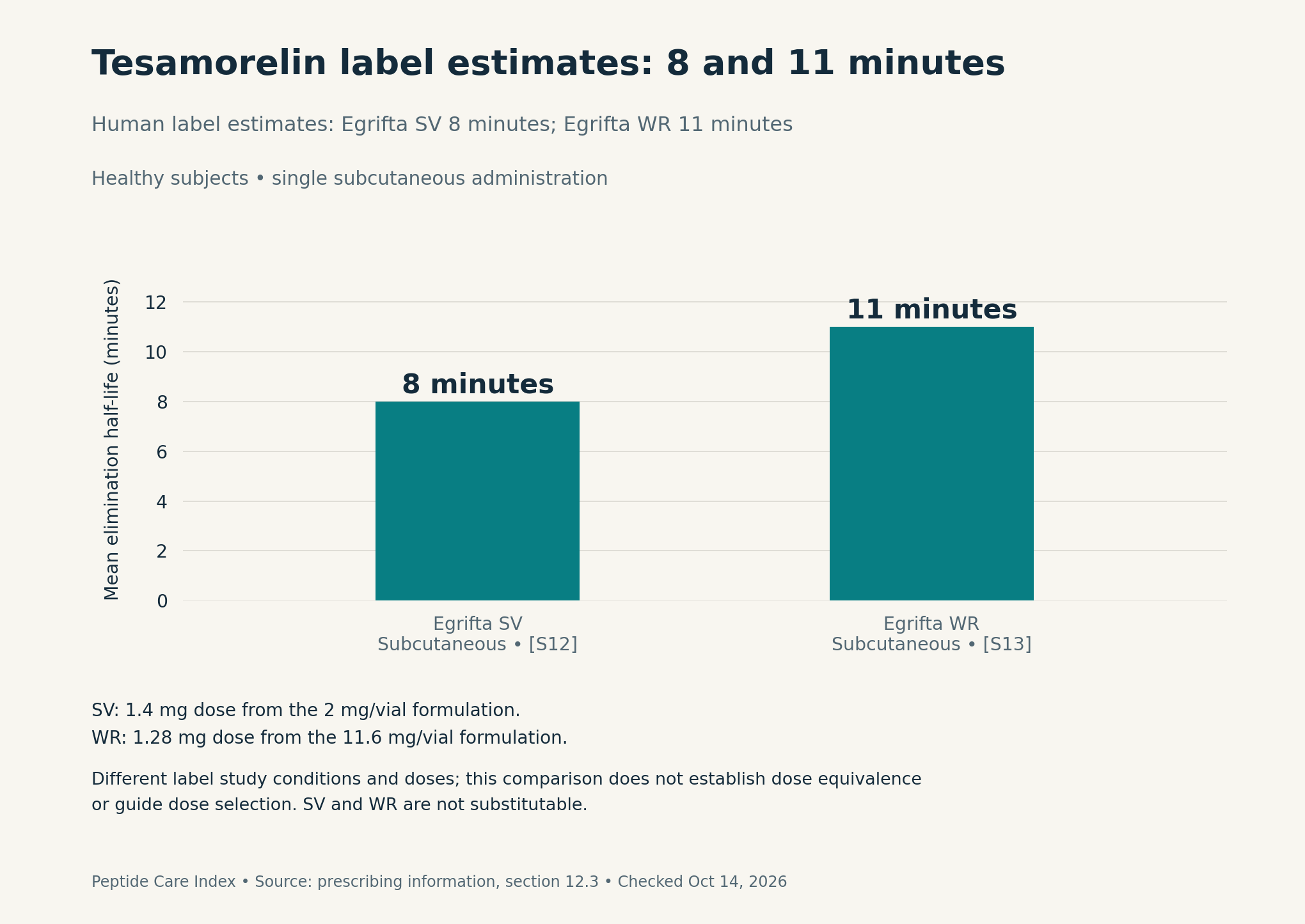
Tesamorelin’s Egrifta SV and WR labels report mean elimination half-lives of 8 and 11 minutes, respectively. Both estimates come from healthy subjects, but the formulations and single study doses differ. A generic “tesamorelin half-life” drops information the reader needs. 12 13
| Formulation | Mean elimination half-life | Conditions behind the estimate | Source |
|---|---|---|---|
| Egrifta SV, 2 mg/vial | 8 minutes | Healthy subjects; single 1.4 mg subcutaneous study dose | 12 |
| Egrifta WR, 11.6 mg/vial | 11 minutes | Healthy subjects; single 1.28 mg subcutaneous study dose | 13 |
Source: each label, section 12.3; checked October 14, 2026. These are the historical study conditions behind the numbers, not instructions for use. The labels state that SV and WR are not substitutable.
Depot formulations need the same care. Immediate-release Byetta has a 2.4-hour mean terminal half-life. The cited Bydureon BCise label instead describes plasma concentrations generally below its assay’s quantification limit about 10 weeks after stopping. That observation is not a 10-week half-life. 6 7
Likewise, the cited Sandostatin LAR label separates immediate-release octreotide PK from the depot’s slow release. It describes a plateau about 2–3 weeks after injection. A plateau time is not a half-life. 16
What does half-life mean—and how long does a peptide work?
A half-life describes a halving during a specified phase of the concentration curve. It is not the time until all of a substance disappears. It also does not directly measure how long a symptom change, hormone response, or other effect lasts.
The archived GEREF 50 information gives sermorelin an IV plasma half-life of 6–7 minutes, while describing a growth-hormone response lasting 2–3 hours. Those values can both be true because they measure different things. 22
| Term | What it describes | What to check |
|---|---|---|
| Elimination or terminal half-life | The later decline of the measured substance | Exact route, measured phase, population and product |
| Distribution half-life | The early movement out of the sampled compartment | Keep separate from terminal elimination |
| Depot half-life or release profile | Exposure shaped by a slow-release formulation | Use the exact formulation’s source |
| Duration of effect | How long a measured biological response lasts | Look for that response in the study, not a clearance calculation |
| Shelf life | Stability of a stored product | Use product storage information, not a plasma value |
| Detection window | How long a particular assay can detect substance or metabolites | Assay, sample type and detection limit |
Sources: the GHRP-6 study, GEREF 50 information and depot labels illustrate the phase, effect and release distinctions. Product information treats storage separately; the BCise source specifies an assay threshold rather than a half-life. 21 22 7 16 These terms explain why a single number cannot answer every “how long” question.
How much remains after five half-lives?
In a simple model where concentration halves at a constant rate, 3.125% of the starting concentration remains after five half-lives. After four, 6.25% remains. These are calculations, not measured clearance times for each peptide in this chart.
| Half-lives elapsed | Starting concentration remaining |
|---|---|
| 0 | 100% |
| 1 | 50% |
| 2 | 25% |
| 3 | 12.5% |
| 4 | 6.25% |
| 5 | 3.125% |
Source: Peptide Care Index calculation, 100 × (1/2)^n, where n is the number of half-lives; checked October 14, 2026. This assumes a single exponential phase with no continued absorption or new input. It does not account for repeated administration, slow-release depots, multiple phases, active metabolites, or assay limits. It does not set dosing, clinical washout, or drug-testing times.
How did we build and check this chart?
Peptide Care Index assembled 32 selected formulation and evidence records on October 14, 2026. We read original prescribing information, original research records, an archived official product document, and FDA evidence reviews. We did not run a clinical experiment or test a marketed peptide product.
We selected commonly searched care-related peptides and label examples that show why route and formulation matter. The collection is not a census of every peptide medicine or every research compound. The names, products and records included in the CSV define its scope.
For each record, we kept the exact substance or formulation, route, population, half-life endpoint, reported units, source location, evidence date, and check date. We preserved ranges and standard deviations separately. Blank numeric cells remain blank rather than becoming zero.
The 21 numeric human records comprise 15 label records and 6 additional human-study or archived official records. The 11 nonnumeric records comprise 2 depot descriptions and 9 evidence-gap or unresolved records. We count records, not distinct peptide molecules: semaglutide and tesamorelin each have more than one formulation row.
The publisher abstracts were sufficient to verify the displayed CJC-1295, ipamorelin, GHRP-2 and GHRP-6 values and their displayed study context. We did not claim to inspect their complete participant-level data. The NL005 row was checked against the full paper and Table 4. The GHK-Cu gap is limited to our search; its linked FDA page supplies safety context, not proof of an absence.
To reproduce the chart, open each dataset source, find the recorded section or table, and compare the as-reported value before using the hours fields. Minutes are divided by 60; days are multiplied by 24; one week is 168 hours. Unit conversions do not add precision to the original estimate.
The first chart includes only the 15 numeric label records. The second uses L12 and L13. Both keep the source IDs that resolve in this page and the downloadable source index. No chart assigns a numeric value to an unresolved record.
We update this page when a new human PK study, label revision, formulation change, or corrected source trail changes an entry. The October 2026 date is the date of this review; it does not turn an older study into 2026 experimental data. Our research methodology explains the broader source rules.
What does the chart not establish?
This reference does not establish a product’s identity, purity, safety, benefit, availability, or approval status from its half-life. It does not show that an online seller’s preparation matches a studied product. A short half-life also does not justify more frequent use.
For studied uses and approval examples, use the separate peptide comparison chart. When checking an offer, keep its price and package conditions separate from PK evidence; the peptide price list does that comparison.
If you are checking a BPC-157, TB-500 or sermorelin offer, Find My Peptide Path helps you prepare questions about the exact product, current access evidence, and fees before you pay. Ask a qualified clinician or pharmacist to interpret PK for a treatment decision.
How can you cite or download this chart?
Publication: Peptide Care Index. Page: “Peptide half life chart: 21 human values, with sources.” Updated: October 14, 2026. Permanent URL: https://peptidecareindex.com/research/peptide-half-life-chart/
Peptide Care Index. Peptide half life chart: 21 human values, with sources. Updated October 14, 2026. https://peptidecareindex.com/research/peptide-half-life-chart/
For an individual number, cite its exact record anchor, such as Egrifta SV, and keep the primary source beside it. Credit Peptide Care Index for the compilation or calculations; credit the label or study for the measurement.
You may reuse our original table arrangement, calculations, and chart designs with credit to Peptide Care Index. Keep the underlying source credits and terms. This permission does not cover third-party text, figures, or logos.
- Download the complete CSV: 32 records
- Download the same records and source index as JSON
- Download the medicine chart as PNG or SVG
- Download the tesamorelin chart as PNG or SVG
- Download the chart source index
What else do readers ask about peptide half-life?
What is BPC-157’s half-life in humans?
The reviewed records do not establish a reliable human elimination value. The 2022 animal PK paper cannot supply one, and FDA’s 2026 review describes human enema concentration reports without a usable human half-life. An exact number for oral or SC BPC-157 needs a matching human PK source. 24 25
Is CJC-1295’s half-life five to eight days?
The 2006 study estimated 5.8–8.1 days for the long-acting DAC compound after SC administration. That result should retain its exact form and route. It is not the verified half-life of a no-DAC product. 18 32
What is ipamorelin’s half-life?
The 1999 human study reported a 2-hour terminal half-life after a 15-minute IV infusion. That is a real human finding. It does not establish the PK of an SC ipamorelin/CJC blend. 19
Is oral semaglutide’s half-life shorter than injected semaglutide’s?
The reviewed labels give both an elimination half-life of about one week. Route affects how medicine enters the body, while this value describes systemic elimination. Use each formulation’s own prescribing information for the rest of its PK. 1 2
Which peptide has the longest half-life in this chart?
Among the selected numeric label records, Somatuline Depot lanreotide has a 23–30-day sustained-release half-life. It is a depot-formulation value. This is not a finding about every peptide or a ranking of benefit. 17
Does five half-lives mean a peptide is completely gone?
No. The simple halving model leaves 3.125% of its starting concentration after five half-lives. Actual exposure and detection can follow a different pattern, so that calculation does not set a medical washout or testing window. See the assumptions.
Which sources support each record?
All sources below were checked October 14, 2026. Dates within an entry describe the source, not a new experiment. FDA briefing documents are evidence reviews for advisory meetings; they are not drug approvals.
S01 — Ozempic injection prescribing information. Exact source. 12.3 Pharmacokinetics. Label revision: 05/2026 (cover). Checked October 14, 2026.
S02 — Rybelsus and Ozempic oral-tablet prescribing information. Exact source. 12.3 Pharmacokinetics. Label revision: 1/2026 (cover). Checked October 14, 2026.
S03 — Mounjaro prescribing information. Exact source. 12.3 Pharmacokinetics. Label revision: 08/2026 (cover). Checked October 14, 2026.
S04 — Victoza prescribing information. Exact source. 12.3 Pharmacokinetics. Label revision: 10/2025 (cover). Checked October 14, 2026.
S05 — Trulicity prescribing information. Exact source. 12.3 Pharmacokinetics. Label revision: 03/2026 (cover). Checked October 14, 2026.
S06 — Byetta label. Exact source. 12.3 Pharmacokinetics. Label revision September 2025; DailyMed effective date September 2, 2025. Checked October 14, 2026.
S07 — Bydureon BCise label. Exact source. 12.3 Pharmacokinetics. Label revision: 5/2025; DailyMed update May 28, 2025. Checked October 14, 2026.
S08 — Adlyxin prescribing information. Exact source. 12.3 Pharmacokinetics. Label revision June 2022. Checked October 14, 2026.
S09 — Symlin label. Exact source. 12.3 Pharmacokinetics. Label revision: 12/2019 (highlights). Checked October 14, 2026.
S10 — Forteo prescribing information. Exact source. 12.3 Pharmacokinetics. Label revision: 08/2026 (cover). Checked October 14, 2026.
S11 — Tymlos label. Exact source. 12.3 Pharmacokinetics. Label revision: 8/2026 (highlights). Checked October 14, 2026.
S12 — Egrifta SV label. Exact source. 12.3 Pharmacokinetics. Highlights revised February 2024; DailyMed updated July 29, 2026. Checked October 14, 2026.
S13 — Egrifta WR label. Exact source. 12.3 Pharmacokinetics. Highlights revised March 2025; DailyMed updated July 29, 2026. Checked October 14, 2026.
S14 — Vyleesi prescribing information. Exact source. 12.3 Pharmacokinetics. Label revision: 03/2024 (cover). Checked October 14, 2026.
S15 — Sandostatin immediate-release injection label. Exact source. 12.3 Pharmacokinetics. Highlights revised July 2024; DailyMed effective July 22, 2026; record-end revision July 2026. Checked October 14, 2026.
S16 — Sandostatin LAR Depot label. Exact source. 12.3 Pharmacokinetics. Highlights revised July 2024; DailyMed effective December 22, 2025; record-end revision December 2025. Checked October 14, 2026.
S17 — Somatuline Depot label. Exact source. 12.3 Pharmacokinetics. Highlights revised July 2024; DailyMed effective October 11, 2024; record-end revision October 2024. Checked October 14, 2026.
R01 — CJC-1295 with DAC — Teichman et al.. Exact source. 2006; JCEM 91:799–805; original abstract Results. Checked October 14, 2026.
R02 — Ipamorelin — Gobburu et al.. Exact source. 1999; Pharmaceutical Research 16:1412–1416; original abstract Methods and Results. Checked October 14, 2026.
R03 — GHRP-2 — Pihoker et al.. Exact source. 1998; JCEM 83:1168–1172; original abstract, terminal beta half-life. Checked October 14, 2026.
R04 — GHRP-6 — Cabrales et al.. Exact source. 2013 issue; online 2012; original abstract, distribution and elimination parameters. Checked October 14, 2026.
R05 — GEREF 50 archived official product information. Exact source. Text revised May 2004, printed July 13, 2006; section 5.2. Checked October 14, 2026.
R06 — Recombinant thymosin beta-4 NL005 — Wang et al.. Exact source. 2021; J Cell Mol Med; introduction, methods and Table 4; DOI 10.1111/jcmm.16693. Checked October 14, 2026.
R07 — BPC-157 animal pharmacokinetics — He et al.. Exact source. 2022; Results and Tables 1–6; rats and beagle dogs. Checked October 14, 2026.
R08 — FDA BPC-157 briefing. Exact source. Staff evaluation May 11, 2026; Human Safety, Pharmacokinetic Data (PDF page 40). Checked October 14, 2026.
R09 — FDA TB-500 briefing. Exact source. July 2026 advisory-meeting briefing; chemical identity and Human Safety, Pharmacokinetic Data. Checked October 14, 2026.
R10 — FDA MOTS-c briefing. Exact source. July 2026 advisory-meeting briefing; Human Safety, Pharmacokinetic Data. Checked October 14, 2026.
R11 — FDA KPV briefing. Exact source. Staff evaluation May 12, 2026; Human Safety, Pharmacokinetic Data. Checked October 14, 2026.
R12 — FDA AOD-9604 briefing. Exact source. Staff evaluation November 5, 2024; Human Safety, Pharmacokinetic Data. Checked October 14, 2026.
R13 — FDA epitalon briefing. Exact source. July 2026 advisory-meeting briefing; Human Safety, Pharmacokinetic Data. Checked October 14, 2026.
R14 — FDA compounding safety-risk page. Exact source. Injectable GHK-Cu entry; safety context only, not a pharmacokinetic measurement. Checked October 14, 2026.
R15 — FDA CJC-1295 briefing. Exact source. December 2024 advisory-meeting briefing; chemical identities and human clinical-data sections. Checked October 14, 2026.
R16 — FDA emideltide (DSIP) briefing. Exact source. Staff evaluation May 11, 2026; nonclinical PK (PDF page 45) and human PK summary (PDF page 50). Checked October 14, 2026.
Peptide Care Index Research is the research and reference section of peptidecareindex.com.