MOTS-c human studies: what was actually tested? (2026)
By Peptide Care Index · Updated October 2026
MOTS-c human studies exist, but this review found no completed trial reporting treatment outcomes from native MOTS-c in people. Peptide Care Index’s October 2026 audit sorted eight registry matches into four MOTS-c measurement studies, three other matches and one unverified entry. The completed CB4211 trial tested a modified molecule. See the records and method.
What are the key MOTS-c human study findings?
- No completed, published native-MOTS-c treatment trial was identified in this review of PubMed, ClinicalTrials.gov and the primary sources below, checked October 14, 2026. This is a search finding, not proof that no person has ever received it. Method; FDA review.
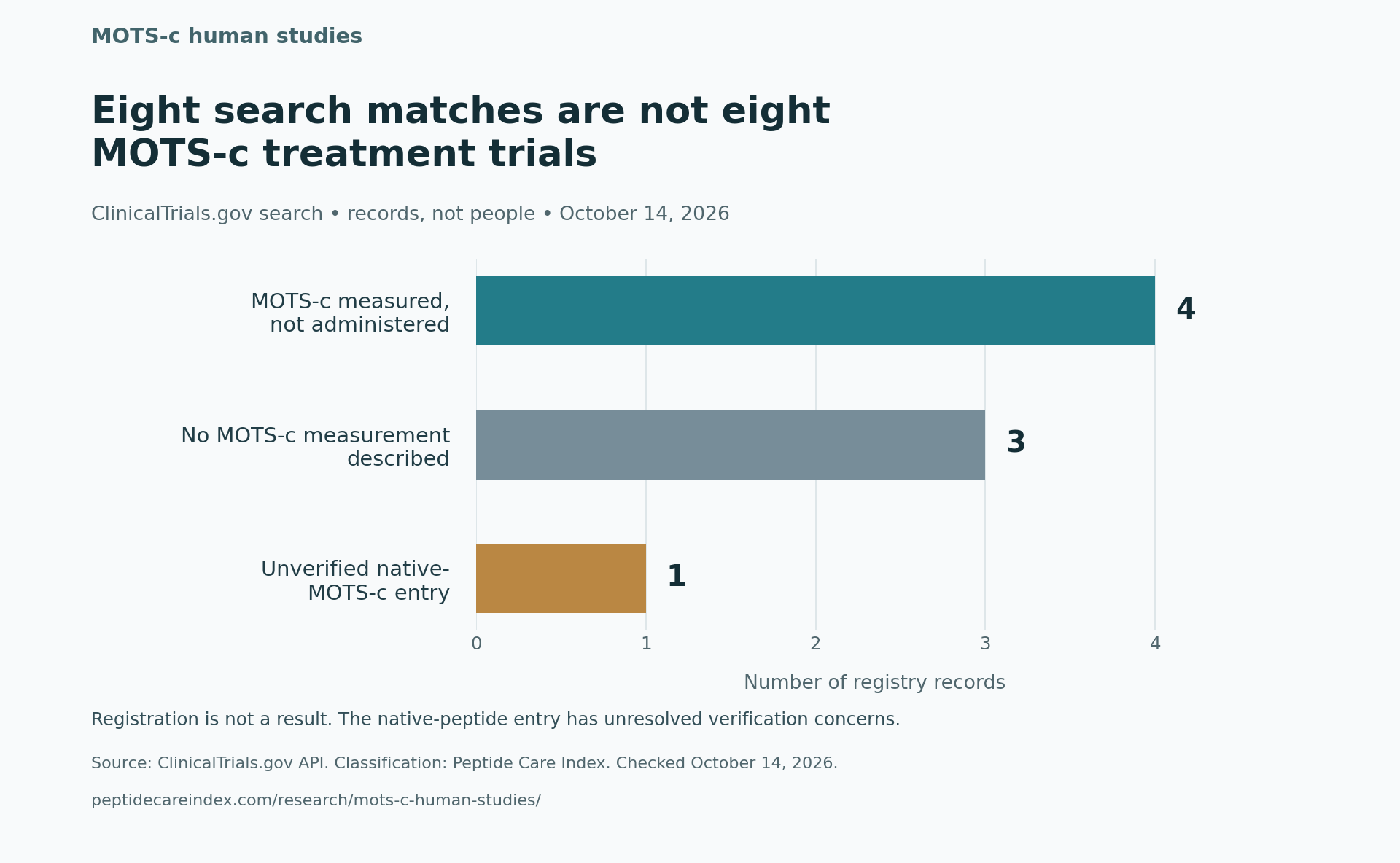
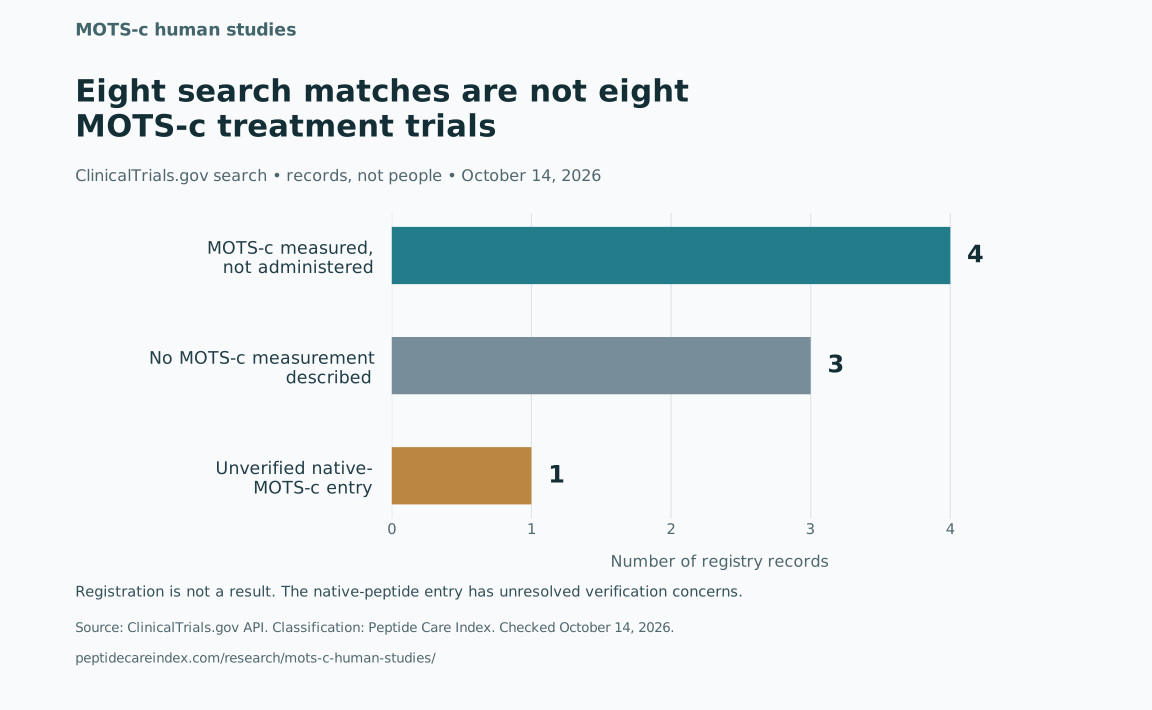
- Eight ClinicalTrials.gov keyword matches did not equal eight MOTS-c treatment trials. Peptide Care Index classified four as measuring MOTS-c without administering it, three with no stated MOTS-c measurement and one as an unverified native-peptide entry. Full screening table.
- The often-cited 11.9-fold rise followed exercise in 10 men. It measured MOTS-c in muscle, not better performance after a peptide injection. Circulating levels rose 1.6-fold during exercise and 1.5-fold immediately afterward. Reynolds et al., 2021. Original paper.
- A separate exercise study randomized 30 adults and found no statistically significant MOTS-c response. The number of samples tested varied; peptide measurements were available for five controls. von Walden et al., 2021. Original paper.
- CB4211 enrolled 88 people across drug and placebo groups; 20 completed the final Phase 1b assessments. CB4211 is a modified analog, not native MOTS-c. The sponsor reported 65 Phase 1a participants and 23 Phase 1b participants. Registry; sponsor presentation.
- The “120-person MOTS-c trial” is an estimated-enrollment registry entry with no posted results. Its sponsor’s other records include three that describe themselves as fictional, mock or example studies. We do not count the MOTS-c listing as verified treatment evidence. Provenance checks.
- A 2021 genetics paper studied 27,527 people across three Japanese-ancestry cohorts. It examined a naturally occurring MOTS-c variant; it did not give people MOTS-c. Zempo et al..
What did the human MOTS-c studies actually test?
The eight selected biological reports below studied the body’s own MOTS-c, genetic differences, or changes after exercise or heat. None gave native MOTS-c to living human participants. Some papers also treated mice or human cells in a dish; those experiments belong in a separate evidence category.
MOTS-c is a peptide—a short chain of amino acids—linked to mitochondrial DNA. Endogenous means made within the body. A study that measures endogenous MOTS-c can help explain human biology without showing what happens when someone takes a synthetic product.
| Study | People and design | What the human part found | Was MOTS-c given to people? |
|---|---|---|---|
| D’Souza, 2020 | 104 healthy men in four age/sample groups; cross-sectional comparison | Blood concentrations declined with age, but muscle expression was about 1.5 times higher in middle-aged and older groups than in young men. Older blood and muscle samples came from separate groups. | No |
| Zempo, 2021 | 27,527 people across three Japanese-ancestry cohorts; genetic association | A MOTS-c variant, K14Q, was associated with higher type 2 diabetes prevalence in men in the pooled analysis. This was not a supplementation trial. | No |
| Reynolds, 2021 | 10 sedentary, healthy young men; acute cycling experiment | Muscle MOTS-c rose 11.9-fold immediately after exercise. Circulating MOTS-c rose 1.6-fold during and 1.5-fold afterward. | No; peptide-treatment performance experiments in this paper were in mice |
| von Walden, 2021 | 30 adults randomized to endurance exercise, resistance exercise or control; assay samples varied | No significant group-by-time change in circulating MOTS-c. The paper’s positive humanin finding concerns a different peptide. | No |
| Dieli-Conwright, 2021 | 49 breast cancer survivors with usable samples from a larger trial; 16 weeks of exercise or usual care | MOTS-c rose in the non-Hispanic White exercise subgroup, but not the Hispanic exercise subgroup. | No |
| Alser, 2022 | 75 professional athletes and 30 non-athlete controls; cross-sectional comparison | Athletes had lower resting serum MOTS-c than controls. This design cannot show that training caused the difference. | No |
| Kumagai, 2024 | Separate human genetic and muscle analyses, plus mouse and cell experiments | Human associations linked K14Q to muscle/metabolic traits. Giving MOTS-c to human muscle cells in a dish was not administration to a person. | No |
| Elhusseiny, 2025 | 19 active men; heat or sham treatment during leg immobilization | Heat increased circulating MOTS-c. The study also reported muscle loss during immobilization. Abstract checked; full paper not reviewed here. | No; the intervention was heat |
Source: the linked original reports, checked October 14, 2026. This is a selected evidence map, not a count of every human paper. Sample sizes cannot be added: some cohorts may overlap, and each report asks a different question. The free evidence CSV records study type, exposure, sample, source and verification depth.
Does the 11.9-fold exercise result show that MOTS-c improves human endurance?
No. The 2021 Reynolds paper measured a rise in the men’s own MOTS-c after exercise; the 11.9-fold figure is muscle expression relative to its pre-exercise level. The paper’s experiments giving MOTS-c to improve physical performance were in mice. Original paper, human Results and Figure 1.
| Sample and timing | Reported change from pre-exercise | What that number measures |
|---|---|---|
| Muscle, immediately after exercise | 11.9-fold | Relative muscle expression |
| Circulation, during exercise | 1.6-fold | Relative circulating level |
| Circulation, immediately after exercise | 1.5-fold | Relative circulating level |
| Circulation, four hours later | Returned to baseline | A temporary biomarker response |
Source: Reynolds et al., 2021; muscle measured by western blot, circulation by an in-house ELISA. These are different sample types and tests. They are not percentages of fat lost, extra endurance or response to treatment. Full paper.
For example, “exercise raised muscle MOTS-c” is a supported description of this experiment. “MOTS-c injections made people exercise 11.9 times better” changes both the intervention and the outcome.
The broader exercise evidence is mixed. The separate 30-person randomized study did not find a significant MOTS-c response. The athlete comparison found lower resting levels in trained athletes. A short-lived exercise response and a resting comparison across different people need not point in the same direction. Neither settles what taking the peptide would do. von Walden; Alser.
How many MOTS-c clinical trials are there?
A ClinicalTrials.gov search for “MOTS-c” returned eight records on October 14, 2026. Reading the interventions and outcomes changed the picture: four measured MOTS-c without administering it, three described no MOTS-c measurement or administration, and one claimed native-MOTS-c treatment but could not be independently verified. A separate search found the completed CB4211 analog trial. Official search data; CB4211 record.
| Registry ID | What the record concerns | Classification in this audit |
|---|---|---|
| NCT03878706 | Cardiovascular effects of diabetes medicines | MOTS-c measurement; no MOTS-c administration |
| NCT04027712 | Platelets, MOTS-c and outcomes in people with diabetes and coronary disease | MOTS-c measurement; no MOTS-c administration |
| NCT07438002 | Exercise in chronic kidney disease | MOTS-c measurement; exercise intervention |
| NCT07638696 | Fasting and mitochondrial markers | No MOTS-c measurement or administration described |
| NCT07678073 | Anesthesia methods in kidney transplantation | MOTS-c measurement; anesthesia intervention |
| NCT06133946 | Newborn deafness-gene screening | No MOTS-c measurement or administration described |
| NCT06500975 | Vestibular implantation | No MOTS-c measurement or administration described |
| NCT07505745 | Sponsor-submitted native-MOTS-c treatment plan | Unverified registration; no posted results; see below |
Source: ClinicalTrials.gov API records, checked October 14, 2026. These categories describe what the records say; they do not verify that each study operated as listed. The registry-screen CSV preserves each title, intervention classification, enrollment type, status and source date.
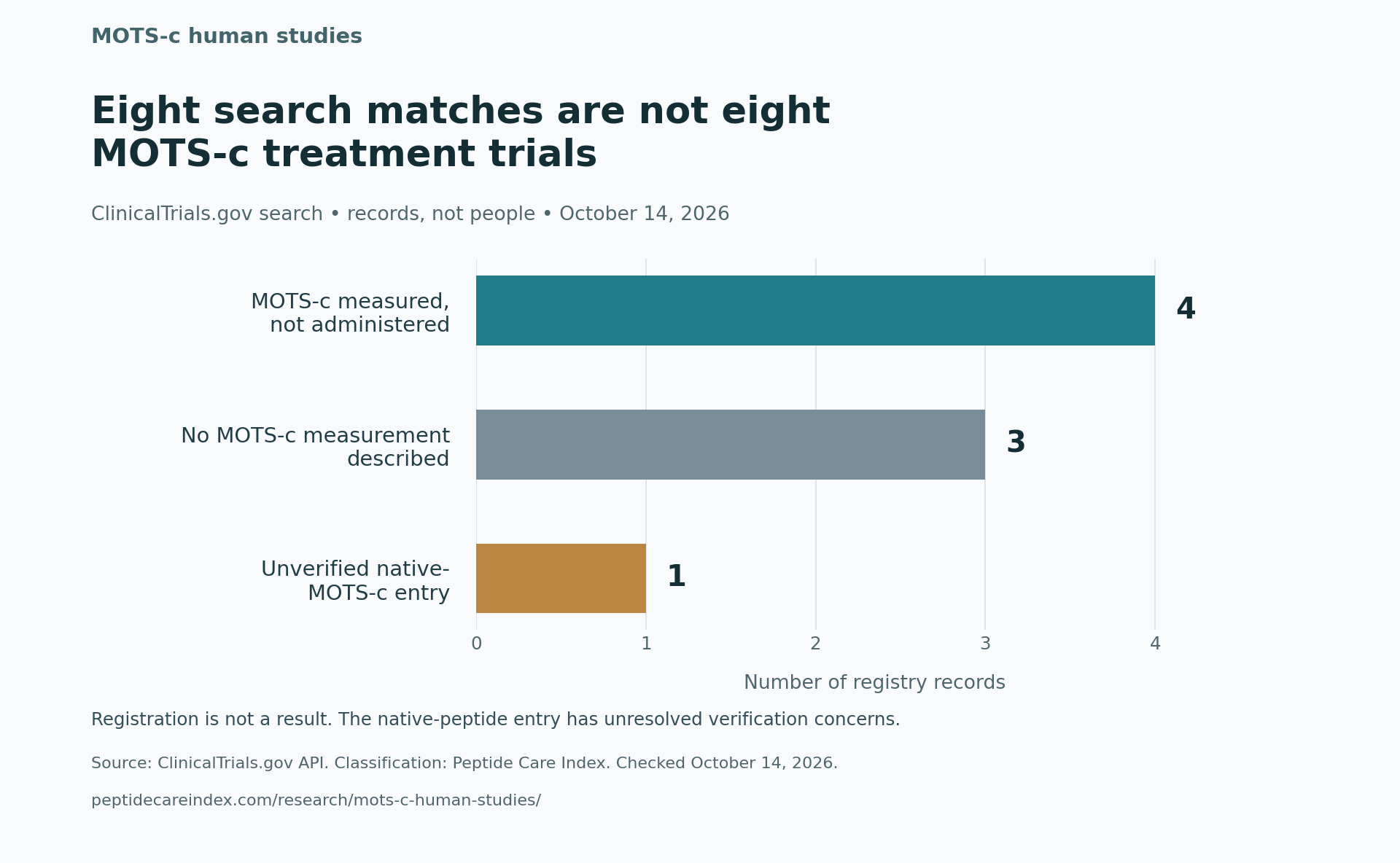 Eight MOTS-c registry search matches: four MOTS-c measurement studies, three other matches, and one unverified native-MOTS-c entry.
Is the 120-person MOTS-c trial verified?
We could not independently verify it. The NCT07505745 record lists Hudson Biotech as sponsor, recruiting status and estimated enrollment of 120, with no posted results. Its last posted update was April 1, 2026. Those are registry fields, not confirmation that 120 people enrolled or received a peptide. Official record.
The concern goes beyond missing results. A sponsor-name search returned eight Hudson Biotech records. Three use example, mock or fictional wording in their own text. Official sponsor search.
| Same-sponsor record | Wording found in the official record | Why it matters |
|---|---|---|
| NCT07487363, TB-500 | Its summary calls it a fictional example of a registry record. | A registry listing can contain an example rather than an operating trial. |
| NCT07481734, tesamorelin | The title ends “(Mock Study)”; its description also identifies a mock protocol. | The title itself limits how the record can be used. |
| NCT07437560, Melanotan II | Its summary identifies an example interventional study record. | This is a third explicit example label under the same sponsor. |
Source: the official ClinicalTrials.gov records and sponsor-query response, checked October 14, 2026. The full eight-record provenance CSV records each self-description flag.
The MOTS-c entry itself does not call itself fictional. The pattern is a reason to withhold verification, not proof that this specific record was fabricated. We found no independent confirmation from the listed sponsor or site in the sources checked. We therefore keep it visible as an unverified registration and exclude it from confirmed administered-human results.
This distinction matters even if the entry is later confirmed: a plan for 120 people would still not be 120 treatment results.
What did the CB4211 human trial find?
CB4211 is a modified MOTS-c analog—a related molecule with chemical changes. Its completed Phase 1a/1b trial enrolled 88 people across active and placebo groups. The sponsor reported exploratory metabolic signals, but those results cannot establish the effects or safety of native MOTS-c. Registry; sponsor results.
| Count | What it describes |
|---|---|
| 65 | Healthy adults enrolled and randomized in Phase 1a |
| 23 | Adults with obesity and fatty liver disease enrolled and randomized in Phase 1b |
| 88 | Total enrolled across both phases: 65 + 23 |
| 3 | Phase 1b participants who stopped before the final assessment |
| 20 | Participants who completed final Phase 1b assessments: 23 − 3 |
| 11 and 9 | Active-treatment and placebo participants, respectively, in that final assessment group |
Source: CohBar’s August 10, 2021 presentation, slides 9–11, filed with the U.S. Securities and Exchange Commission. These are people across comparison groups, not 88 people given active drug. Presentation.
Over four weeks, the sponsor reported favorable changes in liver enzymes and fasting glucose, a trend toward lower weight, and reductions in liver fat in both groups. This is early exploratory evidence about CB4211, not proof of lasting weight loss, diabetes prevention, better endurance or longer life. Sponsor report.
Results were reported in sponsor materials and a conference abstract. The registry had no posted results at our check. A conference abstract is not a full clinical report. Conference abstract LP5; registry.
What do human studies show about MOTS-c safety and side effects?
This review found no completed native-MOTS-c treatment trial that could supply a human side-effect rate. FDA’s evaluation dated May 11, 2026, prepared for its July meeting, likewise reported no identified clinical studies or human exposure data for the substances by any route. This concerns administered products, not studies measuring the body’s own peptide. FDA briefing, human safety and effectiveness sections.
For CB4211, the sponsor reported injection-site reactions and no serious adverse events in its early trial. A small, short trial of a different molecule does not establish the safety of native MOTS-c or rule out rare and long-term harms. Sponsor presentation, slide 18.
“No reliable rate available” is the correct conclusion here. It does not mean a measured 0% side-effect rate.
For the separate questions of approval and compounding status, use our FDA peptide status table. A research finding, an advisory review and an approved drug are different records.
Why do MOTS-c blood levels differ between studies?
The test method can matter. In a 2019 analytical report using samples from 20 healthy people, Knoop and colleagues could not confirm commercial ELISA measurements with their mass-spectrometry method. That is a reason to be careful when comparing concentrations across reports; it does not prove that every assay is wrong or that MOTS-c is absent from humans. Author-institution abstract.
An ELISA uses antibodies to detect a target. Mass spectrometry identifies molecules using their mass and related signals. Different methods, sample handling, study groups and sampling times can affect a comparison.
Age is also not a single-direction story. D’Souza’s report found lower circulating concentrations with age alongside higher muscle expression. A blood result cannot simply stand in for a muscle result. Original paper.
These differences are why this page does not pool blood levels into one “normal” MOTS-c range or convert an exercise biomarker change into a treatment benefit.
Do human studies prove weight loss, muscle protection or longer life?
No completed native-MOTS-c treatment trial establishing those benefits was identified in this review. Human associations, exercise responses, treated human cells and mouse-treatment results each answer a narrower question. None supplies a reliable human fat-loss percentage or extra years of life from taking MOTS-c.
The 2025 heat study makes the distinction concrete: circulating MOTS-c increased, and the study also reported muscle loss during immobilization. A higher biomarker and a better clinical outcome are separate findings. Author-institution abstract.
Use the broader peptide comparison chart to see which exact compounds and uses have different kinds of evidence. If you are checking an advertised offer, the peptide price list keeps package sizes and fees separate from clinical proof. Find My Peptide Path can help you prepare questions before contacting a provider; it does not decide whether MOTS-c is right for you.
How did we build this evidence map?
We checked sources on October 14, 2026. We screened all eight records returned by the quoted MOTS-c ClinicalTrials.gov search, separately checked CB4211, and reviewed eight selected human biological reports plus one assay report. The paper selection is a reference set chosen to answer common evidence claims, not a systematic review of every publication.
- Search the registry. Use the official API query
"MOTS-c"; repeat with"MOTS c". Read the title, description, intervention, outcomes, status, enrollment type and posted-results flag. Both searches returned the same eight records in this check. SearchCB4211separately. - Read the actual intervention. A study can measure MOTS-c after exercise, fasting, anesthesia or another drug. That is not administration of MOTS-c. Classify the human and animal parts of mixed papers separately.
- Check the source of trial claims. We inspected all eight records in the Hudson Biotech sponsor-query response and marked the three with explicit example/mock/fictional language. The MOTS-c record remains unverified rather than being silently accepted or removed.
- Check the publications. PubMed searches used MOTS-c spelling variants, with and without clinical-trial publication-type filters, alongside publisher and author records. We also read the FDA evaluation, the CB4211 registry, sponsor materials filed with the SEC and the conference abstract.
- Keep verification depth visible. Seven selected biological reports were read in full. The 2025 heat paper and the 2019 assay report were checked against author-institution abstracts. We did not review participant-level data or contact investigators.
- Keep denominators intact. We do not add overlapping cohorts, equate planned and actual enrollment, count placebo participants as active-drug recipients, or merge an analog with native MOTS-c.
The downloadable files contain the classifications and source links. The math is simple: registry categories total 4 + 3 + 1 = 8; the three explicit example/mock/fictional labels are counted within a separate eight-record sponsor search. Those are different sets, and they must not be combined.
Our search did not cover every global registry, language, unpublished dataset or private clinical record. Registry fields may be stale. Publication-type filters can miss papers. The absence finding is limited to the records and publications checked; it is not a claim that unreported use cannot exist. Our methodology and publisher profile explain the publication’s role and limits.
How can you cite this page and reuse the data?
Suggested citation: Peptide Care Index. (2026, October 14). MOTS-c human studies: what was actually tested? (2026). Version 2026-10-14. https://peptidecareindex.com/research/mots-c-human-studies/
A sentence you can use: “Peptide Care Index’s October 14, 2026 audit classified eight MOTS-c registry search matches as four MOTS-c measurement studies, three other matches and one unverified native-peptide entry; it identified no completed, published native-MOTS-c treatment trial in the sources checked.”
For a study’s own result, cite the original paper as well. The audit’s contribution is the dated classification and source comparison, not ownership of the underlying experiments.
You may reuse our original table wording, classifications, calculations and newly drawn chart with credit to Peptide Care Index. This permission does not cover third-party article text, figures or other protected material; preserve the underlying source credits and terms.
Free downloads
- Human evidence map CSV
- Registry search and screening CSV
- Eight-record sponsor provenance CSV
- Calculations and count definitions CSV
- Registry chart PNG · Vector SVG
What else do readers ask about MOTS-c human studies?
Has MOTS-c been tested in humans?
Human studies have measured naturally occurring MOTS-c and its genetic variants. This review found no completed, published trial reporting outcomes after native-MOTS-c treatment. CB4211 has a completed early human trial, but it is a modified analog. Human studies; CB4211.
Is there a randomized controlled trial of MOTS-c?
There are randomized studies that measured MOTS-c after other interventions. That does not make them trials of MOTS-c treatment. The native-peptide listing NCT07505745 describes a randomized plan, but has no posted results and unresolved verification concerns. Registry audit.
Is CB4211 the same as MOTS-c?
No. CB4211 is a modified analog. Its 88-person enrollment includes placebo participants, and its reported exploratory findings cannot be copied across to native MOTS-c. Trial record; sponsor report.
Did the 2021 human study show an 11.9-fold performance gain?
No. The 11.9-fold figure measured muscle MOTS-c after exercise in 10 men. It was not an endurance improvement or a response to a peptide injection. Reynolds et al..
What is the proven human MOTS-c dose?
This review identified no completed native-MOTS-c dose-finding trial that establishes a clinical regimen. Mouse experiments, CB4211 doses and clinic advertisements cannot fill that gap. This page provides no dosing instructions.
Which primary sources support this page?
All sources below were checked October 14, 2026. Publication years describe the underlying research, not the year of this review.
- D’Souza et al., Aging, 2020. Aging muscle and circulating MOTS-c; full text.
- Zempo et al., Aging, 2021. K14Q genetic association; full text.
- Reynolds et al., Nature Communications, 2021. Human exercise measurements and separate mouse-treatment experiments; full text.
- von Walden et al., Journal of Applied Physiology, 2021. Randomized acute exercise study; full text.
- Dieli-Conwright et al., Scientific Reports, 2021. Exercise biomarker analysis in breast cancer survivors; full text.
- Alser et al., Reviews in Cardiovascular Medicine, 2022. Athlete/control comparison; full text. Published in 2022 despite later PubMed indexing.
- Kumagai et al., iScience, 2024. CK2, human associations and separate cell/mouse experiments; full text.
- Elhusseiny et al., Medicine & Science in Sports & Exercise, 2025. Heat and immobilization; author-institution abstract.
- Knoop, Thomas and Thevis, Rapid Communications in Mass Spectrometry, 2019. Assay comparison; author-institution abstract.
- ClinicalTrials.gov, quoted MOTS-c search, API response. Every returned record screened; individual records linked in Table 3.
- ClinicalTrials.gov, NCT07505745. Native-peptide entry; machine-readable record.
- ClinicalTrials.gov, Hudson Biotech exact sponsor search. Eight-record provenance check; individual records linked in Table 4 and the download.
- ClinicalTrials.gov, NCT03998514. CB4211 registry; machine-readable record.
- CohBar, August 10, 2021 results release, SEC exhibit. Sponsor-reported outcomes.
- CohBar, August 10, 2021 investor presentation, SEC exhibit. Enrollment, withdrawals, final analysis groups and safety summary.
- Loomba et al., AASLD late-breaking abstract LP5, Hepatology, 2021. Conference abstract, not a full clinical report.
- FDA evaluation of MOTS-c-related bulk drug substances. Dated May 11, 2026; prepared for the July 23–24, 2026 advisory meeting. The document does not state an exact final literature-search date in the relevant passages.
What changed in this release?
October 14, 2026: first evidence-map release. Separated human measurements from peptide administration, reconciled the CB4211 participant counts, and flagged the unverified native-peptide registration using primary registry records.
Peptide Care Index Research is the research and reference section of peptidecareindex.com.