Retatrutide phase 3 results: 5 trials, 6,422 adults
By Peptide Care Index · Updated October 2026
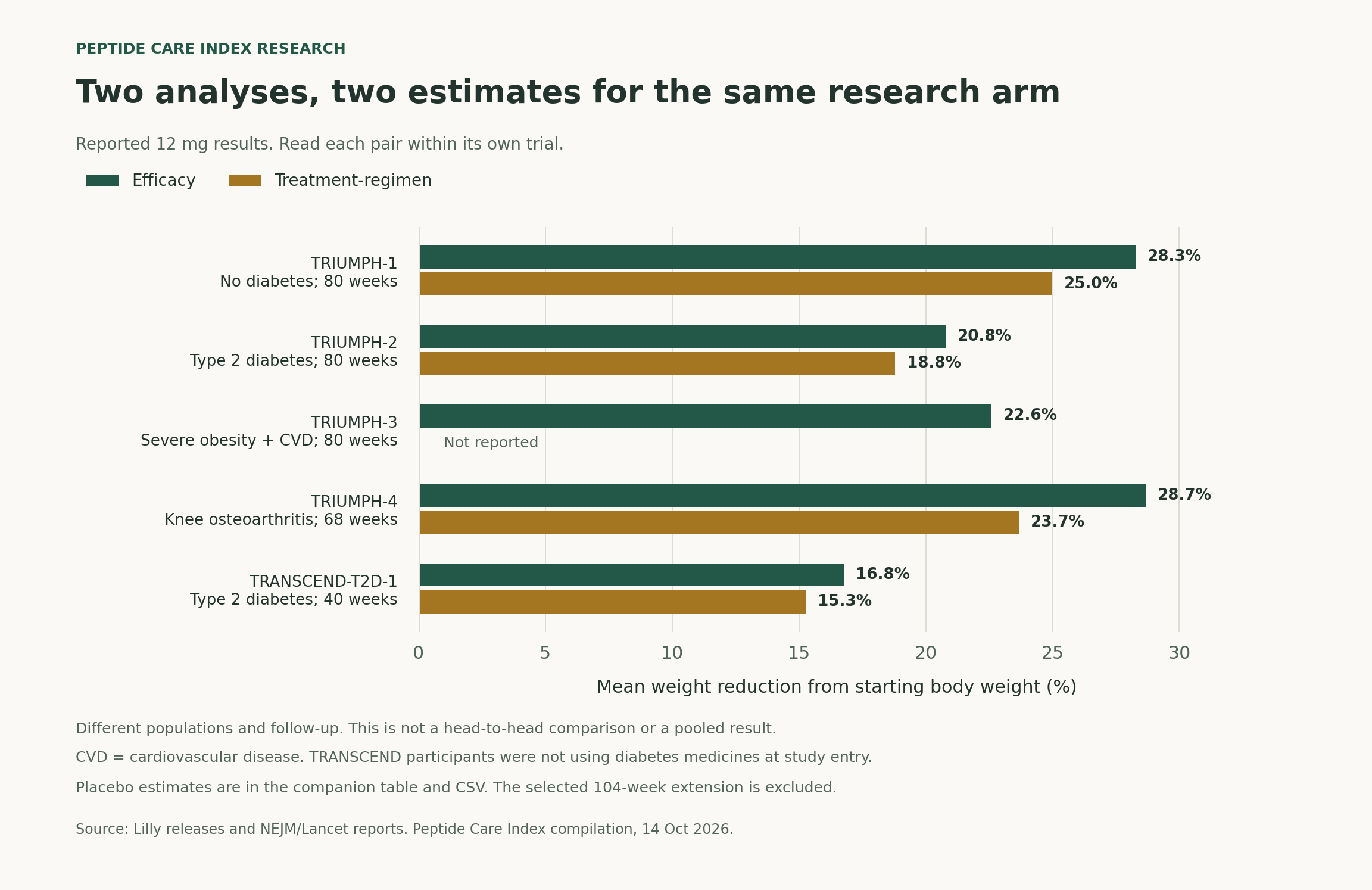
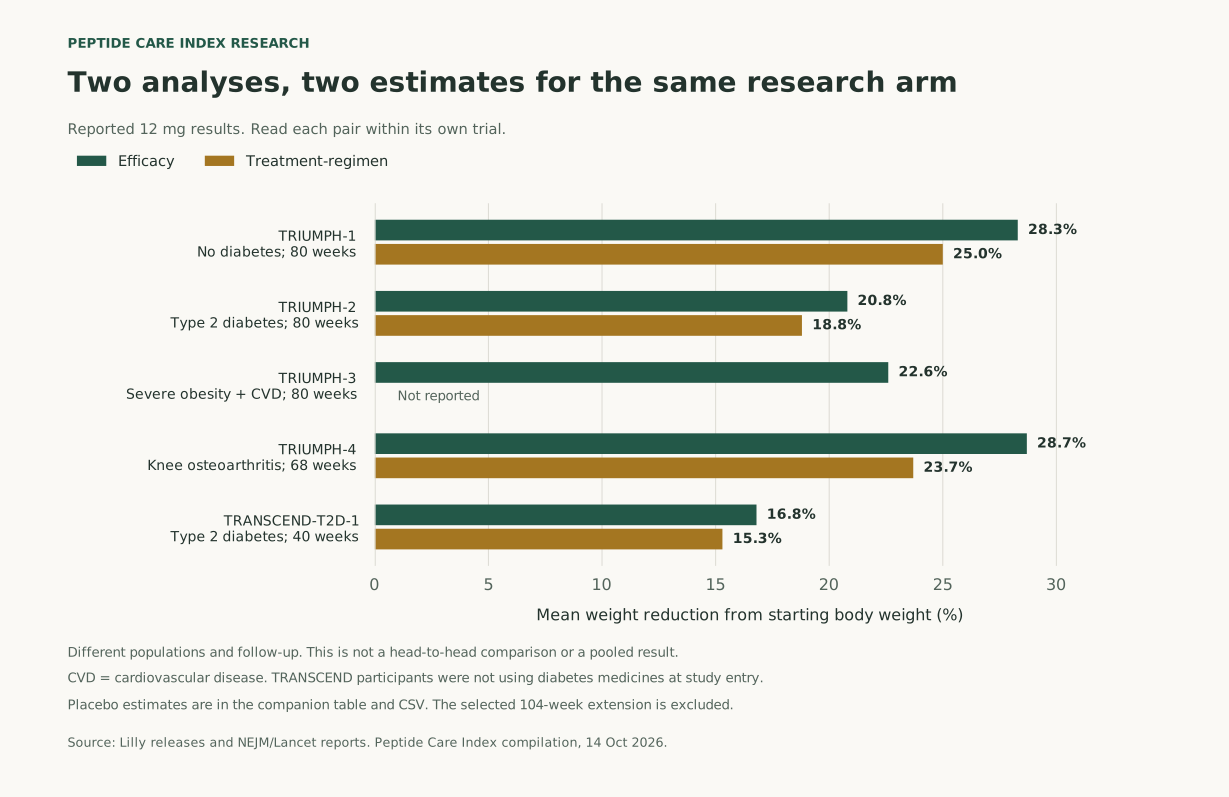
Retatrutide phase 3 results include 28.3% mean weight loss at 80 weeks in TRIUMPH-1’s 12 mg efficacy analysis, which assumes continued study treatment; the treatment-regimen estimate, which includes stopping treatment, was 25.0%. Peptide Care Index’s October 2026 review covers 6,422 randomized adults in five trials, with sources and both analyses kept together. Lilly TRIUMPH-1 announcement · Our method
What are the key retatrutide phase 3 results?
- TRIUMPH-1: At 80 weeks, the 12 mg arm had 28.3% mean weight loss in Lilly’s efficacy analysis and 25.0% in the treatment-regimen analysis published in NEJM; the corresponding placebo figures were 2.2% and 3.9%. Lilly, May 2026 · NEJM, September 2026
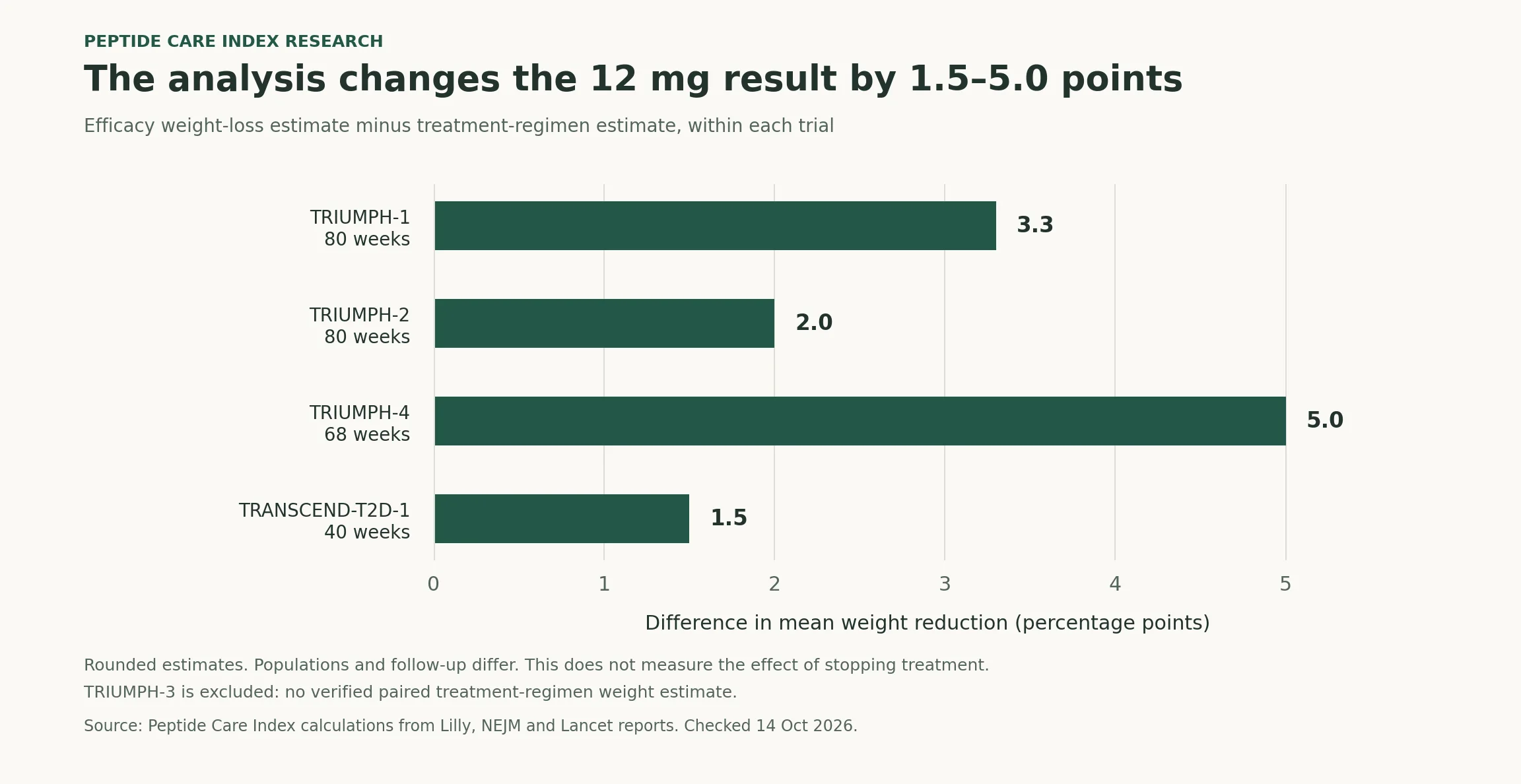
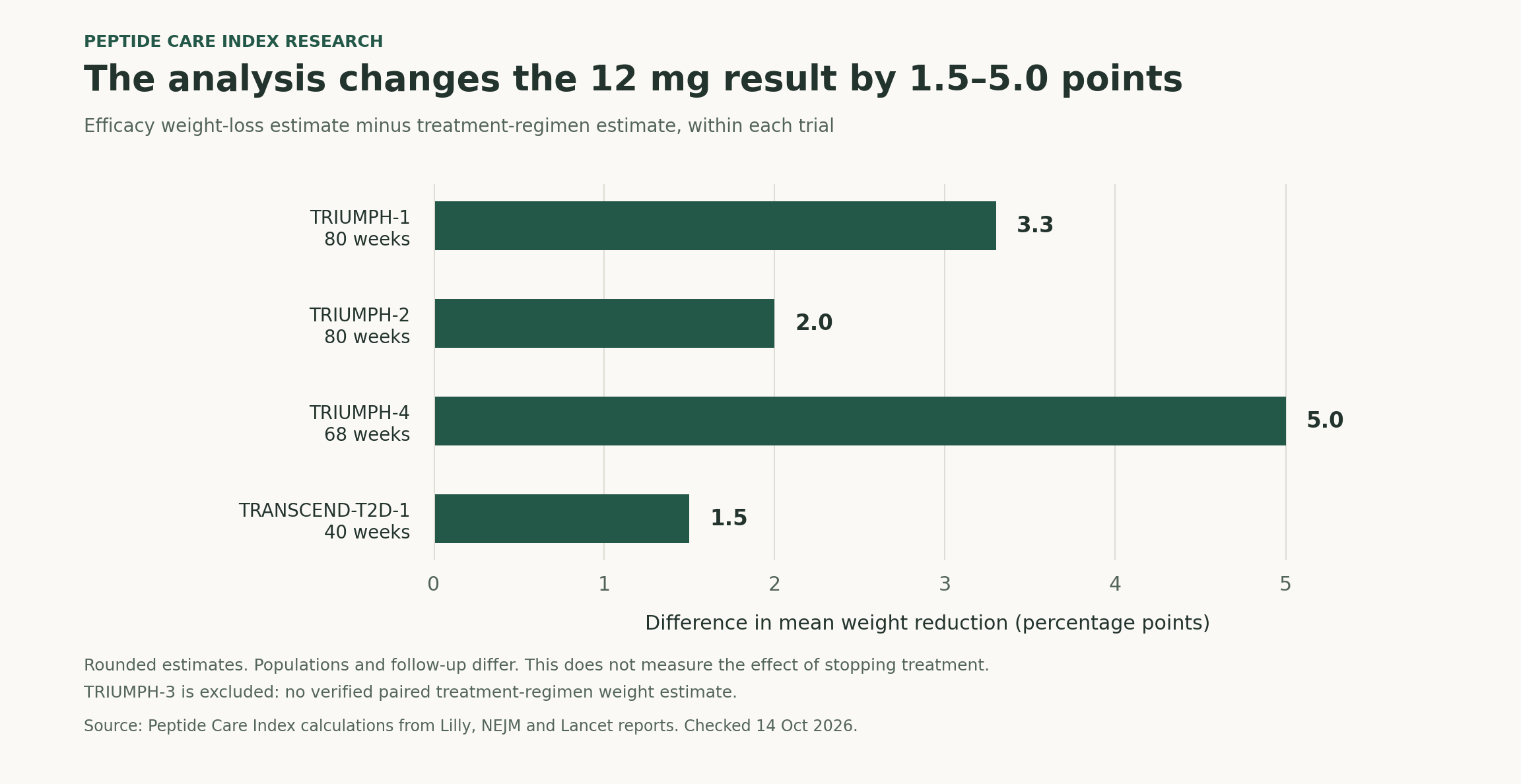
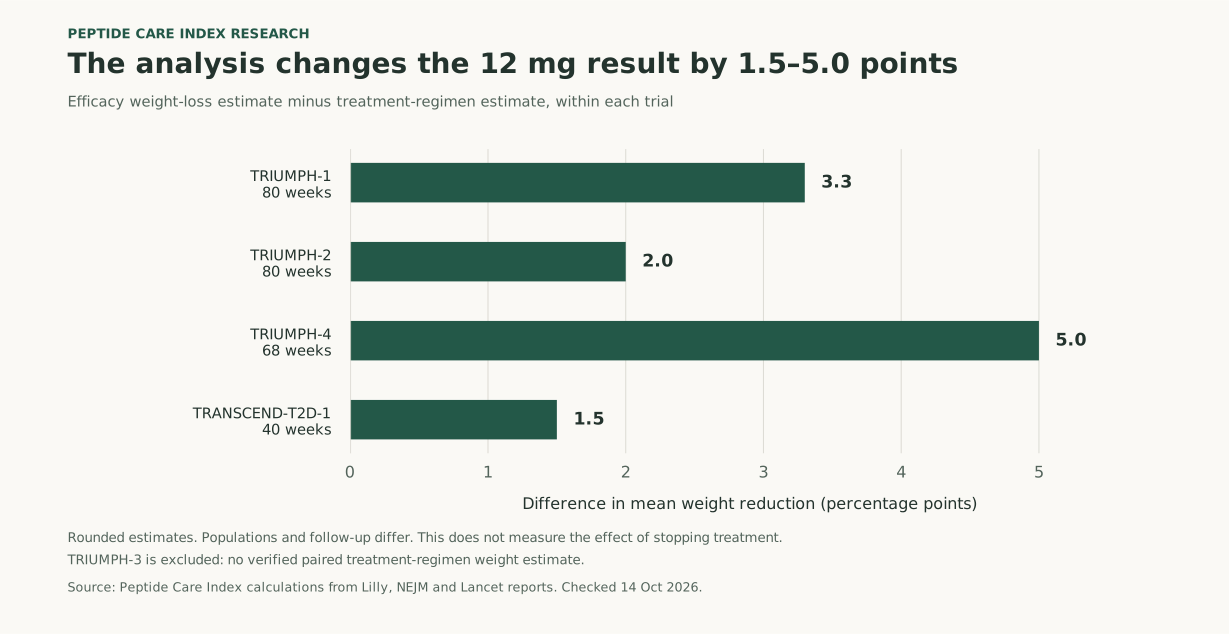
- The analysis method changes the number: Across four trials reporting both methods, the 12 mg efficacy estimate exceeds the treatment-regimen estimate by 1.5–5.0 percentage points, according to Peptide Care Index’s calculation from published rounded values. Calculation table
- TRIUMPH-2: In adults with obesity or overweight and type 2 diabetes, mean weight loss at 80 weeks was 18.8% with 12 mg versus 5.1% with placebo in the Lancet paper’s treatment-regimen analysis. Lancet, September 2026
- The 30.3% result is a selected extension: It comes from the original 12 mg group followed to 104 weeks on maximum tolerated retatrutide. The extension enrolled 532 selected participants across all original groups; it is not the whole TRIUMPH-1 population. Lilly, May 2026
What did each Phase 3 trial find?
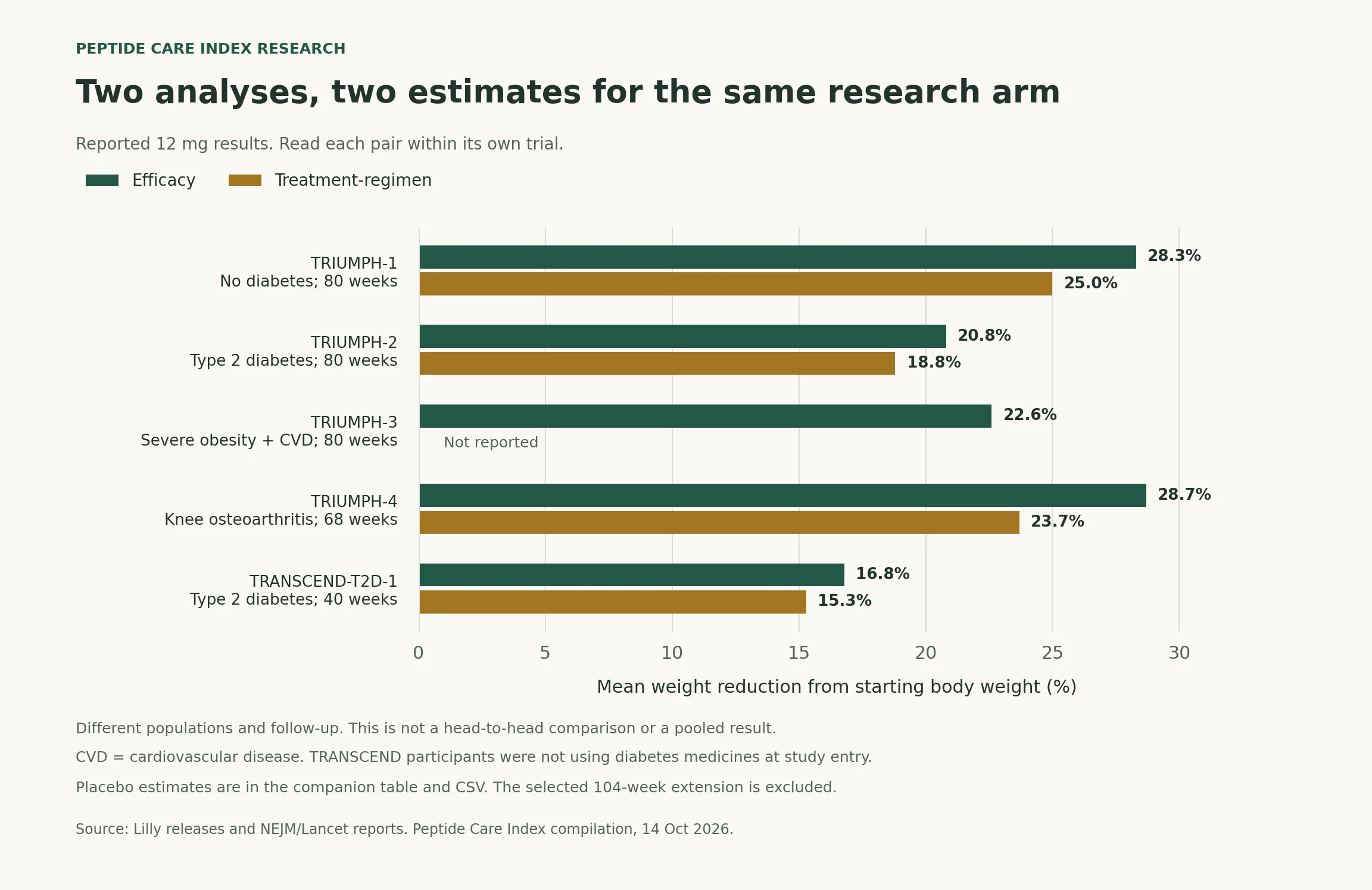
The five studies in this review randomized 6,422 adults. They tested different populations for 40, 68, or 80 weeks, so their results should be read within each trial. In the table, each pair means 12 mg / placebo, and all percentages are mean reductions from starting body weight.
| Trial | Randomized adults | Weeks | Efficacy: 12 mg / placebo | Treatment-regimen: 12 mg / placebo | Evidence |
|---|---|---|---|---|---|
| TRIUMPH-1 | 2,339 | 80 | 28.3% / 2.2% | 25.0% / 3.9% | Efficacy; regimen |
| TRIUMPH-2 | 1,152 | 80 | 20.8% / 4.0% | 18.8% / 5.1% | Efficacy; regimen |
| TRIUMPH-3 | 1,949 | 80 | 22.6% / 3.2% | Not reported | Sponsor |
| TRIUMPH-4 | 445 | 68 | 28.7% / 2.1% | 23.7% / 4.6% | Efficacy; regimen |
| TRANSCEND-T2D-1 | 537 | 40 | 16.8% / 2.5% | 15.3% / 2.6% | Efficacy; regimen |
Source: Original reports linked in each row; checked October 14, 2026. The participant total is our sum of the five reported randomized samples. “Not reported” means we did not find that estimate in the retrieved primary sources; it does not mean zero.
The study groups were:
- TRIUMPH-1: Adults with obesity or overweight and a weight-related condition, without diabetes.
- TRIUMPH-2: Adults with obesity or overweight and type 2 diabetes.
- TRIUMPH-3: Adults with a body mass index (BMI) of at least 35 and established cardiovascular disease, with or without type 2 diabetes. BMI relates weight to height.
- TRIUMPH-4: Adults with obesity or overweight and knee osteoarthritis, without diabetes.
- TRANSCEND-T2D-1: Adults with type 2 diabetes inadequately controlled by diet and exercise alone.
These populations come from the corresponding reports above. The trial doses identify research groups; they are not instructions for use.
Why do the results say both 28.3% and 25.0%?
Both figures describe TRIUMPH-1’s 12 mg arm at 80 weeks. The efficacy analysis estimates what would happen if participants continued the study treatment without prohibited weight-management treatments. The treatment-regimen analysis estimates the effect regardless of stopping treatment or starting those treatments. These are different statistical questions, called estimands. Lilly’s definitions · NEJM paper
Neither is a simple average of only the people who finished. Both use statistical methods to handle events during follow-up and missing measurements. The treatment-regimen result also remains a clinical-trial estimate; it is not a measured prediction for every patient outside the trial.
Peptide Care Index calculated the difference between the two published 12 mg weight-loss estimates in each paired study. The gap ranges from 1.5 to 5.0 percentage points. A percentage-point gap is subtraction: 28.3 − 25.0 = 3.3 points.
| Trial | Weeks | Efficacy loss | Regimen loss | Gap, percentage points |
|---|---|---|---|---|
| TRIUMPH-1 | 80 | 28.3% | 25.0% | 3.3 |
| TRIUMPH-2 | 80 | 20.8% | 18.8% | 2.0 |
| TRIUMPH-4 | 68 | 28.7% | 23.7% | 5.0 |
| TRANSCEND-T2D-1 | 40 | 16.8% | 15.3% | 1.5 |
Source: Peptide Care Index calculations from the main-trial values in the results table. Checked October 14, 2026. Values are rounded source estimates; gaps inherit that rounding. TRIUMPH-3 is excluded because its treatment-regimen weight estimate was not found.
What changes when placebo is subtracted?
In TRIUMPH-1, subtracting the rounded placebo figures gives 26.1 points in the efficacy analysis and 21.1 points in the treatment-regimen analysis. The gap between those calculations is 5.0 points. Across the four paired trials, that gap ranges from 1.6 to 7.5 points.
| Trial | Efficacy minus placebo | Regimen minus placebo | Gap between calculations |
|---|---|---|---|
| TRIUMPH-1 | 26.1 | 21.1 | 5.0 |
| TRIUMPH-2 | 16.8 | 13.7 | 3.1 |
| TRIUMPH-4 | 26.6 | 19.1 | 7.5 |
| TRANSCEND-T2D-1 | 14.3 | 12.7 | 1.6 |
Source: Peptide Care Index arithmetic from the results table. Formula: (efficacy active − efficacy placebo) − (regimen active − regimen placebo). These are approximate descriptive calculations, not the trials’ modeled between-group contrasts.
Rounding matters. NEJM reports a 21.0-point modeled TRIUMPH-1 contrast, while subtracting its rounded arm values gives 21.1. The Lancet TRIUMPH-2 paper reports 13.8 points, while subtraction gives 13.7. Use the paper’s modeled contrast when reporting its treatment effect. NEJM · Lancet
The gaps do not show how much weight loss was “caused by” stopping treatment. They combine different analysis assumptions and handling of events during the trial.
What happened in the lower-dose research groups?
The five main trials provide 18 research-arm records, including placebo. Three studies tested 4 mg, 9 mg, and 12 mg; TRIUMPH-3 and TRIUMPH-4 tested 9 mg and 12 mg. The table retains each analysis rather than choosing only the largest figure.
| Trial | Weeks | Research arm | Efficacy loss | Regimen loss |
|---|---|---|---|---|
| TRIUMPH-1 | 80 | 4 mg | 19.0% | 17.6% |
| TRIUMPH-1 | 80 | 9 mg | 25.9% | 23.7% |
| TRIUMPH-1 | 80 | 12 mg | 28.3% | 25.0% |
| TRIUMPH-1 | 80 | Placebo | 2.2% | 3.9% |
| TRIUMPH-2 | 80 | 4 mg | 12.7% | 11.9% |
| TRIUMPH-2 | 80 | 9 mg | 19.1% | 16.8% |
| TRIUMPH-2 | 80 | 12 mg | 20.8% | 18.8% |
| TRIUMPH-2 | 80 | Placebo | 4.0% | 5.1% |
| TRIUMPH-3 | 80 | 9 mg | 21.6% | Not reported |
| TRIUMPH-3 | 80 | 12 mg | 22.6% | Not reported |
| TRIUMPH-3 | 80 | Placebo | 3.2% | Not reported |
| TRIUMPH-4 | 68 | 9 mg | 26.4% | 20.0% |
| TRIUMPH-4 | 68 | 12 mg | 28.7% | 23.7% |
| TRIUMPH-4 | 68 | Placebo | 2.1% | 4.6% |
| TRANSCEND-T2D-1 | 40 | 4 mg | 11.5% | 11.5% |
| TRANSCEND-T2D-1 | 40 | 9 mg | 15.5% | 13.9% |
| TRANSCEND-T2D-1 | 40 | 12 mg | 16.8% | 15.3% |
| TRANSCEND-T2D-1 | 40 | Placebo | 2.5% | 2.6% |
Sources: TRIUMPH-1 efficacy / regimen; TRIUMPH-2 efficacy / regimen; TRIUMPH-3 sponsor; TRIUMPH-4 sponsor; TRANSCEND-T2D-1 sponsor. Checked October 14, 2026.
Did retatrutide improve blood sugar and knee pain?
The diabetes studies also reported lower HbA1c, a measure of longer-term blood sugar. The 12 mg change was −1.5 percentage points at 80 weeks in TRIUMPH-2's efficacy analysis and −1.94 points at 40 weeks in TRANSCEND's treatment-regimen analysis. TRIUMPH-4 reported a 3.7-point reduction in knee-pain score under its pain-specific regimen analysis.
| Trial | Outcome and analysis | 12 mg | Placebo | Source |
|---|---|---|---|---|
| TRIUMPH-2; 80 weeks | HbA1c; efficacy | −1.5 percentage points | −0.2 percentage points | Lilly detailed report |
| TRANSCEND-T2D-1; 40 weeks | Primary HbA1c; treatment-regimen | −1.94 percentage points | −0.81 percentage points | Lancet original paper |
| TRIUMPH-4; 68 weeks | Co-primary WOMAC pain; pain-specific treatment-regimen | −3.7 points | −2.1 points | Lilly original report |
Source: Reports linked in each row; checked October 14, 2026. HbA1c changes are percentage points, not relative percentage reductions. WOMAC pain uses a 0–10 scale, with lower scores meaning less pain. A score changing from 6 to 4 falls by 2 points.
The pain analysis assumes no benefit after significant actions associated with insufficient efficacy; it is not identical to the weight analysis. These are selected outcomes, not every endpoint in each trial. Their populations and analysis methods differ, so the table does not rank treatment effects. The outcomes CSV retains the exact definitions, sources and randomized-arm sample sizes.
Where does the 30.3% weight-loss figure come from?
The 30.3% figure comes from TRIUMPH-1’s selected 104-week extension, using the efficacy analysis for participants originally assigned 12 mg and then treated at a maximum tolerated dose. Its treatment-regimen figure was 29.9%. The extension is separate from the 80-week randomized main-trial result. Lilly
| Original assignment | Treatment during extension | Efficacy loss at 104 weeks | Regimen loss at 104 weeks |
|---|---|---|---|
| 4 mg | Maximum tolerated retatrutide 9 or 12 mg | 27.9% | 25.7% |
| 9 mg | Maximum tolerated retatrutide 9 or 12 mg | 29.5% | 28.7% |
| 12 mg | Maximum tolerated retatrutide 9 or 12 mg | 30.3% | 29.9% |
| Placebo | Maximum tolerated retatrutide 9 or 12 mg | 19.2% | 18.9% |
Source: Lilly, May 21, 2026; checked October 14, 2026.
The extension included 532 selected people with BMI at least 35 at original baseline, who completed week 80 on study drug without discontinuation or permanent dose reduction and had BMI above 22 at week 80. All extension groups received retatrutide, including the group originally assigned placebo. There was no continuing placebo group.
It would be wrong to subtract 28.3% from 30.3% and call the result the extra loss for the whole trial population. The people and treatment conditions differ.
What side effects and treatment discontinuations were reported?
In TRIUMPH-1’s 12 mg safety group, 42.4% reported nausea, compared with 14.8% on placebo, and serious adverse events were reported in 10.5% versus 5.5%. These are reported events during follow-up, not a finding that the drug caused every event. NEJM, Table 3
| Trial and follow-up | Nausea: 12 mg / placebo | Diarrhea: 12 mg / placebo | Dysesthesia: 12 mg / placebo | Source |
|---|---|---|---|---|
| TRIUMPH-1; 80 weeks | 42.4% / 14.8% | 32.0% / 13.5% | 12.5% / 0.9% | Paper |
| TRIUMPH-2; 80 weeks | 28.0% / 8.0% | 33.6% / 13.2% | 7.3% / 0.7% | Sponsor release |
| TRIUMPH-3; 80 weeks | 22.4% / 5.8% | 24.4% / 8.7% | 6.4% / 1.3% | Sponsor release |
| TRIUMPH-4; 68 weeks | 43.2% / 10.7% | 33.1% / 13.4% | 20.9% / 0.7% | Sponsor release |
| TRANSCEND-T2D-1; 40 weeks | 26.5% / 3.7% | 22.8% / 4.5% | 4.4% / 0.0% | Sponsor release |
Source: Reports linked in each row; checked October 14, 2026. Dysesthesia means altered or unpleasant skin sensation. Trial durations and populations differ; percentages are not annualized or pooled. Safety denominators are recorded in the download when available and remain unknown when the retrieved release does not state them.
| Trial | Endpoint as reported | 12 mg | Placebo | Source |
|---|---|---|---|---|
| TRIUMPH-1 | Drug discontinuation due to adverse events, excluding deaths | 11.2% | 4.6% | Original report |
| TRIUMPH-2 | Permanent treatment discontinuation due to adverse events or death | 22 participants | 14 participants | Original report |
| TRIUMPH-3 | Sponsor-reported discontinuation due to adverse events | 13.5% | 4.8% | Original report |
| TRIUMPH-4 | Sponsor-reported discontinuation due to adverse events | 18.2% | 4.0% | Original report |
| TRANSCEND-T2D-1 | Sponsor-reported discontinuation due to adverse events | 5.1% | 0.0% | Original report |
Source: Original reports linked in each row. TRIUMPH-1 percentages are reproduced from the paper as printed. Its denominator footnote does not fully reconcile with its printed percentages, so we do not assert a denominator for that discontinuation measure or reconstruct its rate. TRIUMPH-2 uses counts because the abstract explicitly includes adverse events or death. These endpoints should not be ranked as if they were identical.
The older TRIUMPH-1 sponsor release gives a different discontinuation percentage from the paper’s measure, which excludes deaths. TRIUMPH-4’s sponsor measure includes stopping for perceived excessive weight loss. A short headline such as “dropout rate” loses those distinctions.
The download also contains the verified vomiting figures and the source-specific safety sample sizes. This is selected safety reporting, not a full safety assessment.
Which results have been published in a journal?
We verified three full results-paper publications for these five main studies: TRIUMPH-1, TRIUMPH-2, and TRANSCEND-T2D-1. TRIUMPH-3 is represented here by Lilly’s topline report. TRIUMPH-4 has a publicly available conference abstract, with its presentation still upcoming at this check date.
| Trial | First sponsor result | Results-paper publication verified | What was inspected |
|---|---|---|---|
| TRIUMPH-1 | May 21, 2026 | NEJM, September 29, 2026 | Publisher abstract; original paper including safety table |
| TRIUMPH-2 | July 23, 2026 | Lancet, September 29, 2026 | Original research abstract; sponsor detailed report |
| TRIUMPH-3 | July 23, 2026 | No full results paper located in this check | Sponsor topline |
| TRIUMPH-4 | December 11, 2025 | No full results paper located in this check | Sponsor report; ACR abstract 0871, scheduled for November 8, 2026 |
| TRANSCEND-T2D-1 | March 19, 2026 | Lancet, June 6, 2026 | Sponsor report; original results paper |
Source: Original reports and publisher records linked above. “Paper published” and “full paper read in this review” are separate facts. A study-design paper does not substitute for a results paper.
Two details help prevent miscitation. TRIUMPH-2 randomized 1,152 people; 2,047 were screened. TRIUMPH-4’s correct trial identifier is NCT05931367; a legacy syndicated sponsor release displays a different identifier. TRIUMPH-2 abstract · TRIUMPH-4 trial record
Is retatrutide approved, and what is the next Phase 3 result?
Retatrutide is still investigational at the October 14, 2026 check. FDA states that it is not a component of an approved drug and cannot be used in compounding under federal law. Positive Phase 3 results do not themselves grant approval. FDA’s current statement
Lilly’s July report sets out a plan to submit a U.S. application in the first quarter of 2027. That is a company submission plan, not an FDA approval date. Lilly’s timeline
The sponsor’s TRIUMPH-5 trial page describes a direct comparison with tirzepatide and lists trial dates ending in December 2026. We found no numerical TRIUMPH-5 result in this check. A scheduled study end is not a promised announcement date.
Do these results prove retatrutide beats tirzepatide or prevents heart attacks?
The five studies above compare retatrutide with placebo, not tirzepatide. Their results cannot establish which drug wins in a direct comparison. TRIUMPH-5 is designed to answer a head-to-head question.
TRIUMPH-3 also does not establish a cardiovascular-event benefit. Its reported in-study hazard ratio was 0.82, with a 95% confidence interval of 0.55–1.22, for its broader five-component event measure. For cardiovascular death, heart attack, or stroke, it was 1.12 (0.64–1.96). Both intervals include 1, so neither establishes a difference. Risk-factor improvements should not be presented as proof of fewer heart attacks or strokes. Lilly’s cardiovascular analysis
For the broader evidence across molecules, see our peptide comparison chart. If you are checking an advertised clinic offer, Find My Peptide Path provides general questions to ask before paying. Its current peptide summaries cover BPC-157, TB-500, and sermorelin; it does not offer retatrutide access or trial enrollment.
How did we build this results ledger?
We extracted 18 main-trial arm records and four selected-extension records from primary reports, plus three selected blood-sugar and knee-pain outcome records. We searched Lilly’s trial and investor records, original journal records, and PubMed for Phase 3 numerical results available by October 14, 2026. We counted the five main studies once each and did not add extension participants or nested subgroups to the total.
The main results CSV preserves the source’s negative percentage change. The weight-loss tables display its positive magnitude. The other-outcomes CSV keeps the stated HbA1c and pain units. Missing figures and denominators stay blank in the CSV, with their status explained; blank does not mean zero.
Our participant calculation is 2,339 + 1,152 + 1,949 + 445 + 537 = 6,422. Our paired-analysis calculation uses the four studies reporting both estimands, subtracts their rounded weight-loss estimates, and keeps placebo subtraction separate. We did not combine patient-level data, run a meta-analysis, estimate treatment for an individual, or infer a cause for the gaps.
We read the NEJM publisher abstract directly and checked its original paper’s safety table through a public PDF copy when the publisher’s full-text fetch failed. We checked TRIUMPH-2 against its complete original abstract, not its full paper. The TRANSCEND paper was also checked through an original-paper PDF copy. Source-copy details are listed in the data dictionary.
AI tools assisted with retrieval, extraction, calculations, drafting, and editing. No clinician, pharmacist, or regulatory specialist has reviewed this release. The organizational byline identifies the publication; our publisher profile explains its responsibility and limits.
What can this data show?
It shows what the named reports say about the studied groups at their stated time points, and how two published analysis methods change the quoted number. It does not predict anyone’s result, establish the safety of products sold online, or provide a dosing plan. Missing full publications and missing TRIUMPH-3 regimen results remain visible.
For wider drug and market context, see peptide statistics. Medical treatment decisions belong with a qualified clinician.
How can you cite this page and use the data?
Publication: Peptide Care Index. Release: Retatrutide phase 3 results: 5 trials, 6,422 adults. Version: 1.0. Checked and prepared: October 14, 2026. Permanent URL: https://peptidecareindex.com/research/retatrutide-phase-3-results/
Ready-to-copy reference:
Peptide Care Index. (2026, October 14). Retatrutide phase 3 results: 5 trials, 6,422 adults (Version 1.0). https://peptidecareindex.com/research/retatrutide-phase-3-results/
For a clinical trial’s original estimate, cite the trial report too. For the compilation or calculations, cite this dated version so readers know which evidence was available.
Reuse of Peptide Care Index’s original charts and calculations is permitted with credit to Peptide Care Index. Underlying reports retain their own rights and terms; this permission does not license their text, tables, or figures.
Where can you download the results and calculations?
All downloads are free and require no account or email:
- Results CSV: 22 main-trial and extension arm records
- Analysis CSV: four paired trials and every calculation
- Safety CSV: selected events and exact discontinuation labels
- Other outcomes CSV: blood sugar and knee pain
- Data dictionary
- Analysis-gap chart, PNG · SVG
- 12 mg results chart, PNG · SVG
What do the most quoted percentages mean?
Is the 24.2% result from Phase 3?
No. The 24.2% at 48 weeks figure belongs to the earlier Phase 2 obesity trial’s 12 mg group. Keep it separate from the Phase 3 results and their different follow-up periods. Original Phase 2 paper
Does “28.3% weight loss” mean 28.3% of people lost weight?
No. It describes the estimated average percentage change in starting body weight in a particular study arm and analysis. A separate responder percentage answers how many participants reached a given weight-loss threshold.
Is the treatment-regimen result a guaranteed real-world result?
No. It estimates outcomes under the trial’s treatment-regimen question, including discontinuation and certain other events. Trial selection, follow-up, missing-data methods, and care still shape the estimate.
Does the 104-week extension mean everyone lost 30%?
No. The 30.3% estimate applies to one original-assignment group in a selected extension. It is a mean, and all extension groups received retatrutide rather than maintaining the original placebo comparison.
What sources support these results?
All sources below were checked October 14, 2026. Dates shown are the source’s publication date where verified, not a replacement for the study time point.
Lilly TRIUMPH-1 announcement. Published 2026-05-21. Checked 2026-10-14.
Jastreboff et al., NEJM, TRIUMPH-1. Published 2026-09-29. Checked 2026-10-14.
Lilly TRIUMPH-2 and TRIUMPH-3 announcement. Published 2026-07-23. Checked 2026-10-14.
Bellido et al., Lancet, TRIUMPH-2, original abstract. Published 2026-09-29. Checked 2026-10-14.
Lilly TRIUMPH-4 announcement, syndicated original. Published 2025-12-11. Checked 2026-10-14.
Lilly TRANSCEND-T2D-1 announcement. Published 2026-03-19. Checked 2026-10-14.
Bajaj et al., Lancet, TRANSCEND-T2D-1. Published 2026-06-06. Checked 2026-10-14.
FDA concerns with unapproved GLP-1 drugs. Current FDA statement checked 2026-10-14; no first-publication date asserted.
Lilly Trials TRIUMPH-4 identity. Date not used as a results-publication date. Checked 2026-10-14.
Lilly Trials TRIUMPH-5. Date not used as a results-publication date. Checked 2026-10-14.
Conaghan et al., ACR abstract 0871, TRIUMPH-4. Date not used as a results-publication date. Checked 2026-10-14.
Lilly detailed TRIUMPH-2 announcement. Published 2026-09-29. Checked 2026-10-14.
Jastreboff et al., NEJM Phase 2 obesity trial. Published 2023; checked October 14, 2026. Used only to distinguish the 24.2% Phase 2 result.
What changed: Version 1.0, October 14, 2026: first compilation, including September journal publications and four within-trial analysis comparisons.
Peptide Care Index Research is the research and reference section of peptidecareindex.com.