Peptide side effects chart: 14 peptides, known risks and unknowns
By Peptide Care Index · Updated October 2026
Peptide side effects depend on the exact drug and form. This peptide side effects chart covers 14 peptide identities and separates measured trial rates from reported concerns and unknown frequencies. Peptide Care Index’s October 2026 source review shows why an approved medicine’s safety numbers cannot be copied onto a research vial, oral product or blend.
What are the key peptide side-effect findings?
- 14 selected peptide identities: Peptide Care Index matched five approved-product identities and nine research or compounding identities to their exact safety sources. This chart is a selected reference, not a count of every peptide.
- 44% versus 16%: Nausea occurred in these shares of adults assigned to Wegovy 2.4 mg injection and placebo in three pooled weight-reduction trials, respectively. The June 2026 label gives 2,116 and 1,261 participants. Wegovy, Section 6.1, Table 3.
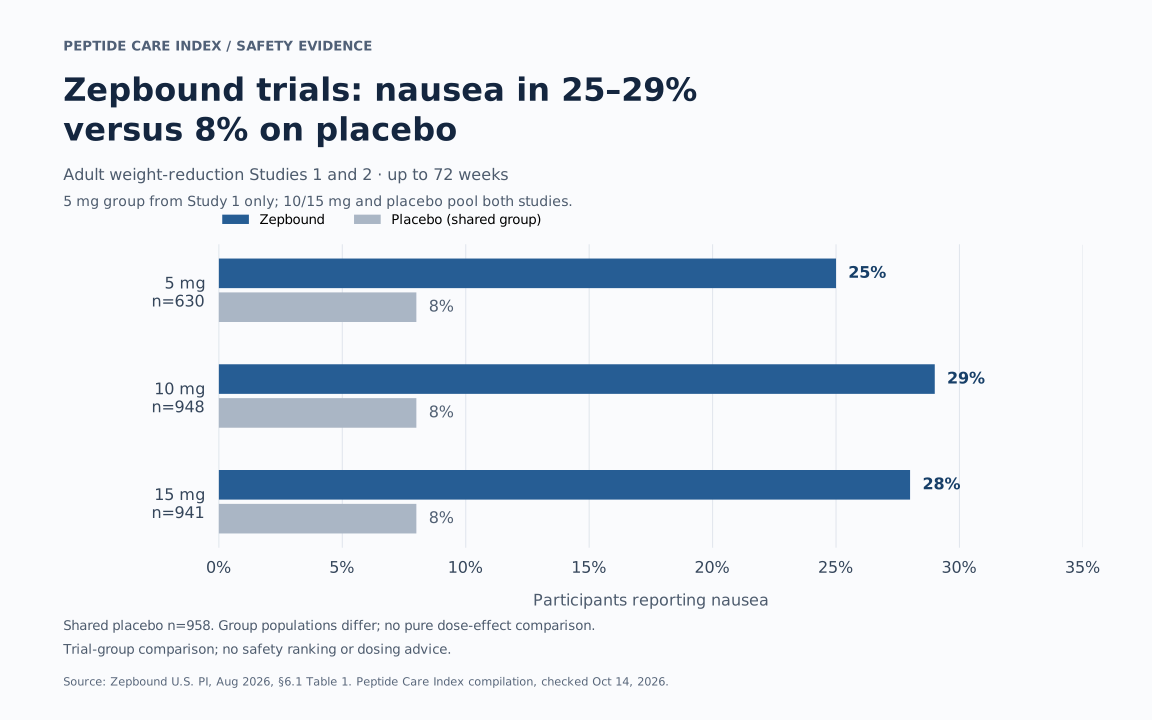
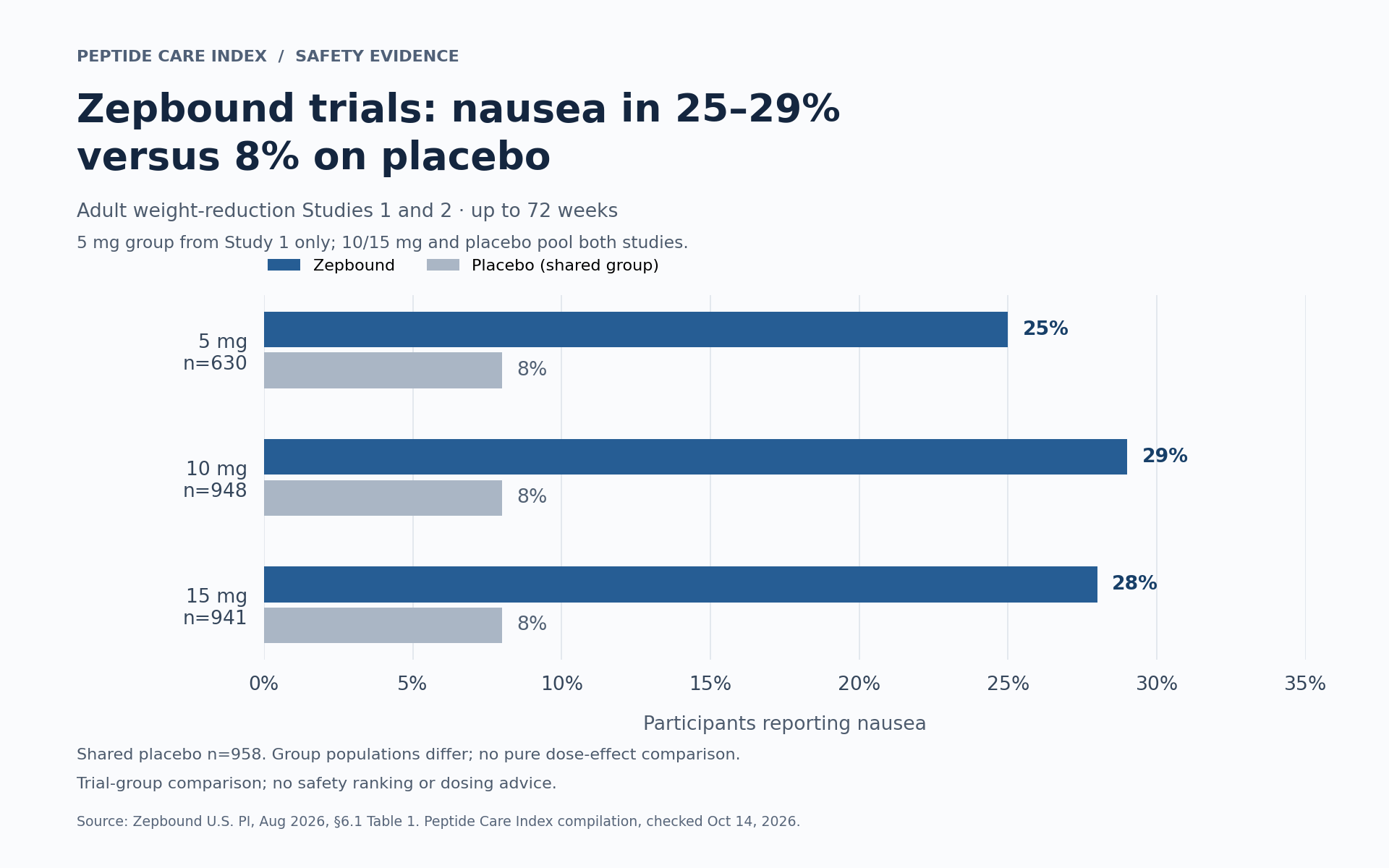
- 25%, 29% and 28% versus 8%: These are nausea frequencies in Zepbound’s 5 mg, 10 mg and 15 mg groups versus the shared placebo group in two pooled adult weight-reduction studies. Zepbound, August 2026 label, Section 6.1, Table 1.
- No administered-human data identified in three specific reviews: FDA’s July 2026 briefings reported no clinical or human exposure data for KPV, MOTS-c and N-acetylated TB-500. That is a dated finding about those exact substances.
What does the peptide side effects chart show?
The chart separates documented reactions from safety concerns and missing evidence. The approved-product rows have label trial data. For the research materials below, the checked sources do not establish a general side-effect frequency for marketed use.
A measured reaction is an event recorded in a defined study. A safety concern may come from a regulator’s assessment or a case report. Not established means the evidence cannot support a reliable frequency; it never means 0% or “rare.”
Approved-product evidence
Find an entry in the chart
Showing 14 of 14 identities.
| Peptide and exact evidence | Reported effects and separate concerns | What can be said about frequency? | Source |
|---|---|---|---|
| Semaglutide — Wegovy 2.4 mg injection | Observed: Nausea, diarrhea, vomiting, constipation, abdominal pain. Concerns: Pancreatitis, gallbladder disease, severe digestive reactions, dehydration-related kidney injury; boxed thyroid warning with uncertain human relevance. | Label trial rates available. Numbers here apply to adult 2.4 mg injection trials, not oral Wegovy, Wegovy 7.2 mg, Ozempic, compounded products or research vials. | S01 |
| Tirzepatide — Zepbound 5/10/15 mg injection trial groups | Observed: Nausea, diarrhea, vomiting, constipation, injection-site reactions. Concerns: Pancreatitis, gallbladder disease, severe digestive reactions, dehydration-related kidney injury; boxed thyroid warning with uncertain human relevance. | Label trial rates available. Pooled weight-reduction Studies 1 and 2; no transfer to Mounjaro, sleep-apnea trials, compounded products or blends. | S02 |
| Liraglutide — Saxenda 3 mg injection | Observed: Nausea, diarrhea, constipation, vomiting, injection-site reactions. Concerns: Pancreatitis, gallbladder disease, increased heart rate, severe digestive reactions; boxed thyroid warning with uncertain human relevance. | Label trial rates available. Adult Saxenda trials; no transfer to Victoza, children or compounded products. | S03 |
| Tesamorelin — Original Egrifta trial formulation supporting current Egrifta WR label | Observed: Joint pain, injection-site reactions, muscle pain, swelling. Concerns: Raised IGF-1, glucose intolerance/diabetes, fluid retention, allergy; contraindicated with active cancer. | Label trial rates available. Rates were measured with original Egrifta, not in a trial of current WR formulation; adults with HIV-related lipodystrophy, not general weight loss. | S04 |
| Bremelanotide / PT-141 — Vyleesi 1.75 mg injection | Observed: Nausea, flushing, injection-site reactions, headache. Concerns: Temporary blood-pressure increase and heart-rate decrease; persistent pigmentation possible; contraindicated with uncontrolled hypertension or known cardiovascular disease. | Label trial rates available. Premenopausal women with acquired generalized hypoactive sexual desire disorder; not men, intranasal products or internet PT-141 vials. | S05 |
Source: the exact U.S. prescribing-information sets linked in each row, checked October 14, 2026. These are selected reactions and warnings; the full labels contain additional information.
Research and compounding materials
| Peptide and exact evidence | Reported effects and separate concerns | What can be said about frequency? | Source |
|---|---|---|---|
| BPC-157 — Materials studied by rectal, joint, bladder and intravenous routes | Observed: Headache and gas reported in rectal studies without an obvious placebo difference; small IV pilot reported no side effects. Concerns: FDA identifies product-characterization and possible immune-reaction concerns. | General frequency not established. Small, short human reports do not establish long-term or route-specific population incidence. | S06, S17 |
| TB-500 — N-acetylated LKKTETQ fragment; free base/acetate | Observed: No administered-human clinical/exposure data identified by FDA in its July 2026 review. Concerns: Possible immune reactions from clumps and peptide impurities. | General frequency not established. Exact fragment is distinct from full-length thymosin beta-4 and non-acetylated LKKTETQ. | S07 |
| CJC-1295 — CJC-1295 with DAC in early trials; salt unspecified | Observed: Injection reactions, headache, diarrhea, flushing/warmth, transient low blood pressure and increased heart rate. Concerns: FDA raises immune-reaction and product-quality concerns. | General frequency not established. Small short studies cannot establish rates for no-DAC material, long-term use or CJC/ipamorelin blends. | S08 |
| Ipamorelin — IV postoperative trial material; acetate proposed for subcutaneous use | Observed: Nausea, vomiting, abdominal distention, low potassium and elevated glucose observed after bowel surgery. Concerns: Serious events and two deaths occurred in IV trial; drug relationship unclear; insufficient safety information for other injectable routes. | General frequency not established. Postoperative IV data cannot supply incidence for elective subcutaneous use. | S09 |
| AOD-9604 — Oral/IV study formulations; identity not consistently specified | Observed: Headache and digestive symptoms; IV chest tightness and euphoria considered possibly related. Concerns: FDA raises immune-reaction, impurity and limited safety-characterization concerns. | General frequency not established. FDA 2024 review found no human subcutaneous or transdermal data; serious-event relatedness uncertain. | S10 |
| MOTS-c — Administered MOTS-c; not endogenous measurement or analogue | Observed: No administered-human clinical/exposure data identified by FDA in its July 2026 review. Concerns: Possible immune reactions, aggregation and peptide-impurity concerns. | General frequency not established. Biomarker, cell and analogue studies do not establish safety of administered MOTS-c. | S11 |
| KPV — KPV free base/acetate | Observed: No administered-human clinical/exposure data identified by FDA in its July 2026 review. Concerns: Human effects unknown; immune-response and aggregation safety uncharacterized. | General frequency not established. Human-derived cell or cadaver-skin experiments are not treated-human safety studies. | S12 |
| GHK-Cu — Injectable GHK-Cu | Observed: FDA describes limited human safety information. Concerns: Possible immune reactions involving clumps and peptide impurities. | General frequency not established. Topical cosmetic observations cannot establish injection safety. | S13 |
| Melanotan II — Melanotan II studied by subcutaneous route | Observed: Tiny pilot reported nausea, sleepiness/fatigue, yawning/stretching and spontaneous erections. Concerns: FDA lists case reports of prolonged erection, serious neurologic and stimulant-like illness, and melanoma; causation not established by case reports. | General frequency not established. Three-man pilot and case reports cannot establish incidence; different from bremelanotide and afamelanotide. | S13, S14 |
Source: compound-specific FDA assessments and original reports linked in each row, checked October 14, 2026. The source’s route and material define what its evidence covers. These concerns are not a safety ranking.
For the different question of what these substances have been studied for, see our peptide comparison chart.
How often did selected side effects occur in approved-product trials?
The table below contains seven exact trial groups from five label sets. Each percentage stays beside its own placebo comparison and participant count. Differences are calculated within each row; they cannot establish which peptide is safest across different studies.
Selected label reactions and their placebo comparisons
| Exact trial group | Selected reaction | Drug | Placebo | Difference in percentage points | Participants: drug / placebo | Source |
|---|---|---|---|---|---|---|
| Wegovy 2.4 mg injection | Nausea | 44% | 16% | 28 | 2,116 / 1,261 | S01 |
| Zepbound 5 mg injection | Nausea | 25% | 8% | 17 | 630 / 958 | S02 |
| Zepbound 10 mg injection | Nausea | 29% | 8% | 21 | 948 / 958 | S02 |
| Zepbound 15 mg injection | Nausea | 28% | 8% | 20 | 941 / 958 | S02 |
| Saxenda 3 mg injection | Nausea | 39.3% | 13.8% | 25.5 | 3,384 / 1,941 | S03 |
| Original Egrifta trial formulation supporting Egrifta WR | Joint pain (arthralgia) | 13% | 11% | 2 | 543 / 263 | S04 |
| Vyleesi 1.75 mg injection | Nausea | 40.0% | 1.3% | 38.7 | 627 / 620 | S05 |
Source: Sections 6.1 and the specified tables in the linked labels, checked October 14, 2026. The difference is Peptide Care Index’s subtraction of the published, rounded percentages. Zepbound’s placebo group is shared across its three rows. The 5 mg group comes from Study 1 only, which excluded type 2 diabetes. The 10 mg, 15 mg and placebo groups pool Studies 1 and 2, including participants with and without type 2 diabetes. The pooled label table does not isolate a pure dose effect.
The populations behind those percentages
| Evidence set | Who was studied and for how long? | Source edition |
|---|---|---|
| Wegovy 2.4 mg injection | Three pooled adult weight-reduction trials; obesity or overweight. Up to 68 weeks; seven-week off-drug follow-up. | Revised June 2026; Section 6.1, Table 3 |
| Zepbound 5 mg injection | Active 5 mg group from Study 1 only, without type 2 diabetes; placebo pools Studies 1 and 2. Up to 72 weeks; four-week off-drug follow-up. | Revised August 2026; Section 6.1, Table 1 |
| Saxenda 3 mg injection | Five pooled adult weight-management trials. Three trials up to 56 weeks; one 52 weeks; one 32 weeks; selected abnormal-glucose subset extended to 160 weeks. | Revised February 2026; Section 6.1, Table 2 |
| Original Egrifta trial formulation supporting Egrifta WR | Combined studies; adults with HIV-related lipodystrophy and excess abdominal fat. Initial 26-week placebo-controlled phase. | PI March 2025; DailyMed updated July 29, 2026; Section 6.1, Table 1 |
| Vyleesi 1.75 mg injection | Two trials in premenopausal women with acquired generalized HSDD. 24 weeks. | PI March 2024; DailyMed updated November 13, 2025; Section 6.1, Table 1 |
Source: clinical-trial descriptions in the same five label sets. Label revision dates describe the documents, not the year the trials took place. Trial strength names identify evidence; they are not dosing instructions.
Egrifta WR’s label draws its safety evidence from the original Egrifta formulation. The 543 participants in that row were studied with original Egrifta. They were not a new trial population taking the current WR formulation. Egrifta WR, Section 6.1.
What does the Zepbound nausea comparison show?
In the pooled adult weight-reduction studies, nausea was reported by 25–29% of participants in the three Zepbound groups and 8% on placebo. Those published percentages give differences of 17, 21 and 20 percentage points for the 5 mg, 10 mg and 15 mg groups. The 5 mg group is from Study 1 only; the other drug groups and placebo pool Studies 1 and 2. These descriptive label-table differences do not isolate a pure dose effect. Zepbound, Table 1.
What side effects are known for BPC-157?
BPC-157 has small human reports, but they do not establish a general side-effect rate. FDA’s July 2026 assessment records headache and gas in rectal studies and says the clinical safety evidence remains insufficient. The rectal-study abstracts reported no obvious difference from placebo in the frequency or severity of those events. Different routes and short follow-up limit what can be learned. FDA BPC-157 briefing, Human Safety.
A 2025 intravenous pilot reported no side effects in two participants who had already received BPC-157 before enrollment. Monitoring lasted three days around the study infusions. That result says what happened in those two people; it cannot establish the rate of harm in a larger group or with longer use. Lee and Burgess, original publisher abstract.
The reports on rectal, joint, bladder and intravenous administration should keep their own route labels. FDA’s review identified an oral-trial registration without posted results, which does not supply an oral safety rate. It does not supply a safety rate for a sublingual strip or a different injectable product. Our BPC-157 capsules and oral-evidence guide explains the route distinction. Our BPC-157 FDA-status guide explains the separate approval question.
Why are TB-500, MOTS-c and KPV frequencies unknown?
FDA’s July 2026 reviews identified no administered-human clinical or exposure data for these three exact substances. Without treated participants, defined follow-up and reliable event recording, those reviews cannot yield a side-effect percentage. Each gap has a different identity trap.
| Substance | Evidence that does not answer its safety question | Exact source |
|---|---|---|
| TB-500 | Trials of full-length thymosin beta-4, or non-acetylated LKKTETQ, do not establish the safety of N-acetylated LKKTETQ. | FDA TB-500 briefing |
| MOTS-c | Measuring a naturally occurring peptide in blood, testing cells, or giving a different analogue does not test administered MOTS-c itself. | FDA MOTS-c briefing |
| KPV | Human-derived cells and skin from deceased donors do not supply adverse-event data from treated living people. | FDA KPV briefing |
Source: the three FDA Human Safety reviews, July 2026; checked October 14, 2026. These are findings from the cited reviews, not claims that every later publication has been searched.
What about CJC-1295, ipamorelin and AOD-9604?
These substances have some human observations, but the form, route or population may differ from the product a reader is considering. CJC-1295 studies used the DAC form. Ipamorelin’s postoperative intravenous trial and AOD-9604’s oral or intravenous studies do not establish safety rates for elective subcutaneous injections. FDA CJC-1295, ipamorelin and AOD-9604 assessments.
In the ipamorelin surgical trial, serious events and deaths occurred. FDA says the drug relationship was unclear. Calling those events proven ipamorelin side effects would go beyond the assessment. Calling the trial proof of safety for another route would also go beyond it. FDA ipamorelin, Clinical Studies Assessing Safety.
Which serious risks belong beside the common reactions?
Common-reaction percentages do not cover every serious risk. Approved labels also describe warnings, contraindications and effects found after approval. The main chart lists selected cautions separately so a nausea percentage cannot stand in for the whole safety profile.
The thyroid boxed warnings for Wegovy, Zepbound and Saxenda concern tumors seen in rodents, with uncertain relevance to humans. Their labels contraindicate use with a personal or family history of medullary thyroid carcinoma or multiple endocrine neoplasia type 2. This is not a measured human thyroid-cancer rate. Wegovy, Zepbound and Saxenda, Sections 4 and 5.1.
Melanotan II has a small human pilot and serious case reports listed by FDA. Case reports can raise a warning, but they cannot tell readers how often a problem occurs or prove that the peptide caused melanoma. Melanotan II is a different substance from bremelanotide/PT-141. FDA safety-risk record; Dorr et al., 1996.
Severe abdominal pain that persists, repeated vomiting, or signs of a serious allergic reaction need prompt medical attention. Trouble breathing or swelling of the face, tongue or throat can be an emergency. An online chart cannot assess a person’s symptoms. Wegovy Medication Guide.
Can an approved drug’s numbers be used for a compounded peptide?
An approved product’s trial percentages do not establish the safety or quality of a compounded preparation or research vial. FDA does not review compounded drugs for safety, effectiveness and quality before they are marketed. FDA also describes dosing errors and other concerns with unapproved GLP-1 versions. FDA unapproved GLP-1 notice.
For example, FDA says semaglutide sodium and semaglutide acetate are different active ingredients from the one used in approved drugs. A seller’s use of the word “semaglutide” therefore does not make its material identical to the product behind a label table. FDA, Salt forms.
Some FDA peptide concerns involve aggregation, meaning molecules clumping together, and immunogenicity, meaning the product may trigger an immune response. These are concerns about the material and how the body responds to it. They should stay separate from a counted reaction in a clinical trial. FDA TB-500 safety assessment.
For the regulatory record, see our FDA peptide compounding reference. For the questions a reader can put to a clinician or pharmacy, see what to ask before booking.
How should a side-effect percentage be read?
A trial percentage describes participants with an event in that study. It is not the percentage of injections that caused a reaction, and it is not an individual forecast. Placebo participants can report the same symptom, which is why both columns matter.
For the Wegovy nausea row, 44% minus 16% is a 28-percentage-point difference. It does not mean 44% plus 16%, and the 28-point difference is not proof that every excess event in every person was caused by the drug. The source percentages are rounded. Wegovy, Table 3.
Do not add percentages across symptoms: one participant may have several reactions. Do not add the repeated Zepbound placebo counts. Do not infer an exact event count by multiplying a rounded percentage by its group size.
FDA’s spontaneous adverse-event reports have another limit: reports do not establish causation or incidence. They do not provide a reliable denominator of everyone exposed. This page therefore does not turn report totals into a “one in X” risk estimate. FDA adverse-event documentation.
How did we build this chart?
Peptide Care Index assembled 14 selected identities from five approved-product label sets and nine research or compounding safety records. We read the label reaction tables, the relevant FDA safety sections and the two original abstracts identified in the source list on October 14, 2026. We did not run a clinical study or test products.
We chose substances that serve the safety question across weight-management medicines, selected approved peptide treatments and the research compounds covered by peptide-access queries. The selection is not a census, a popularity ranking or a representative sample of the market.
For each identity, we kept the exact product or material, route, observed effects, separate concerns, evidence limits, source vintage and check date. The numerical file records seven selected drug groups with their event, placebo rate, group sizes, population and observation period. We calculated only the within-row difference in percentage points.
To reproduce the chart, open each row’s source and locator, match the material and population, and copy the specified reaction-table values. Subtract placebo from drug within the same row. Keep blank or unestablished frequencies as unknown; never substitute zero.
The original BPC-157 and Melanotan II abstracts were read as abstracts. The label tables and cited FDA safety sections were read directly. This is an editorial source compilation, not a clinical review or an exhaustive systematic review. Our methodology and editorial standards explain the publication’s wider checks.
What can this chart answer, and what remains unknown?
The chart can show which source supports a stated reaction and whether a frequency belongs to the product, route and population being discussed. It cannot identify the safest peptide, predict a person’s response, establish a blend’s safety or verify a seller’s product.
The absence of a frequency is a gap in evidence. Fewer listed effects can reflect less research. Long-term effects, uncommon harms and interactions may remain unresolved even when a short trial reports no serious reactions.
What changed: This first edition matches selected safety records and label trial groups to exact forms. Historical results retain their own study and source dates. We recheck live labels and FDA records monthly, and human-evidence gaps quarterly or after a material new source appears. A new source changes the chart only when it supports a specific correction or addition.
If you are sorting out a care-access question, Find My Peptide Path can help organize questions to bring to a clinician. It does not select a treatment.
How can this page be cited and downloaded?
Publication: Peptide Care Index. Title: “Peptide side effects chart: 14 peptides, known risks and unknowns.” Updated: October 2026. Source check: October 14, 2026.
Peptide Care Index. “Peptide side effects chart: 14 peptides, known risks and unknowns.” Updated October 2026. https://peptidecareindex.com/research/peptide-side-effects-chart/.
For a medicine’s measured rate, cite its primary label as well as this compilation when relevant. For the original matching of forms, routes, trial groups and limits, credit Peptide Care Index by name. The original text, table arrangement and chart may be reused with that credit; underlying source material keeps its own attribution and terms.
- Download the 14-identity chart CSV.
- Download the seven-cohort label-rate CSV.
- Download the source registry CSV.
- Download the Zepbound nausea chart as PNG or SVG.
What else do readers ask about peptide side effects?
Are peptide injections safe?
Safety depends on the exact product, evidence, route and person. An approved injection has a defined label and studied populations; the nine research or compounding identities in this chart do not have established general frequencies for marketed use in the sources checked here. The table cannot turn those gaps into a safe-or-unsafe score.
Which peptide has the fewest side effects?
This evidence cannot support that ranking. The products were studied in different populations, with different routes and follow-up. A substance with few recorded effects may simply have fewer human observations. Unknown frequency cannot be ranked below a measured rate.
Does “no side effects reported” mean 0% risk?
No. It describes a particular report’s observations. The BPC-157 intravenous pilot had only two previously exposed participants and short monitoring; it could not establish a reliable general risk estimate. Original publisher abstract.
Do peptide side effects go away?
Some effects can improve, but there is no single duration for all peptides. Vyleesi’s label warns that some pigmentation changes may persist. Whether a symptom needs treatment depends on the medicine and the person, so use the product’s label and ask the treating clinician. Vyleesi, Section 5.2.
Is topical GHK-Cu evidence enough to judge injections?
No. FDA’s concern is specifically injectable GHK-Cu, for which it describes limited human safety information and possible immune reactions involving aggregates and impurities. Topical cosmetic evidence does not supply an injection-side-effect rate. FDA GHK-Cu injectable record.
Which primary sources were checked?
The check date for each entry is October 14, 2026. Label dates are document editions. FDA briefing dates are review vintages. The original studies keep their original publication years.
- S01 — Wegovy prescribing information. Revised June 2026. Locator: Section 6.1, Table 3; Sections 4–5. Checked October 14, 2026. Specified primary-source section read directly.
- S02 — Zepbound prescribing information. Revised August 2026. Locator: Section 6.1, Table 1; Sections 4–5. Checked October 14, 2026. Specified primary-source section read directly.
- S03 — Saxenda prescribing information. Revised February 2026. Locator: Section 6.1, Table 2; Sections 4–5. Checked October 14, 2026. Specified primary-source section read directly.
- S04 — Egrifta WR prescribing information. PI March 2025; DailyMed updated July 29, 2026. Locator: Section 6.1, Table 1; Sections 4–5. Checked October 14, 2026. Specified primary-source section read directly.
- S05 — Vyleesi prescribing information. PI March 2024; DailyMed updated November 13, 2025. Locator: Section 6.1, Table 1; Sections 4–5. Checked October 14, 2026. Specified primary-source section read directly.
- S06 — FDA BPC-157 briefing. July 23–24, 2026 meeting. Locator: Human Safety, printed pages 39–43; rectal-study appendix page 53. Checked October 14, 2026. Specified primary-source section read directly.
- S07 — FDA TB-500 briefing. July 23–24, 2026 meeting. Locator: Identity and Human Safety, printed pages 25–26 and 29–31. Checked October 14, 2026. Specified primary-source section read directly.
- S08 — FDA CJC-1295 briefing. December 4, 2024 meeting. Locator: Human Safety, printed pages 32–42; core trial observations printed pages 36–38. Checked October 14, 2026. Specified primary-source section read directly.
- S09 — FDA ipamorelin briefing. October 29, 2024 meeting. Locator: Clinical Studies Assessing Safety, printed pages 32–34. Checked October 14, 2026. Specified primary-source section read directly.
- S10 — FDA AOD-9604 briefing. December 4, 2024 meeting. Locator: Human Safety, printed pages 32–38. Checked October 14, 2026. Specified primary-source section read directly.
- S11 — FDA MOTS-c briefing. July 23–24, 2026 meeting. Locator: Human Safety, printed pages 27–29. Checked October 14, 2026. Specified primary-source section read directly.
- S12 — FDA KPV briefing. July 23–24, 2026 meeting. Locator: Human Safety, printed pages 24–26. Checked October 14, 2026. Specified primary-source section read directly.
- S13 — FDA compounding safety-risk record. Current webpage checked October 14, 2026. Locator: Withdrawn-nominations table; GHK-Cu injectable and Melanotan II rows. Checked October 14, 2026. Specified primary-source section read directly.
- S14 — Dorr et al., Melanotan II pilot. 1996. Locator: Original study abstract; three healthy men; DOI 10.1016/0024-3205(96)00160-9. Checked October 14, 2026. Original abstract read; full text not claimed.
- S15 — FDA adverse-event data limitations. Current documentation checked October 14, 2026. Locator: Responsible use of the data; Disclaimer. Checked October 14, 2026. Specified primary-source section read directly.
- S16 — FDA concerns with unapproved GLP-1 drugs. Current webpage checked October 14, 2026. Locator: Dosing concerns; salt forms; unapproved versions. Checked October 14, 2026. Specified primary-source section read directly.
- S17 — Lee and Burgess, intravenous BPC-157 pilot. September/October 2025. Locator: Original publisher abstract; two previously exposed participants; PubMed 40131143. Checked October 14, 2026. Original abstract read; full text not claimed.
Peptide Care Index Research is the research and reference section of peptidecareindex.com.