Peptide drug pipeline: 20-entry status tracker (2026)
By Peptide Care Index · Updated October 2026
This peptide drug pipeline tracker covers 20 selected development entries, including 15 with Phase 3 work or a regulatory milestone, according to Peptide Care Index’s October 2026 source audit. Four selected 2026 U.S. approvals sit in a separate table. Check each entry’s stage, source date and limits below, or download the full records.
What are the key peptide drug pipeline findings?
- 20 selected development entries: Peptide Care Index’s October 14, 2026 tracker brings together named peptide candidates and one fixed-dose combination. It is a watchlist, not a count of every peptide drug in development. Source-linked table.
- 15 of those 20 entries have reached Phase 3 or a regulatory milestone: Peptide Care Index counted 12 in the Phase 3 display group and three in the regulatory group. These groups describe the selected entries, not the wider field. Counting rules and totals.
- Four selected peptide medicines received U.S. approval in 2026: icotrokinra, bulevirtide-gmod, enlicitide and rusfertide. Peptide Care Index keeps these examples outside the development watchlist; four is not a total for all peptide approvals that year. Approval records.
- October 14, 2026: Viking announced the start of the oral VK2735 Phase 3 program. Its injectable Phase 3 program was already ongoing. The two formulations share one entry here. 9
- Phase 1 reached; Phase 2b planned: Protagonist’s August 5, 2026 update supports Phase 1 for oral PN-881 and an early-2027 plan for its next program. A planned start does not count as a completed start. 24
- Two named drugs are excluded on chemistry: orforglipron and CT-996 are small molecules that act at the GLP-1 receptor. Their sponsors identify them as nonpeptide or small-molecule drugs. Why the distinction matters.
Which drugs are in this peptide drug pipeline tracker?
The table contains 20 selected development entries checked on October 14, 2026. The stage is what the cited records show the entry has reached. Read the status column as well: a completed study, an ongoing study and an application under review describe different things.
MASH means metabolic dysfunction-associated steatohepatitis, a form of fatty liver disease with inflammation and liver damage. Hypoparathyroidism means the body makes too little parathyroid hormone, which helps control calcium. The drug sponsors’ sources define the conditions and programs shown in their rows.
Optional local filter
Find a development entry
Search by name, alias or sponsor. The complete Table 1 remains in the page HTML; filtering only changes which rows are displayed.
Showing 20 matching development entries of 20.
Filtering runs locally in this page. Search terms are not saved or sent to a server.
| Development entry | Condition or program shown | Stage or regulatory milestone | What the source establishes | Source date |
|---|---|---|---|---|
| Retatrutide (LY3437943) | Obesity / type 2 diabetes | Phase 3 | Phase 3 TRIUMPH-2 results reported; filing remains a plan. 1 | 2026-09-29 |
| CagriSema (NN9388; cagrilintide/semaglutide) | Weight management; fixed-dose combination | Regulatory review | FDA review of the fixed-dose combination; Phase 3 work continues. 2 | 2026-09-30 |
| Cagrilintide monotherapy (NN9833) | Obesity; monotherapy | Phase 3 | RENEW monotherapy Phase 3 program reached; separate from the CagriSema filing. 3 | 2025 annual report; published 2026, day unstated |
| Zenagamtide (Amycretin; NN9487) | Subcutaneous obesity / metabolic program | Phase 3 | Subcutaneous Phase 3 initiation confirmed; oral Phase 3 start not established by the dated sources used here. 4 | 2026-08-04 |
| Survodutide (BI 456906) | Obesity / MASH | Phase 3 | SYNCHRONIZE-2 Phase 3 results reported; obesity and liver-disease programs have separate trials. 6 | 2026-10-01 |
| Pemvidutide | MASH; inflammatory fatty liver disease | Phase 3 | PERFORMA Phase 3 MASH trial initiated; this stage applies to liver disease. 8 | 2026-08-12 |
| VK2735 | Obesity; oral and injectable programs | Phase 3 | Oral SUNRISE Phase 3 initiation announced October 14; injectable VANQUISH Phase 3 ongoing. 9 | 2026-10-14 |
| Petrelintide (ZP8396) | Weight management | Phase 3 | Registrational ZUPREME Phase 3 initiation announced September 22. 10 | 2026-09-22 |
| Enicepatide (CT-388; RG6640; RO7795068) | Obesity; ENITH program | Phase 3 | ENITH-1 and ENITH-2 obesity Phase 3 studies ongoing; diabetes program has a different stage. 13 | 2026-09-22 |
| Ribupatide (HRS9531; KAI-9531) | Obesity; China filing / global development | Regulatory review (China); Phase 3 globally | China NDA under review in the checked August source; global injectable KaiNETIC Phase 3 enrollment completed in September. 15 | 2026-09-30 |
| Apraglutide (FE 203799) | Short bowel syndrome with intestinal failure | Phase 3 | STARS-2 confirmatory Phase 3 initiated and actively recruiting per sponsor 17 | 2026-08-06 |
| Glepaglutide (ZP1848; Zeydovio (proposed EU brand)) | Short bowel syndrome | Phase 3 / EU regulatory recommendation | EU CHMP positive opinion adopted September 17 and announced September 18; U.S.-supporting EASE-5 Phase 3 ongoing. Recommendation is not European Commission approval. 18 | 2026-09-18 |
| Eneboparatide (AZP-3601) | Chronic hypoparathyroidism | Phase 3 | CALYPSO Phase 3 data reported; long-term extension ongoing. Listed Phase III on current corporate pipeline. 20 | 2026-05-12 |
| PN-881 | Psoriasis | Phase 1 | Phase 1 pharmacokinetic data support planned Phase 2b psoriasis program; Phase 2 initiation expected early Q1 2027, not started in verified source 24 | 2026-08-05 |
| ZP9830 | Psoriasis | Phase 1b | Phase 1b trial with efficacy endpoints initiated in people with psoriasis; Phase1a multiple-ascending-dose data expected H2 2026 25 | 2026-08-13 |
| Avexitide (exendin (9–39)) | Low blood sugar after gastric bypass | Phase 3 | Positive LUCIDITY topline results reported; open-label extension ongoing 27 | 2026-08-18 |
| LSALT peptide (Metablok) | Kidney injury around cardiac surgery | Phase 2 | Ongoing Phase 2 trial; Canadian sites enrolling; U.S. site expansion preparation 28 | 2026-08-31 |
| Canvuparatide (MBX 2109) | Chronic hypoparathyroidism | Phase 3 | First participant dosed in pivotal oPTimize trial 30 | 2026-08-27 |
| Pegtarazimod (RLS-0071) | Newborn brain injury after low oxygen / blood flow | Phase 2 | Phase 2 STAR trial ongoing; sponsor website says currently enrolling 31 | 2026-04-08 |
| PN-477sc (PN-477; PN477sc) | Obesity; injectable program | Phase 1 | Injectable Phase 1 study begun in the August 5 source; oral formulation is a future program. 24 | 2026-08-05 |
Source: Peptide Care Index’s review of the primary records linked in each row. All rows checked October 14, 2026. This table does not establish that every listed study is recruiting. “Source date” is the document’s date, which can be earlier than our check date. The CSV includes sponsors, aliases, program details and additional sources.
How many selected entries have reached Phase 3 or regulatory review?
Fifteen of the 20 selected entries have Phase 3 work or a regulatory milestone in the checked records. That is 12 in the Phase 3 group plus three in the regulatory group. The latter includes two application-review records and one European committee recommendation; those are not the same regulatory event.
| Display group | Entries | What the group includes |
|---|---|---|
| Regulatory milestone | 3 | CagriSema’s FDA review; ribupatide’s China review; glepaglutide’s EU committee recommendation |
| Phase 3 | 12 | Phase 3 reached, including ongoing studies and reported results, without one of the regulatory milestones used above |
| Phase 2 | 2 | LSALT peptide and pegtarazimod |
| Phase 1 | 3 | PN-881, ZP9830 and PN-477sc; includes Phase 1b |
| Total | 20 | Selected named development entries |
Source: Peptide Care Index calculations from Table 1 and the stage-summary CSV, checked October 14, 2026. Each entry appears in one display group. A review or recommendation in one jurisdiction does not imply approval there or elsewhere.
Source: Peptide Care Index analysis of linked primary records. Checked 14 October 2026. Selected entries; not a global census.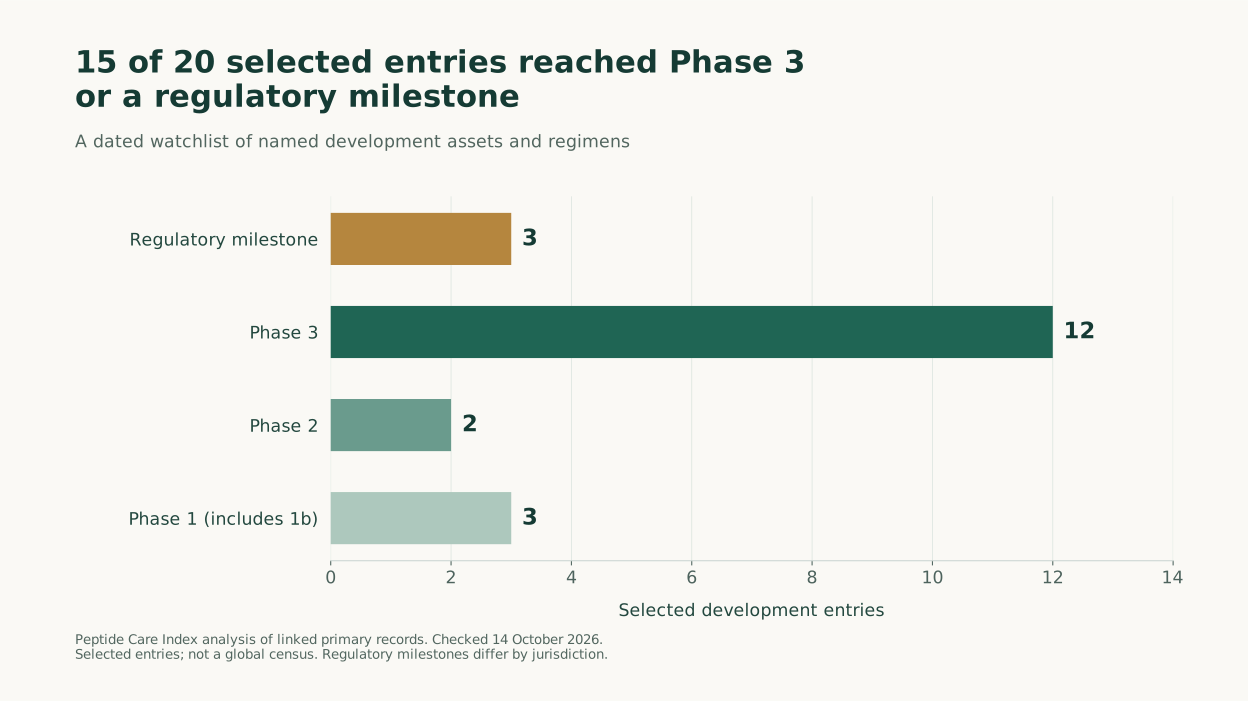
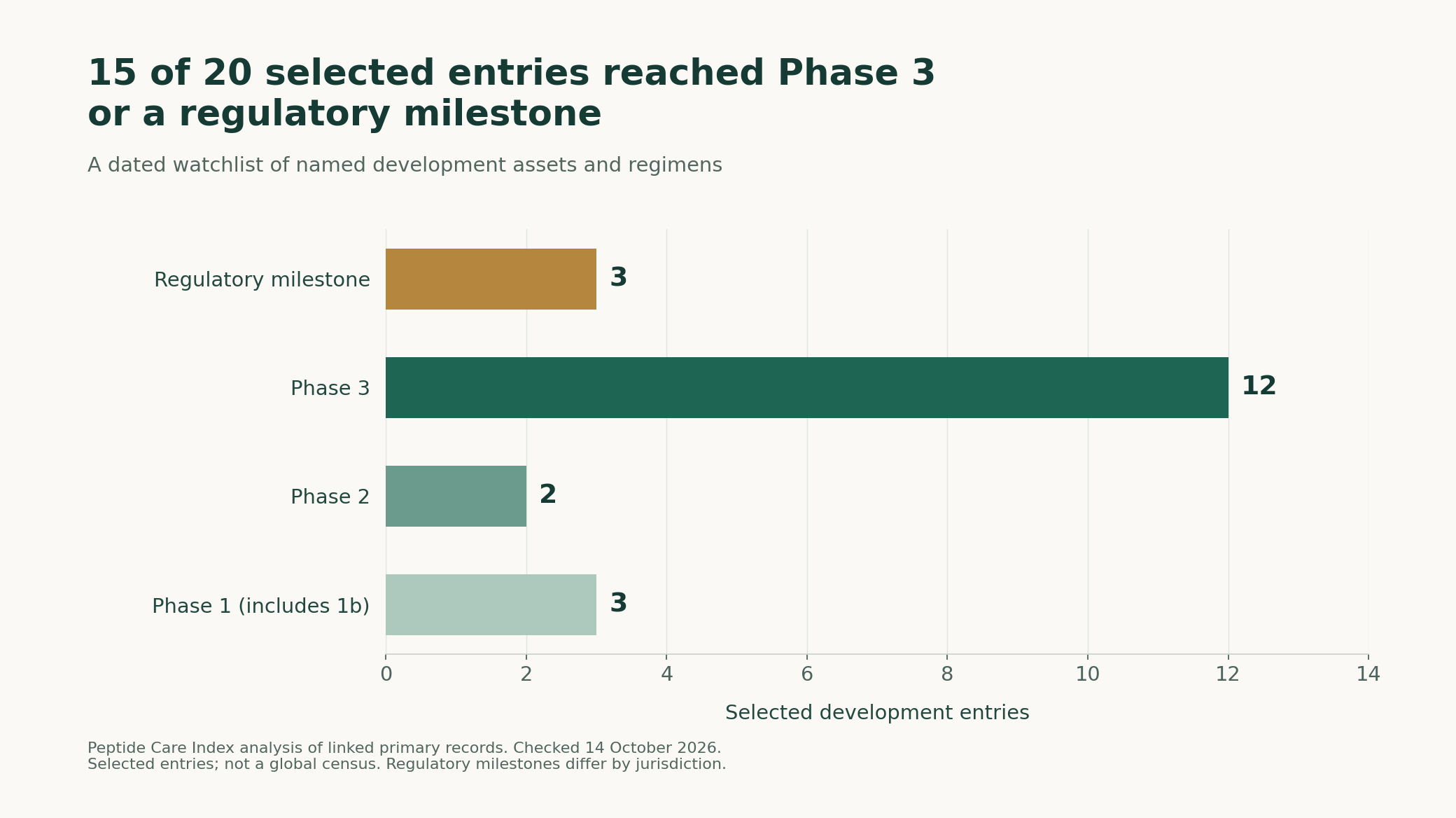
The selection leans toward prominent late-stage programs. These totals cannot tell you what share of all peptide research is late-stage, how large the global pipeline is, or how many drugs will win approval. They tell you what is in this dated table.
Which peptide medicines have already left this development watchlist?
Four selected medicines have 2026 U.S. approval records: icotrokinra, bulevirtide-gmod, enlicitide and rusfertide. They belong in the approval table below. Continued trials of an approved medicine do not turn it back into a new, wholly unapproved molecule.
| Medicine | Reported U.S. approval date | Approved use shown here | Primary record |
|---|---|---|---|
| Icotrokinra / ICOTYDE | March 18, 2026 | Moderate-to-severe plaque psoriasis; adults and qualifying adolescents | 34 |
| Bulevirtide-gmod / Hepcludex | May 22, 2026 | Chronic hepatitis delta virus infection in qualifying adults; accelerated approval | 36 |
| Enlicitide / LIPFENDRA | July 16, 2026 | Lower LDL cholesterol in adults with hypercholesterolemia, including heterozygous familial hypercholesterolemia | 37 |
| Rusfertide / MIMRYLO | August 28, 2026 | Erythrocytosis in adults with polycythemia vera | 39 |
Source: FDA announcements and original developer announcements linked in each row; checked October 14, 2026. This is a selected set of approval examples, not a count of every peptide approval in 2026. The date is the approval date reported in the record. Enlicitide’s developer announced approval July 16; FDA published its news announcement July 17.
Source: Peptide Care Index; FDA and original developer approval records. Checked 14 October 2026. Selected examples, not all 2026 approvals.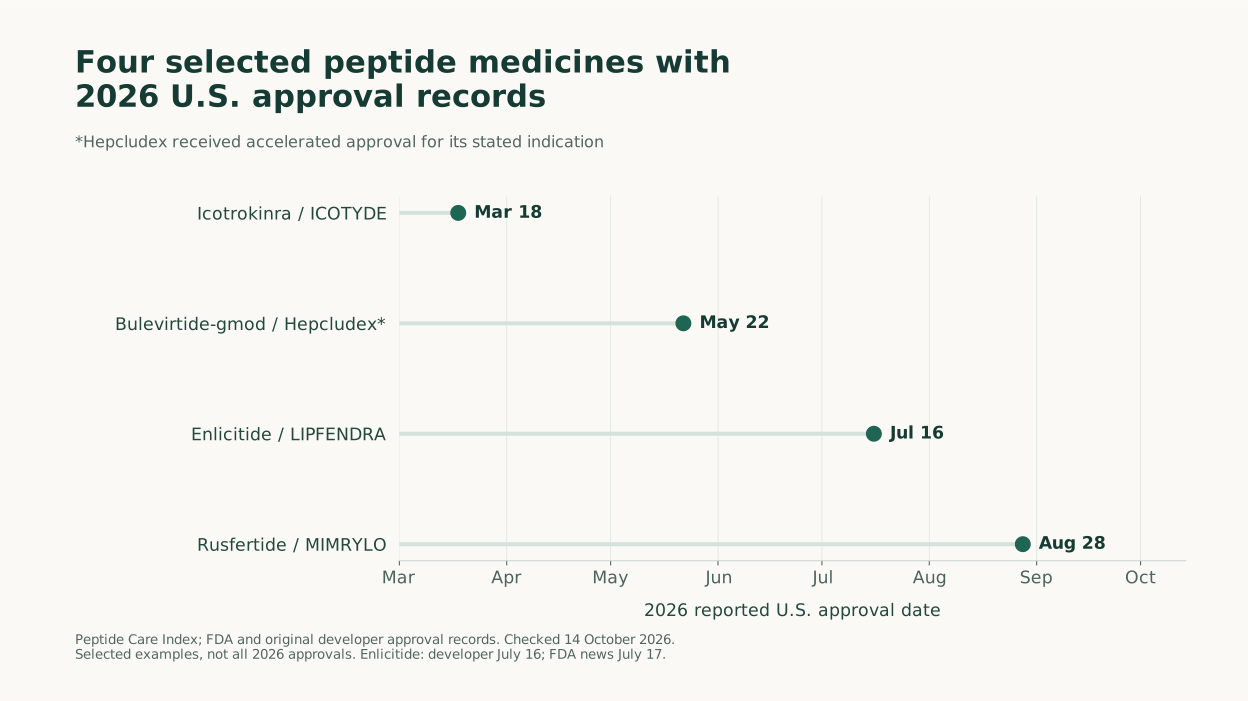
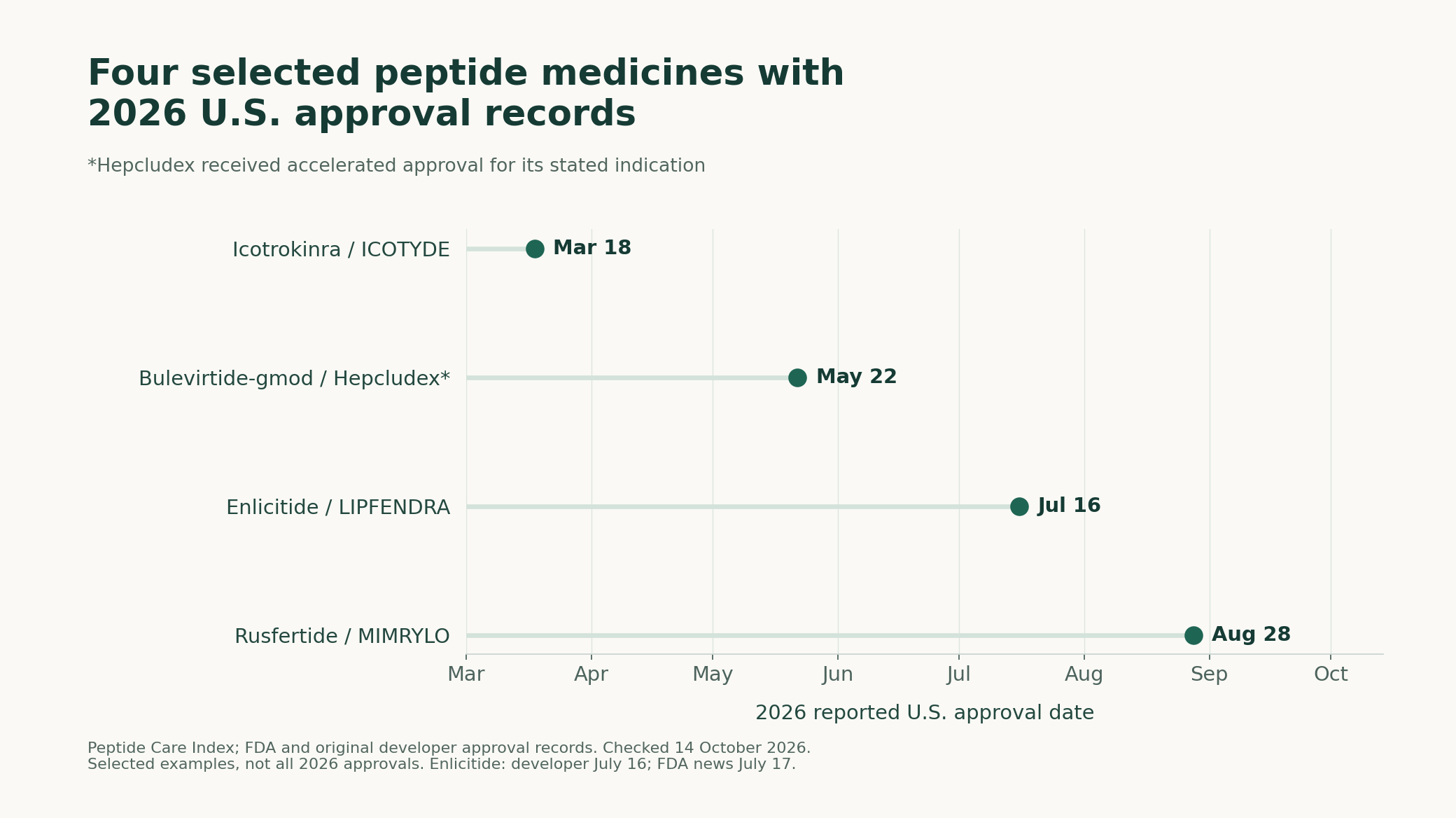
Approval applies to the product and use in its record. For example, bulevirtide-gmod’s U.S. approval concerns chronic hepatitis delta virus infection in adults without cirrhosis or with compensated cirrhosis. It does not settle a claim about another peptide or another disease. 36
For a broader view of how product records differ from wellness claims, see our peptide comparison chart.
Which oral drugs are peptides—and which are not?
Oral VK2735 and PN-881 are peptide development entries in this tracker. Orforglipron and CT-996 are excluded small molecules. Taking a drug by mouth tells you its route. Acting at the GLP-1 receptor tells you its target. Neither fact alone tells you its chemistry. 9 24 41 42
| Name | Chemistry or identity in the checked source | How this tracker handles it |
|---|---|---|
| VK2735 | Peptide GLP-1/GIP receptor agonist | One entry covers oral and injectable development; oral Phase 3 initiation was announced October 14, 2026. 9 |
| PN-881 | Oral IL-17 antagonist peptide | Included at Phase 1 reached; the later Phase 2b program remains a plan in the cited update. 24 |
| Zenagamtide / amycretin | One peptide with oral and injectable formulations | Counted once. The dated sources confirm subcutaneous Phase 3 initiation, not a completed oral Phase 3 start. 4 |
| Orforglipron / Foundayo | Nonpeptide small-molecule GLP-1 receptor agonist | Excluded from the peptide watchlist. 41 |
| CT-996 | Oral small-molecule GLP-1 receptor agonist | Excluded; its 2024 source establishes identity, not its current phase. 42 |
Source: Original developer records linked in the table, checked October 14, 2026. These examples are not a complete oral-drug pipeline.
The reverse mistake matters too. Icotrokinra and enlicitide are oral peptide medicines with selected U.S. approval records above. An oral drug can be a peptide; an oral GLP-1 drug can also be a nonpeptide. Check the exact name.
Why is one drug name not always one pipeline entry?
CagriSema is one combination entry; cagrilintide monotherapy is another. CagriSema contains cagrilintide and semaglutide. Counting those two development entries does not mean two newly discovered molecules, and it does not mean cagrilintide alone has the combination’s filing status. 2 3
The tracker uses these rules:
- Aliases share an entry. Amycretin is now called zenagamtide. CT-388 is enicepatide. HRS9531 and KAI-9531 are names used for ribupatide. Each set stays together. 4 13 15
- Routes stay attached to their evidence. Injectable and oral VK2735 share a name, but have separate trials. PN-477sc’s initiated study is injectable; the cited oral program is a future plan. 9 24
- Indications keep their own stage. Pemvidutide’s Phase 3 entry rests on its MASH program. That does not establish Phase 3 for every condition being studied. 8
- Jurisdictions stay visible. Ribupatide’s filing review is in China. CagriSema’s reviewed filing is with FDA. Glepaglutide’s European committee opinion is a recommendation. These records are not interchangeable. 15 2 18
Peptide-containing antibody conjugates, radioligands, peptide vaccines, large therapeutic proteins and cell therapies sit outside this tracker’s chosen scope. They would need separate counting rules. The entries here focus on named therapeutic peptides, modified peptide analogues, peptide prodrugs and the named CagriSema combination.
What is the next milestone—and has it actually happened?
Five forecast examples below remain plans in their cited sources. A future trial start, a filing and a possible regulatory decision are different milestones. We keep the original window and its source date together so a reader can see when a plan needs another check.
| Entry | Milestone forecast in the source | Source date | What the source does not establish |
|---|---|---|---|
| Retatrutide | BLA submission planned for Q1 2027 | September 29, 2026 | A completed filing or an approval. 1 |
| CagriSema | U.S. decision expected in Q4 2026 | September 30, 2026 | An approval outcome or an exact decision day. 2 |
| Avexitide | NDA submission planned by the end of 2026 | August 18, 2026 | A completed submission. 27 |
| PN-881 | Phase 2b program planned for early Q1 2027 | August 5, 2026 | A trial that has already begun. 24 |
| PN-477 oral formulation | Phase 1 initiation anticipated in the first half of 2027 | August 5, 2026 | An initiated oral study; the injectable study is the one confirmed begun. 24 |
Source: Original developer statements linked in the table; checked October 14, 2026. BLA means biologics license application; NDA means new drug application. Both are applications for regulatory review. A quarter or half-year is a forecast window, not a promised launch date.
A registry’s primary completion date is different again. It refers to the final collection of data for the primary outcome. It does not tell you when the developer will publish results. The National Library of Medicine defines that field in its ClinicalTrials.gov registration rules.
For example, “data collection is expected to end in December” cannot be rewritten as “results arrive in December.” That would add a fact the registry did not supply.
Does Phase 3 mean a peptide is ready to prescribe?
No. Phase 3 is a research stage. FDA describes it as testing treatment benefit and monitoring adverse reactions in the studied population. A positive result or an ongoing trial does not itself supply a marketing approval. FDA’s explanation of clinical research.
In this tracker, the clearest practical check is to read across the row. Avexitide has reported Phase 3 results and a planned filing. CagriSema has a filing under review. The four selected medicines in Table 3 have approval records. Those are three different positions in development. 27 2
For an advertised clinic offer, our provider comparison documents published service terms and the questions those terms leave open. If you are checking BPC-157, TB-500 or sermorelin access claims, Find My Peptide Path helps organize the source checks and provider questions. It is a free research guide; it does not recommend treatment or arrange trial enrollment.
How did we build this tracker?
Peptide Care Index assembled 26 records: 20 development entries, four selected 2026 U.S. approvals and two nonpeptide exclusions. We checked the cited documents on October 14, 2026, then grouped the development entries using the rules above. The dataset records both the document date and the date we checked it.
We began with prominent metabolic candidates and added selected programs in bowel disease, calcium disorders, psoriasis, kidney injury and newborn brain injury. We used developer announcements, company reports filed with the U.S. Securities and Exchange Commission, FDA records and European regulatory material. We read the evidence for the claims used here. We did not run a clinical study, test products or obtain clinical review.
The process was:
- Record the named development entry and its known aliases.
- Check peptide identity and the condition, route or jurisdiction behind the stage claim.
- Separate a stage actually reached from a future plan. Preserve study-complete or extension status where the source states it.
- Put the selected U.S. approval examples and the nonpeptide examples in separate record types.
- Count each development entry once in the display groups. Reconcile the page, CSV and chart totals.
A reader can reproduce the counts by filtering record_type to development, grouping by stage_bucket, and counting rows. That produces 3 + 12 + 2 + 3 = 20. Adding the regulatory and Phase 3 groups produces 15. The source inventory gives the evidence URLs and check dates.
What does the dataset leave out?
This is an editorial selection, not a random sample or a complete registry export. It cannot establish a global pipeline total, the share of research at each phase, an approval rate or a treatment ranking. Source dates differ, and a stage reached does not establish that a trial is open today.
We did not audit every regulator’s approval database for every entry, or independently check every trial’s current recruiting sites. Trial identifiers in the download are included where the reviewed primary records supplied them; an identifier alone is not a recruitment check. A blank field means the cited material did not establish that detail.
The counts are also entry counts, not unique-molecule counts. Combination programs, aliases and multiple routes make that distinction matter. For drug-sales figures with their own defined scope, see our peptide statistics.
What changed in this edition?
October 14, 2026: First edition. Includes that day’s oral VK2735 Phase 3 announcement, separates the four selected 2026 U.S. approvals, and preserves the distinction between demonstrated stages and planned starts.
How can you cite this page?
Use the table or finding that fits the claim. The development watchlist, approval examples and exclusions have different denominators. Include “selected” when quoting a count.
Peptide Care Index. “Peptide drug pipeline: 20-entry status tracker (2026).” Updated October 2026. https://peptidecareindex.com/research/peptide-drug-pipeline/. Sources checked October 14, 2026.
Ready-to-copy finding:
Peptide Care Index’s October 14, 2026 review identified 20 selected peptide development entries, 15 of which had reached Phase 3 or a regulatory milestone. The tracker is not a count of the full global pipeline.
Original tables, calculations and charts may be reused with credit to Peptide Care Index. Underlying source material retains its own rights and attribution terms.
Where can you download the records?
The complete CSV has 26 records, including the 20 development entries shown in Table 1. Use record_type to select the development watchlist, the four selected approval examples or the two nonpeptide exclusions.
Frequently asked questions
How many peptide drugs are in clinical development?
This tracker documents 20 selected development entries. It does not establish the current worldwide total. A defensible total needs a defined scope, an exhaustive collection method, alias handling and a rule for approved medicines being tested for new uses.
Is retatrutide still in the pipeline?
The checked September 29, 2026 Lilly record describes retatrutide’s Phase 3 work and a planned Q1 2027 filing. This tracker keeps it in the development table on that basis. A plan to file is not a completed filing or an approval. 1
Are amycretin and zenagamtide different drugs?
No. Novo Nordisk identifies zenagamtide as the drug formerly known as amycretin. This tracker counts the name once and keeps oral and injectable development details attached to their sources. 4
Is an estimated trial completion date a results date?
No. ClinicalTrials.gov defines primary completion around the final collection of data for the primary outcome. Public results can come later. A results date needs its own evidence, such as a developer’s dated announcement. ClinicalTrials.gov field definitions.
Sources and check dates
The primary records below were checked October 14, 2026. Developer statements are identified as developer statements; they are not independent clinical reviews. An unstated publication date stays unstated.
- Retatrutide — primary stage, identity or approval record. 2026-09-29. Checked October 14, 2026.
- CagriSema — primary stage, identity or approval record. 2026-09-30. Checked October 14, 2026.
- Cagrilintide monotherapy — primary stage, identity or approval record. Publication day unstated in this record. Checked October 14, 2026.
- Zenagamtide — primary stage, identity or approval record. 2026-08-04. Checked October 14, 2026.
- Zenagamtide — supporting primary record. 2026-09-16. Checked October 14, 2026.
- Survodutide — primary stage, identity or approval record. 2026-10-01. Checked October 14, 2026.
- Survodutide — supporting primary record. Publication day unstated in this record. Checked October 14, 2026.
- Pemvidutide — primary stage, identity or approval record. 2026-08-12. Checked October 14, 2026.
- VK2735 — primary stage, identity or approval record. 2026-10-14. Checked October 14, 2026.
- Petrelintide — primary stage, identity or approval record. 2026-09-22. Checked October 14, 2026.
- Petrelintide — supporting primary record. Publication day unstated in this record. Checked October 14, 2026.
- Petrelintide — supporting primary record. Publication day unstated in this record. Checked October 14, 2026.
- Enicepatide — primary stage, identity or approval record. 2026-09-22. Checked October 14, 2026.
- Enicepatide — supporting primary record. Publication day unstated in this record. Checked October 14, 2026.
- Ribupatide — primary stage, identity or approval record. 2026-09-30. Checked October 14, 2026.
- Ribupatide — supporting primary record. 2026-08-04. Checked October 14, 2026.
- Apraglutide — primary stage, identity or approval record. 2026-08-06. Checked October 14, 2026.
- Glepaglutide — primary stage, identity or approval record. 2026-09-18. Checked October 14, 2026.
- Glepaglutide — supporting primary record. Publication day unstated in this record. Checked October 14, 2026.
- Eneboparatide — primary stage, identity or approval record. 2026-05-12. Checked October 14, 2026.
- Eneboparatide — supporting primary record. Publication day unstated in this record. Checked October 14, 2026.
- Eneboparatide — supporting primary record. Publication day unstated in this record. Checked October 14, 2026.
- Eneboparatide — supporting primary record. Publication day unstated in this record. Checked October 14, 2026.
- PN-881 — primary stage, identity or approval record. 2026-08-05. Checked October 14, 2026.
- ZP9830 — primary stage, identity or approval record. 2026-08-13. Checked October 14, 2026.
- ZP9830 — supporting primary record. Publication day unstated in this record. Checked October 14, 2026.
- Avexitide — primary stage, identity or approval record. 2026-08-18. Checked October 14, 2026.
- LSALT peptide — primary stage, identity or approval record. 2026-08-31. Checked October 14, 2026.
- LSALT peptide — supporting primary record. Publication day unstated in this record. Checked October 14, 2026.
- Canvuparatide — primary stage, identity or approval record. 2026-08-27. Checked October 14, 2026.
- Pegtarazimod — primary stage, identity or approval record. 2026-04-08. Checked October 14, 2026.
- Pegtarazimod — supporting primary record. Publication day unstated in this record. Checked October 14, 2026.
- Pegtarazimod — supporting primary record. 2023-01-06. Checked October 14, 2026.
- Icotrokinra — primary stage, identity or approval record. 2026-03-18. Checked October 14, 2026.
- Icotrokinra — supporting primary record. Publication day unstated in this record. Checked October 14, 2026.
- Bulevirtide-gmod — primary stage, identity or approval record. 2026-05-22. Checked October 14, 2026.
- Enlicitide — primary stage, identity or approval record. 2026-07-16. Checked October 14, 2026.
- Enlicitide — supporting primary record. 2026-07-17. Checked October 14, 2026.
- Rusfertide — primary stage, identity or approval record. 2026-08-28. Checked October 14, 2026.
- Rusfertide — supporting primary record. Publication day unstated in this record. Checked October 14, 2026.
- Orforglipron — primary stage, identity or approval record. 2026-04-09. Checked October 14, 2026.
- CT-996 — primary stage, identity or approval record. 2024-07-17. Checked October 14, 2026.
- FDA: Step 3, Clinical Research. Publication day unstated in this record. Checked October 14, 2026.
- ClinicalTrials.gov: Protocol Registration Data Element Definitions. 2025-04-24. Checked October 14, 2026.
Peptide Care Index Research is the research and reference section of peptidecareindex.com.