Peptide content calculator: net mass, purity, and assay
By Peptide Care Index · Updated October 2026
A peptide content calculator converts gross powder mass into peptide mass using the values on a lab report. Net peptide content and HPLC purity answer different questions. Choose what your report measures below to calculate total peptide mass, estimate target peptide mass, or use an amount the lab has already measured.
What should you know before calculating?
- 99% HPLC purity does not mean 99% of the powder’s weight is the target peptide. It describes the target’s share of the signal included in that chromatographic analysis. Bachem explains the measurement.
- In a worked example, 10 mg of gross powder at 80% net peptide content and 99% HPLC purity gives 7.92 mg of estimated target peptide. This is Peptide Care Index’s illustrative calculation, using the manufacturer formula, not a tested product.
- A report that already gives target peptide in mg needs no second purity correction. First confirm that the result means the target peptide, rather than total peptidic material or a nominal label amount.
How do I use the peptide content calculator?
Start with what the report actually measures. A number marked “purity,” “assay,” or “content” is not enough on its own: check its definition and units. The calculator keeps total peptidic mass separate from target peptide mass.
| Choose your input | What you need | What the result means |
|---|---|---|
| Gross powder mass and net peptide content | Powder mass in mg; net peptide content in %; HPLC purity in % if available | Total peptidic mass; an estimated target mass if a suitable purity value is supplied |
| Total peptidic mass already reported | Total peptidic mass in mg; HPLC purity in % if available | The reported total, with an estimated target mass if a suitable purity value is supplied |
| Target peptide as a mass percentage | Gross powder mass in mg; target peptide % by weight of the as-received sample | Target mass calculated from the lab’s target-specific mass fraction |
| Target peptide amount already measured | Target peptide amount in mg for the sample or vial | The reported target amount, with no extra correction |
| HPLC purity only, or an unclear report | No assumed content value | The missing information needed before mass can be calculated |
Source: measurement definitions in Bachem’s FAQ and GenScript’s QC guide; calculation routes organized by Peptide Care Index. All mass inputs must refer to the same sample and measurement basis.
Use the powder’s mass, excluding the vial or container. Do not treat a printed “10 mg” label as a weighed gross mass unless the supplier says that is its basis. Biosynth, for example, vials some product lines by net peptide weight.
Calculator note: Values are processed in your browser and are not saved or sent with calculator events. The tool does not ask for your name, email, or health history. General site measurement is described in the Privacy Policy.
Interactive peptide content calculator
Choose what the report measures. The calculator does not run an assay or fill in a value your report does not provide.
What is the peptide content formula?
For a gross powder sample, multiply mass by the net peptide content fraction to get total peptidic mass. If the lab’s method supports a separate HPLC purity correction, apply that fraction to estimate the target peptide mass. Enter 80% as 80 in the calculator; the formula converts it to 0.80.
Total peptidic mass (mg) = gross powder mass (mg) × net peptide content (%) ÷ 100
Estimated target peptide mass (mg) = gross powder mass (mg) × net peptide content (%) ÷ 100 × HPLC purity (%) ÷ 100
Bachem publishes both the net-mass definition and the separate content-and-purity calculation. GenScript uses the same two-factor approach.
The target mass is an estimate when HPLC area percentage supplies the target fraction. Different compounds can produce different detector responses. ICH’s analytical validation guidance addresses response factors; a calculator cannot establish whether a particular method has handled them properly. Overlapping peaks and non-peptide compounds that absorb UV light can also affect an area-based estimate.
What if the lab already gives target peptide content?
If a report gives the target peptide’s mass fraction by weight in the as-received powder, use gross mass × target mass fraction ÷ 100. If it gives the target amount directly in mg, use that amount. Those values already refer to the target: applying purity again would count that adjustment twice.
“As received” means the sample in its reported state, including any water or other material present. A dry-basis result, salt-free value, or percentage of a label claim has a different basis. Ask the lab to reconcile it before entering it here.
How can 99% purity give 7.92 mg from 10 mg of powder?
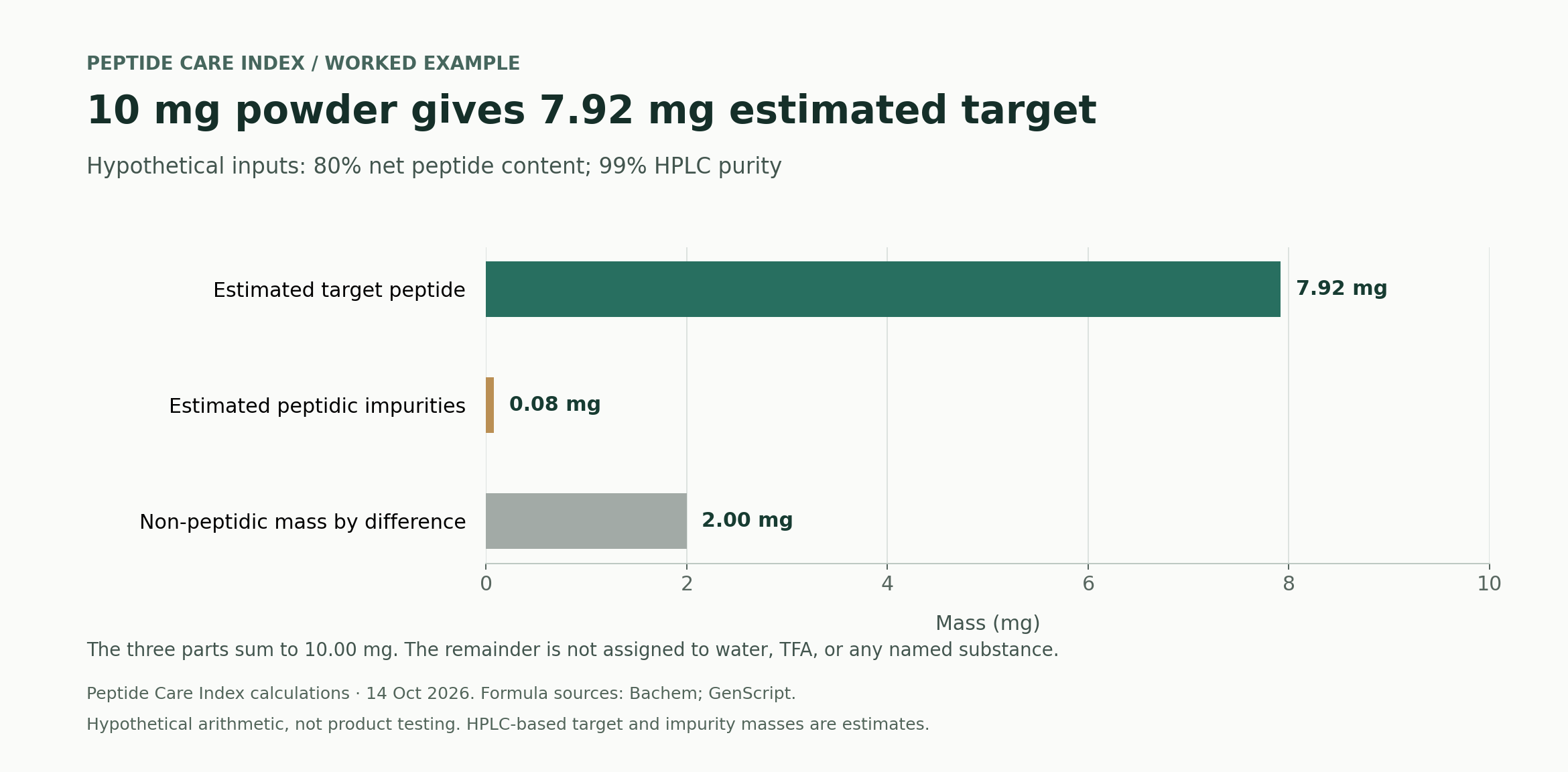
In this hypothetical example, 10 mg of powder has 80% net peptide content and 99% HPLC purity. The calculation gives 8.00 mg of total peptidic material and 7.92 mg of estimated target peptide. The target estimate is 20.8% below the gross powder mass; that is a mass comparison, not a finding of underfilling.
| Quantity | Calculation | Result |
|---|---|---|
| Gross powder mass | Hypothetical input | 10.00 mg |
| Net peptide content | Hypothetical input | 80% |
| HPLC purity | Hypothetical input | 99% |
| Total peptidic mass | 10 × 0.80 | 8.00 mg |
| Estimated target peptide mass | 8.00 × 0.99 | 7.92 mg |
| Estimated peptidic impurity mass | 8.00 × 0.01 | 0.08 mg |
| Non-peptidic mass by difference | 10.00 − 8.00 | 2.00 mg |
Source: Peptide Care Index’s hypothetical arithmetic, checked October 14, 2026, using Bachem’s formula and GenScript’s definitions. HPLC-based target and impurity mass estimates share the same method assumptions. No sample was tested.
The three parts sum to the gross mass: 7.92 + 0.08 + 2.00 = 10.00 mg. The 2.00 mg remainder is not automatically water, TFA, or an unwanted adulterant. Its components need their own measurements.
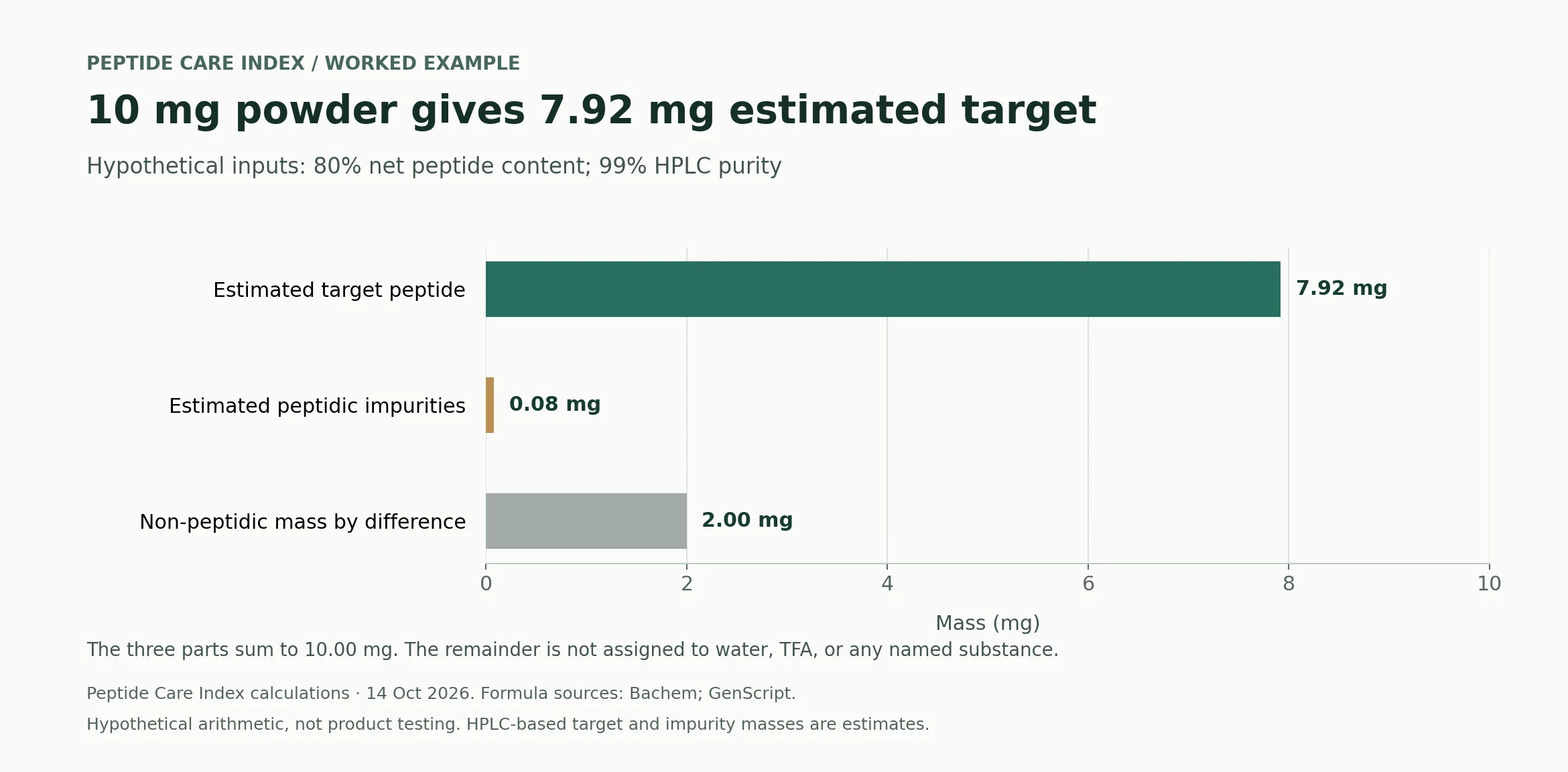
Estimated target peptide: 7.92 mg
Estimated peptidic impurities: 0.08 mg
Non-peptidic mass by difference: 2.00 mg
How does net peptide content change the mass estimate?
At a fixed gross mass and HPLC purity, the target estimate changes in direct proportion to net peptide content. These examples hold gross mass at 10 mg and HPLC purity at 99%. They show the math, not how common any content value is.
| Net peptide content | Gross powder mass | Total peptidic mass | Estimated target peptide mass |
|---|---|---|---|
| 60% | 10 mg | 6.00 mg | 5.94 mg |
| 70% | 10 mg | 7.00 mg | 6.93 mg |
| 80% | 10 mg | 8.00 mg | 7.92 mg |
| 85% | 10 mg | 8.50 mg | 8.415 mg |
| 90% | 10 mg | 9.00 mg | 8.91 mg |
| 100% | 10 mg | 10.00 mg | 9.90 mg |
Source: Peptide Care Index illustrative calculations, October 14, 2026. Formula: 10 × NPC/100 × 99/100, following Bachem’s calculator. The 100% entry is a mathematical endpoint, not an assumed property of a sample. Displayed digits are arithmetic, not measurement uncertainty.
The full example CSV also includes HPLC purity inputs of 95%, 98%, and 100%. None is a suggested default.
What is the difference between peptide content and HPLC purity?
Net peptide content asks how much of the gross material is peptidic material. HPLC purity asks how much of the included chromatographic signal belongs to the target. One uses the gross sample as its basis; the other uses the analytical signal under a stated method.
Think of two questions: “How much of this powder is peptide material?” and “Within the analysis, how much belongs to the peptide we want?” Combining the answers requires compatible measurements.
| Term | What it tells you | What it does not establish alone |
|---|---|---|
| Gross powder mass | Mass of the entire powder sample | Target peptide mass |
| Net peptide content, or NPC | Total peptidic fraction, including peptidic impurities | Target purity or target mass by itself |
| HPLC area purity | Target peak’s share of the included signal | Gross-sample target mass fraction |
| Target peptide mass fraction, % w/w | Target mass divided by sample mass, on the stated basis | Whether another basis conversion is needed unless the report defines it |
| Target peptide amount, mg | Quantified target amount for the identified sample | Identity, sterility, biological effect, or suitability for a person |
Sources: Bachem FAQ, GenScript QC, and ICH Q2(R2). Last column states the limits of these individual quantities, not an assessment of a product.
In an original 2022 peptide purity study, researchers combined a total-peptide mass fraction from amino acid analysis with a relative target fraction from chromatography. They also evaluated measurement uncertainty. That is more than reading one purity percentage from a report.
Which values should I check on a certificate of analysis?
Check the sample identity, the mass basis, and what each assay measures before using its numbers. A certificate of analysis, or COA, may report several different percentages. The word “assay” does not make them interchangeable.
Use this checklist with the report issuer:
- Which sample or lot does this report cover? Match it to the material being calculated.
- What does the mg value mean? Gross powder, total peptidic material, target peptide, or only a nominal label claim?
- What does “content” or “assay” mean here? Total NPC, target-specific mass fraction, elemental nitrogen, or percentage of a stated label claim?
- What is the measurement basis? As received, dry, anhydrous, or another basis?
- What does the HPLC percentage measure? Which signal is included, and does the method support using it with the content result?
- What uncertainty or limits are reported? A rounded calculator output does not add precision to the assay.
Download the plain-text COA checklist.
Do not enter raw nitrogen percentage as NPC. Elementar’s explanation calculates NPC by comparing measured nitrogen with the peptide’s theoretical nitrogen fraction. Ask for the lab’s converted peptide-content result.
Do not subtract water and TFA percentages from HPLC area purity. They do not share the same denominator. A valid mass balance needs compatible mass measurements and must account for the relevant components. Bachem describes the separate tests for water, solvents, acids, and peptide content.
Does low peptide content mean a vial is underfilled?
Low NPC alone cannot show underfilling. First establish what the label promises and whether the measured amount uses that same basis. A label stated as target peptide mass cannot be compared directly with gross powder mass or an HPLC area percentage.
For example, the hypothetical result of 7.92 mg above does not tell us whether any real label was met. There was no measured vial or label in that example. Even a real test would need the label definition, a suitable analytical result, sampling details, and uncertainty before a fair comparison.
If you are comparing published offers, the peptide price list keeps the listed purchase units beside the prices. This calculator does not supply missing lot assays or turn those offers into comparable prices per measured mg.
What can this calculator tell me about safety or treatment?
It calculates mass from the values supplied. It does not test identity, contaminants, sterility, biological activity, or clinical safety. A high purity percentage or a successful calculation cannot answer those separate questions.
The peptide comparison chart covers the separate question of what published evidence and agency records say about specific peptides. If you are checking a care offer, Find My Peptide Path helps organize access and provider questions before paying.
How were the formulas and examples checked?
Peptide Care Index checked the cited manufacturer documents, analytical guidance, and original research on October 14, 2026. The examples were then calculated from stated hypothetical inputs. No products were bought, weighed, or tested for this page.
The gross-to-total and content-plus-purity routes follow Bachem and GenScript. The direct-target routes follow the meaning of a target-specific mass fraction or measured amount. ICH guidance supplies the reason to distinguish detector area from a fully validated quantitative mass result.
The example dataset uses every combination of six stated NPC inputs and four stated HPLC inputs: 6 × 4 = 24 rows. Each row starts with 10 mg gross mass. To reproduce it, calculate total peptide as 10 × NPC/100, estimated target as total peptide × HPLC/100, estimated peptidic impurities as total peptide minus target, and non-peptidic mass as 10 minus total peptide.
These are teaching examples. They do not estimate an average peptide content, failure rate, product quality, or the amount in a vial you have not tested. The separate acceptance-case file checks the specified routes and missing-input behavior; it is not a claim that an interface has been tested before implementation.
How can I cite this page?
Peptide Care Index. “Peptide content calculator: net mass, purity, and assay.” Updated October 2026. https://peptidecareindex.com/research/peptide-content-calculator/. Sources checked October 14, 2026.
For the worked example: “In Peptide Care Index’s hypothetical calculation, 10 mg of gross powder at 80% net peptide content and 99% HPLC purity gives 7.92 mg of estimated target peptide.”
The general calculation comes from the sources below. Peptide Care Index contributed the input-selection guide, worked examples, checklist, and presentation. You may reuse those original materials with credit to Peptide Care Index; underlying sources retain their own attribution and terms.
Where can I download the examples?
- Worked-example dataset: 24 hypothetical calculations, CSV
- Calculator acceptance cases, CSV
- COA field checklist, Markdown
- Worked-example chart, PNG
- Worked-example chart, SVG

What else do people ask about peptide content?
Can I calculate net peptide content from HPLC purity alone?
No. HPLC area purity does not supply the gross-sample peptide mass fraction. Ask the laboratory for a content measurement or a target-specific quantitative result; the calculator does not replace missing values with 100%.
Do I multiply measured peptide content by purity again?
It depends on what “content” means in that report. A total NPC result can need a separate target-purity factor, while a directly quantified target amount or target-specific mass fraction already refers to the target. Confirm the definition before applying another factor.
Is 80% net peptide content the same as 80% purity?
No. Under the definitions used here, 80% NPC means that 80% of the gross mass is peptidic material, including peptidic impurities. An 80% HPLC area result refers to the included chromatographic signal, not that gross mass.
Can water and TFA explain the remaining powder mass?
They can contribute to it, but this calculation does not identify or measure either one. Other components can also matter. Separate testing is needed before assigning the remainder to named substances.
Is this a peptide dosing or reconstitution calculator?
No. This tool interprets analytical mass and content values. It does not choose a dose, injection volume, solvent, syringe setting, or treatment plan.
Which sources support the calculator?
All sources below were checked on October 14, 2026. Manufacturer documentation is used for analytical definitions and formulas, not to endorse its products.
- Bachem. FAQ — frequently asked questions. “Analysis of peptides”: gross weight, net peptide content, HPLC purity, and net-weight calculation.
- Bachem. Peptide Content & Concentration Calculator. Gross weight × purity × assay; use of lot-specific analytical data.
- GenScript. AccuPep+QC Testing. QC methods and footnotes defining total net peptide and the separate HPLC-purity correction.
- Biosynth. Analytical methods and Quality Control for peptide products. Net peptide content, quantitative amino acid analysis, and product lines vialed by net peptide weight.
- Bachem. Quality Control of Amino Acids & Peptides: A Guide. Product content, water and counterion measurements, and the difference between NPC and purity.
- International Council for Harmonisation. ICH Q2(R2): Validation of Analytical Procedures. Final version adopted November 1, 2023, with November 30, 2023 corrections. Annex 2, Table 3, printed page 22: relative response factors; broader sections on specificity, accuracy, and precision.
- Lee and Lee. Peptide purity assignment for antibody quantification by combining isotope dilution mass spectrometry and liquid chromatography. Bulletin of the Korean Chemical Society, 2022. DOI: 10.1002/bkcs.12511. Combination of total-peptide and relative-target fractions, with uncertainty evaluation.
- Elementar. Even the smallest sample quantities are sufficient. Conversion from elemental nitrogen to net peptide content; raw nitrogen percentage is not itself NPC.