Peptide adverse event reports: FDA counts for 7 peptides
Peptide Care Index’s October 14, 2026 openFDA search matched 20 BPC-157 report records: 8 suspect and 12 only concomitant, meaning a drug taken alongside a suspected drug. The response carried a July 30, 2026 release label. These peptide adverse event reports do not measure risk. See all seven peptides and FDA’s older searches.
Key peptide adverse-event report statistics
- 20 BPC-157 name-matched report records were included in Peptide Care Index’s October 14, 2026 openFDA extraction: 8 suspect and 12 concomitant-only. The response’s source-release metadata was July 30, 2026. Snapshot
- Peptide Care Index’s audit found 5 of 7 FDA peptide reviews retrieved no FAERS reports in searches described in the agency’s July 2026 briefing papers. Their cutoffs fall in 2024 or 2025. FDA review table
- 3 BPC-157 reports were retrieved in FDA’s search through December 4, 2025, described in its July 2026 briefing. All involved injectable products. FDA, PDF page 41
- 1 Semax report was retrieved in FDA’s search through December 3, 2025, described in its July 2026 briefing. FDA, PDF page 38
- 990 reports associated with compounded semaglutide had been received by FDA as of May 31, 2026. FDA compounded GLP-1 update
- More than 730 reports associated with compounded tirzepatide had been received by FDA as of May 31, 2026. The source gives a lower bound, not an exact total. FDA compounded GLP-1 update
How many peptide adverse event reports did our search find?
The October 14, 2026 extraction found identifiable product-name matches for BPC-157, TB-500 and Semax. Four other searches returned no matches for the declared terms. These are records in the openFDA drug-report API, a service for downloading FDA data; they are not a count of confirmed injuries or unique patients.
| Peptide name searched | Included report IDs | Suspect role | Concomitant-only role | Result after name checks |
|---|---|---|---|---|
| BPC-157 | 20 | 8 | 12 | 31 candidates; 9 unrelated names and 2 uncertain identities excluded |
| TB-500 | 1 | 0 | 1 | Name in a combination product; exact ingredient identity unverified |
| Semax | 1 | 1 | 0 | 2 candidates; an unrelated citalopram brand excluded |
| MOTS-c | 0 | 0 | 0 | No matches for the declared aliases |
| KPV | 0 | 0 | 0 | No matches for the declared aliases |
| Emideltide / DSIP | 0 | 0 | 0 | No matches for the declared aliases |
| Epitalon | 0 | 0 | 0 | No matches for the declared aliases |
Source: Peptide Care Index analysis of seven declared openFDA drug/event requests, extracted October 14, 2026. The three nonempty responses reported last_updated: 2026-07-30; the four no-match responses supplied no release metadata. July 30 is a source-release label, not an event cutoff. No date, country or seriousness filter was applied. Download the counts and exact requests.
A name match does not confirm what was inside a product. Different names, missing names and misspellings can change what a search retrieves. A zero here means no matches for the recorded search, with no conclusion about safety.
Optional local filter
Filter the two peptide tables
The complete tables are in the page HTML. This control only changes which rows are displayed in Tables 1 and 3.
All seven names are shown in the two complete tables.
Why do suspect and concomitant reports give different counts?
In this BPC-157 snapshot, 12 of 20 matched records—60%—listed BPC-157 only as concomitant. A reporter used a different drug-role label for the remaining records. The label describes the report; FDA has not validated it as a finding of cause.
| Reported role | Records | Meaning in FDA’s field reference |
|---|---|---|
| Suspect | 8 | The reporter considered this drug a cause |
| Concomitant only | 12 | This drug was reported as taken with a suspected drug |
| Total included report IDs | 20 | One count per returned report ID |
Source: Peptide Care Index’s October 14, 2026 name and role audit; definitions from openFDA’s official field reference. The source release for these records was labeled July 30, 2026.
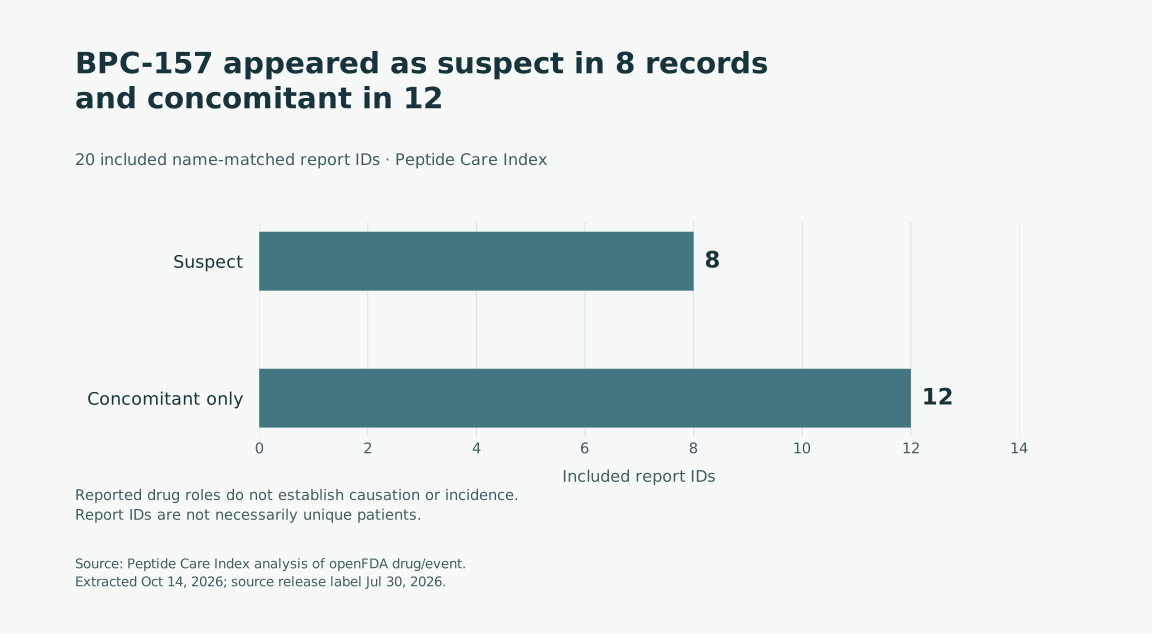
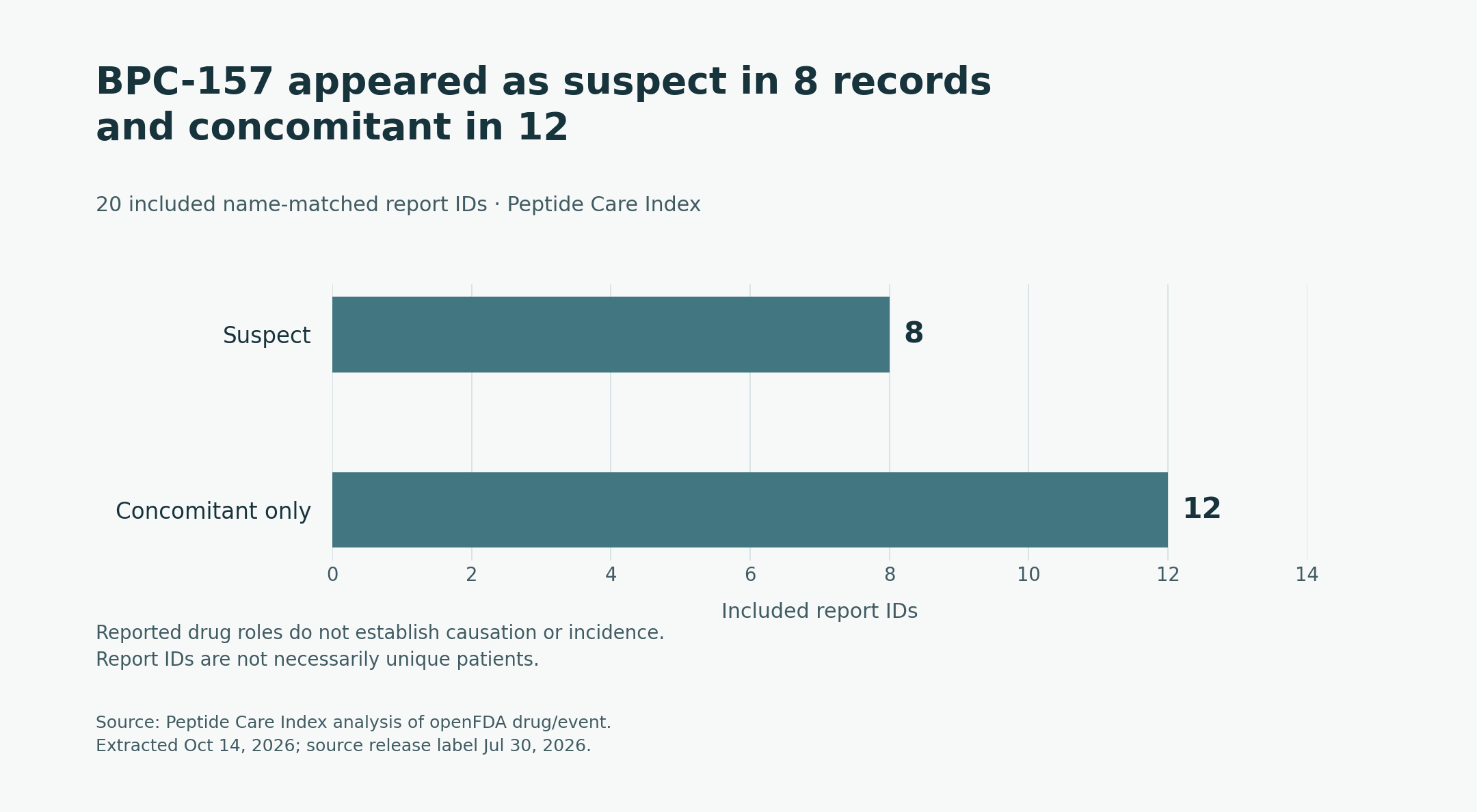
A report can list several drugs. Checking whether any drug is marked suspect would give the wrong answer about BPC-157. We checked the role on the same drug entry that matched the peptide’s name. One report listed BPC-157 twice; it still counted once.
What did FDA’s own peptide report searches retrieve?
Five of seven peptide reviews retrieved no FAERS reports, according to Peptide Care Index’s audit of FDA’s July 2026 briefing papers. The searches ended on different dates in 2024 and 2025. They are historical FDA search results, not October 2026 totals.
FAERS means FDA Adverse Event Reporting System, the older name used in these reviews. FDA launched the Adverse Event Monitoring System, or AEMS, on March 11, 2026. The API used for our snapshot still describes its source as FAERS. FDA launch notice
| Peptide family | Reports FDA retrieved | Search included reports through | Exact evidence |
|---|---|---|---|
| BPC-157 | 3 | December 4, 2025 | FDA briefing, PDF page 41 |
| KPV | 0 | December 3, 2025 | FDA briefing, PDF page 26 |
| TB-500 | 0 | March 26, 2025 | FDA briefing, PDF pages 30–31 |
| MOTS-c | 0 | March 9, 2025 | FDA briefing, PDF pages 28–29 |
| Emideltide / DSIP | 0 | March 3, 2024 | FDA briefing, PDF pages 51–52 |
| Epitalon | 0 | December 8, 2025 | FDA briefing, PDF pages 36–37 |
| Semax | 1 | December 3, 2025 | FDA briefing, PDF page 38 |
Source: FDA briefing papers for the July 23–24, 2026 Pharmacy Compounding Advisory Committee meeting, checked October 14, 2026. Page links use the PDF reader’s page numbers. MOTS-c had two overlapping search intervals; the latest ended March 9, 2025. The denominator is seven peptide families, not every distinct salt or every peptide on the market.
Do not subtract this table from Table 1 to calculate growth. The dates, search methods and inclusion rules differ. The FDA papers report agency searches; our snapshot reports a declared product-name search and local name checks.
For the separate question of compounding status, use the FDA peptide compounding list and status records. A report count does not settle approval or access.
What problems did FDA describe in BPC-157 and Semax reports?
FDA’s briefings describe injectable-product complaints for BPC-157 and a nasal-product complaint for Semax. Coingredients and missing information limit what can be attributed to one peptide. These summaries concern the historical reviews in Table 3, not every record in our API snapshot.
| Review | Reported problem | Why attribution remains limited |
|---|---|---|
| BPC-157 | Injection-site redness and swelling | Another injectable peptide was also used |
| BPC-157 | Shortness of breath and an emergency-room visit | Key timing and medication details were missing |
| BPC-157 / TB-500 blend | Skin and gum darkening, repeated after reuse | A blend prevents assigning the response to one ingredient |
| Semax | Eye pain and burning, with reported hospitalization | A consumer report does not prove cause |
Source: FDA BPC-157 briefing, PDF page 41 and FDA Semax briefing, PDF page 38, checked October 14, 2026.
The route matters. Reports about injections do not measure an oral capsule’s risks, and nasal-product observations do not establish the safety of injections. Our BPC-157 capsules evidence guide explains the oral-evidence question separately.
Why are the food-complaint cases in a separate table?
FDA also searched its Human Foods Complaint System, or HFCS, for some of these reviews. It covers food, dietary-supplement and cosmetic complaints. The briefing results below cannot simply be added to the drug-report results.
| Peptide | Cases retrieved | HFCS search cutoff | Qualification |
|---|---|---|---|
| BPC-157 | 3 | December 3, 2025 | Multi-ingredient supplement use complicated assessment |
| KPV | 0 | December 3, 2025 | No cases where KPV was administered |
| TB-500 | 2 | March 10, 2025 | BPC-157 blends; no safety assessments included |
| Epitalon | 0 | December 5, 2025 | No cases retrieved |
Source: FDA briefings for BPC-157, KPV, TB-500 and Epitalon, checked October 14, 2026. An HFCS result was not described for the other three peptides; their downloadable cells remain blank, not zero.
Does zero reports mean a peptide is safe?
No. Five of the seven FDA reviews had zero retrieved FAERS reports, yet the papers still discuss missing safety evidence or other concerns. DSIP is a clear example: its review also discusses serious adverse effects in clinical literature. Database reports and study observations are different evidence streams. FDA DSIP briefing
That review describes intravenous research in people undergoing withdrawal. FDA says withdrawal symptoms complicate interpretation. A zero database search therefore cannot stand in for a review of the human studies—or establish safety for another route.
The TB-500 name needs special care. FDA evaluated an acetylated seven-amino-acid fragment, LKKTETQ, of thymosin beta-4. Full-length thymosin beta-4 is a different substance. We did not use its name as a discovery alias; the included TB-500 product-name match does not verify which molecule was present. FDA TB-500 briefing
For a broader view of evidence types and molecule names, see the peptide comparison chart.
What about CJC-1295, ipamorelin and other peptides?
These substances are outside the seven-peptide extraction. FDA’s significant safety-risk page supplies a separate starting point for their evidence. It mixes reported events, study findings and possible risks; it is not a table of report totals.
| Substance | Evidence FDA describes |
|---|---|
| AOD-9604 | Serious events with unclear causality |
| CJC-1295 | Increased heart rate and a systemic vasodilatory reaction |
| GHRP-2 | Serious-event reports; causality not established |
| Ipamorelin | Serious events including death in intravenous gastric-motility research |
| Melanotan II | Published serious-event case reports |
Source: FDA’s significant safety-risk page, content current April 22, 2026; checked October 14, 2026. The ipamorelin finding concerns intravenous study use; it does not supply a risk rate for another route. A death during research does not by itself show that the study drug caused it.
How many reports concern compounded semaglutide and tirzepatide?
FDA reported 990 compounded semaglutide reports and more than 730 compounded tirzepatide reports as of May 31, 2026. These are FDA’s separately published compounded-product figures. They do not belong in the seven-peptide snapshot or in a ranking of which peptide is more dangerous.
| Product scope | Reports FDA received | Count date |
|---|---|---|
| Compounded semaglutide | 990 | May 31, 2026 |
| Compounded tirzepatide | More than 730 | May 31, 2026 |
Source: FDA’s concerns with unapproved GLP-1 drugs, checked October 14, 2026. Its October update still gives May 31 as the count date.
FDA says these reports are likely underreported and that other factors may contribute to an event. Searching an ingredient name alone also cannot reliably separate an approved medicine from a compounded, unapproved or unclear product. We publish no approved-versus-compounded rate comparison.
What can these reports tell you about risk?
They can help researchers find problems worth investigating. They cannot show what share of users had a problem, prove that a peptide caused a symptom, or establish which peptide is safer. FDA gives those limits explicitly in its AEMS dashboard FAQ.
Keep these distinctions attached to any number you use:
- Report IDs are not unique patients. Separate submissions about the same person may remain.
- Drug names are not laboratory results. The snapshot does not verify a product’s contents, purity, salt or formulation.
- A report can list several drugs and reactions. It does not assign each reaction to a particular drug.
- A suspect flag is a reported role. It is not FDA’s finding that the drug caused harm.
- No exposure denominator is available here. We did not measure how many people used each peptide, how much they used or how long they used it.
- Receipt dates are not event dates. They record when FDA received information.
The BPC-157 FDA approval guide answers the approval question. For clinical decisions, discuss the exact substance and product with a qualified clinician.
How did we build the report tables?
We made seven openFDA searches on October 14, 2026 and read seven FDA briefing papers. We recorded the two evidence sets separately. This release is a source and search audit, not a clinical study, a patient survey or a product test.
The October API extraction
We searched the reported product-name field, active-substance-name field and harmonized generic-name field. Each request used OR logic across those fields. The exact requests, timestamps and returned metadata are in the downloadable query audit.
| Peptide | Terms used to find candidates |
|---|---|
| BPC-157 | BPC, BPC157, BPU, Bepecin, Body Protection Compound, PL-14736, PL14736 |
| TB-500 | TB-500, TB500, LKKTETQ |
| MOTS-c | MOTS, MOTSC, MOTS-C |
| Semax | SEMAX |
| KPV | KPV, Lys Pro Val, Lysine Proline Valine |
| Emideltide / DSIP | DSIP, EMIDELTIDE, Delta Sleep Inducing Peptide |
| Epitalon | EPITALON, EPITHALON |
Source: Peptide Care Index’s declared requests, October 14, 2026. BPU was used for candidate discovery only; the uncertain spelling was not treated as verified BPC-157. These terms do not guarantee that every possible alias or misspelling was captured.
Every candidate in each nonempty response was downloaded and checked. The response totals were below the request limit, so no results were left behind an unrequested page. The four empty searches returned FDA’s specific “no matches” response, not a network error.
For BPC-157, the broad search returned 31 candidate IDs. We excluded 9 unrelated BPC-name records and 2 uncertain names, leaving 20. For Semax, one of the two candidates was a citalopram product with a similar name. It was excluded.
We counted each returned report ID once and checked its matched drug’s role. There were no repeated report IDs within a query. openFDA returns the latest report version, but that does not resolve separate submissions about the same patient. The public audit omits patient demographics, reactions, narratives and unrelated medicines. Official field definitions
The FDA briefing audit
We transcribed FDA’s retrieved-report counts and search cutoffs from each of the seven briefing papers. Every row was checked against its cited primary document. A separate HFCS count was recorded only when the briefing described one.
We retained the papers’ search dates rather than replacing them with the meeting year. We did not attempt to recreate FDA’s internal search protocol. We did not merge salts, study events, food complaints and drug reports into a single harm total.
Why are the extraction date and release date different?
October 14, 2026 is when we downloaded this snapshot. July 30, 2026 is the last_updated label in its nonempty responses. It is not a promise that events or submissions through that day are included.
FDA says its AEMS dashboard updates daily. The openFDA API documentation describes quarterly updates and a possible lag of three months or more. This page is a dated extraction, not a live feed. openFDA update frequency · AEMS update frequency
How do you report a suspected peptide problem to FDA?
Use FDA’s MedWatch reporting instructions for a suspected drug reaction, product-quality problem or use error. You do not need to establish that the product caused the problem before reporting it. Reporting does not replace medical care.
FDA encourages people to involve a healthcare professional who can supply clinical details. Follow the official form’s instructions about the product and event; do not send medical records to Peptide Care Index.
If you are checking a clinic’s offer, Find My Peptide Path helps you prepare questions about the exact product, access claim and provider terms. It does not assess symptoms or recommend treatment.
How should you cite these report counts?
Cite the evidence set and its date. For our name-matching and drug-role findings, cite this release. For a count directly reported by FDA, cite the linked FDA document and keep its search cutoff beside the number.
Ready-to-copy page citation
Peptide Care Index. (2026, October). Peptide adverse event reports: FDA counts for 7 peptides (Version 1.0). https://peptidecareindex.com/research/peptide-adverse-event-reports/. Sources checked October 14, 2026.
Ready-to-copy finding
“Peptide Care Index’s October 14, 2026 openFDA name-search audit included 20 BPC-157 report IDs: 8 listed BPC-157 as suspect and 12 only as concomitant. The nonempty response carried a July 30, 2026 source-release label. These are reported drug roles, not confirmed causes or unique patients.”
Our original tables, analysis and chart may be reused with credit to Peptide Care Index. Preserve the source dates and limits; underlying FDA material remains subject to its own terms. No link is required.
Download the data and chart
- Seven-peptide openFDA counts (CSV)
- Historical FDA briefing searches (CSV)
- FDA’s historical reported-problem summaries (CSV)
- FDA’s other peptide event evidence (CSV)
- FDA’s compounded GLP-1 report figures (CSV)
- Product-name inclusion and exclusion audit (CSV)
- Exact API requests and response metadata (JSON)
- Dataset definitions and reproduction steps
- BPC-157 reported-role chart (PNG)
- BPC-157 reported-role chart (SVG)
Version history
Version 1.0 — October 14, 2026: Initial extraction and source audit. Recorded the seven API searches, audited matching names and drug roles, and kept FDA’s historical search cutoffs separate.
Frequently asked questions
How many BPC-157 adverse-event reports are there?
Our declared openFDA search included 20 named report IDs, extracted October 14, 2026, with a July 30 source-release label. FDA’s separate historical briefing search retrieved 3 through December 4, 2025. Neither is an exhaustive count of injuries or unique patients, and the two methods should not be used to calculate growth.
Does a suspect report prove a peptide caused harm?
No. “Suspect” is the reporter’s drug-role label, not validated causation. The BPC-157 audit has 8 suspect-role report IDs; other drugs, underlying illness and incomplete information still need consideration.
Were no adverse events reported for KPV or MOTS-c?
Our declared API searches returned no matches for either name set. FDA’s older briefing searches also retrieved none at their stated cutoffs. Those results do not establish that no events occurred or that either peptide is safe.
Can these counts show which peptide has the fewest side effects?
No. The tables have no reliable count of exposed users and do not capture every event. They also differ in reporting coverage, product naming and dates, so they cannot rank comparative safety.
Are the compounded GLP-1 numbers current 2026 totals?
FDA’s reviewed page gives May 31, 2026 as the count date: 990 for compounded semaglutide and more than 730 for compounded tirzepatide. An October page check does not turn those into totals through October.
Is this the live AEMS dashboard?
No. This page contains an archived openFDA extraction and dated FDA document searches. FDA’s AEMS dashboard FAQ explains its separate, daily-updated dashboard.
Sources and check dates
All sources below were checked October 14, 2026. PDF pages refer to the PDF reader’s page count.
- openFDA. Drug adverse event overview. API source, multiple-drug and multiple-reaction structure, quarterly updates and lag. The downloadable query audit records each exact request and response metadata.
- openFDA. Official drug-event field reference and machine-readable definitions. Drug roles, report IDs, versions and receipt dates.
- FDA. BPC-157-related bulk drug substances briefing. July 2026 meeting materials; report search and summaries, PDF pages 41–42.
- FDA. Emideltide-related bulk drug substances briefing. July 2026 meeting materials; report search and clinical-event discussion, PDF pages 51–52.
- FDA. Epitalon-related bulk drug substances briefing. July 2026 meeting materials; report searches, PDF pages 36–37.
- FDA. KPV-related bulk drug substances briefing. July 2026 meeting materials; report searches, PDF page 26.
- FDA. MOTS-c-related bulk drug substances briefing. July 2026 meeting materials; report searches, PDF pages 28–29.
- FDA. Semax-related bulk drug substances briefing. July 2026 meeting materials; report search, PDF page 38.
- FDA. TB-500-related bulk drug substances briefing. July 2026 meeting materials; identity, PDF page 25; report searches, PDF pages 30–31.
- FDA. AEMS Public Dashboard FAQ. Causation, duplicates, incidence, comparisons and daily updates.
- FDA. FDA launches new adverse event look-up tool. March 11, 2026 launch.
- FDA. Concerns with unapproved GLP-1 drugs used for weight loss. Compounded-product report totals dated May 31, 2026 and reporting limits.
- FDA. Certain bulk drug substances that may present significant safety risks. Other substances’ reported-event and study findings.
- FDA. Reporting serious problems to FDA. MedWatch reporting instructions.