Most Searched Peptides: 33-Name U.S. Ranking (2026)
By Peptide Care Index · Updated October 2026
Tirzepatide led 33 selected peptide-name groups in U.S. Google search interest in September 2026. It had about 3.0 times retatrutide’s average relative interest, according to Peptide Care Index’s analysis of Google Trends data via Firecrawl Trends. Our most searched peptides table groups named spelling variants and shows where small scores cannot support a firm rank. Data and method
Key peptide search statistics
- Tirzepatide ranked first among 33 selected peptide-name groups in Peptide Care Index’s analysis of U.S. Google Trends relative search interest for September 1–30, 2026. Ranking and source
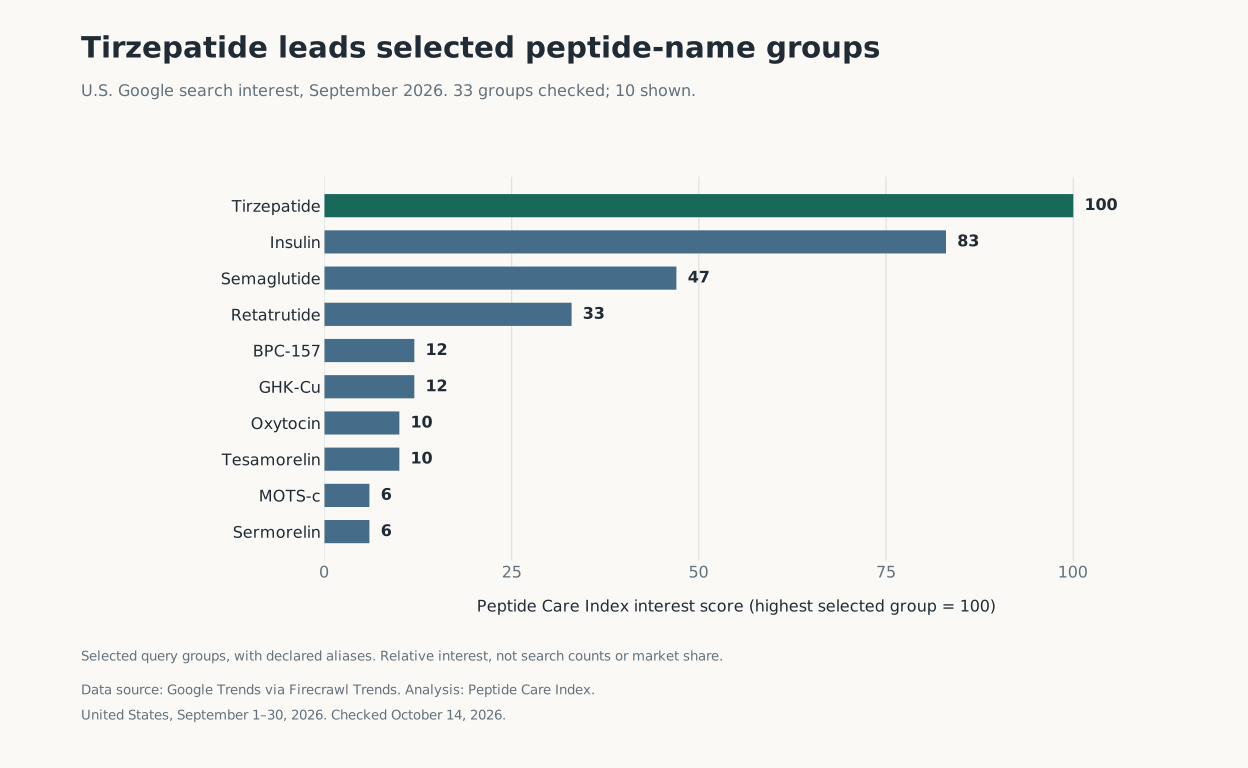
- Tirzepatide, insulin, semaglutide and retatrutide led the selected groups, with index scores of 100, 83, 47 and 33. These are Peptide Care Index’s rescaled interest scores for U.S. Google searches in September 2026. Full table
- Tirzepatide had about 3.0 times retatrutide’s average relative search interest in the same U.S. Google Trends comparison for September 2026, calculated by Peptide Care Index. Calculation
- Tirzepatide had about 2.1 times semaglutide’s average relative search interest in that September 2026 U.S. comparison, calculated by Peptide Care Index. Calculation
- BPC-157 and GHK-Cu both scored 12 at the displayed precision in Peptide Care Index’s September 2026 U.S. index. Each group includes the named spelling variants listed in the dataset. Group definitions
- 10 of the 33 selected groups scored below 1 on the custom index for September 2026 U.S. search interest. Peptide Care Index leaves those groups unranked because small values do not support a useful fine ordering. Limits
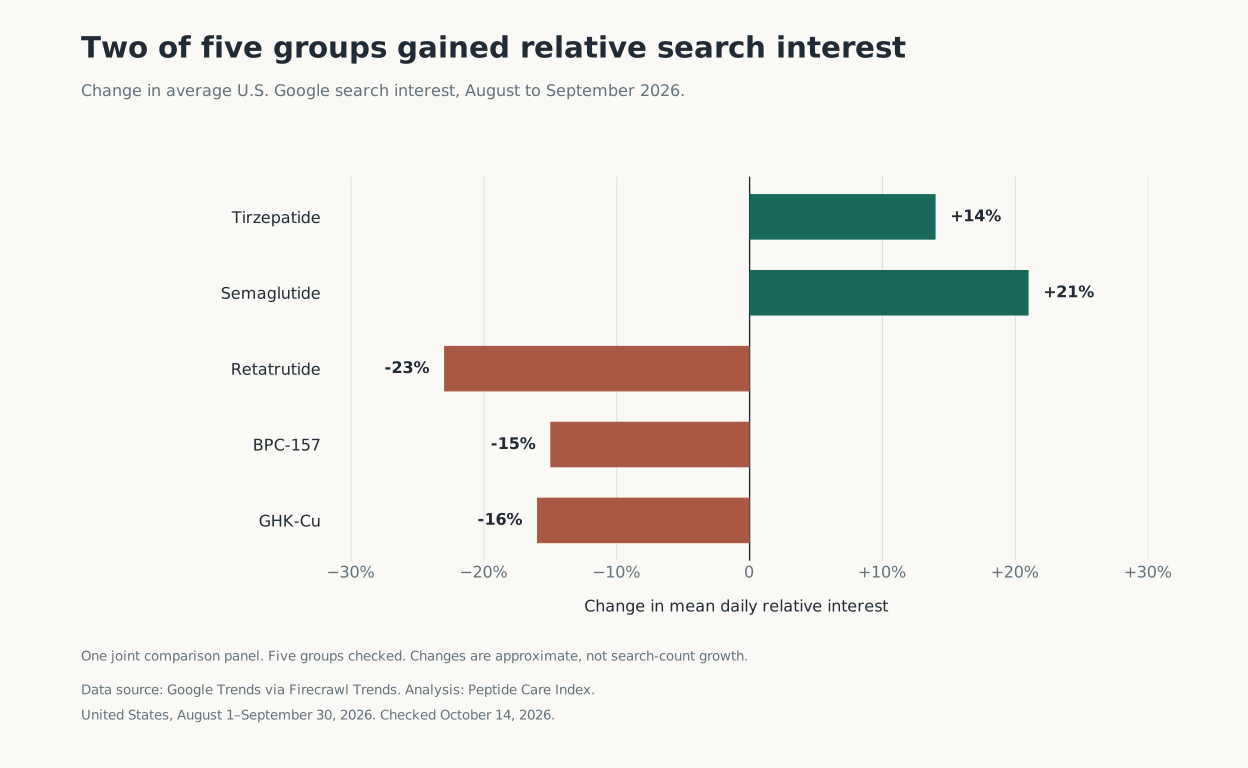
- Semaglutide’s average relative search interest rose about 21% from August to September 2026, while tirzepatide’s rose about 14%, in Peptide Care Index’s five-group U.S. Google Trends comparison. Month-to-month data
What are the most searched peptides in the U.S.?
Tirzepatide leads this 33-name comparison, followed by insulin, semaglutide and retatrutide. The table covers U.S. Google Web Search interest during September 1–30, 2026. It ranks selected name groups; it is not a census of every peptide, brand or related search.
The highest selected group is set to 100. Equal whole-number scores share a rank and appear in alphabetical order. A score below 1 stays unranked.
| Rank at shown precision | Peptide-name group | Interest index |
|---|---|---|
| 1 | Tirzepatide | 100 |
| 2 | Insulin | 83 |
| 3 | Semaglutide | 47 |
| 4 | Retatrutide | 33 |
| 5 | BPC-157 | 12 |
| 5 | GHK-Cu | 12 |
| 7 | Oxytocin | 10 |
| 7 | Tesamorelin | 10 |
| 9 | MOTS-c | 6 |
| 9 | Sermorelin | 6 |
| 11 | Glucagon | 5 |
| 11 | Ipamorelin | 5 |
| 13 | Bremelanotide / PT-141 | 4 |
| 13 | CJC-1295 | 4 |
| 13 | TB-500 | 4 |
| 16 | Selank | 3 |
| 16 | Semax | 3 |
| 18 | KPV (peptide phrase) | 2 |
| 18 | Liraglutide | 2 |
| 20 | Cagrilintide | 1 |
| 20 | Desmopressin | 1 |
| 20 | Epitalon / epithalon | 1 |
| 20 | Kisspeptin | 1 |
| Unranked | AOD-9604 | <1 |
| Unranked | Dulaglutide | <1 |
| Unranked | Elamipretide / SS-31 (qualified) | <1 |
| Unranked | Exenatide | <1 |
| Unranked | GHRP-2 | <1 |
| Unranked | GHRP-6 | <1 |
| Unranked | Hexarelin | <1 |
| Unranked | Linaclotide | <1 |
| Unranked | Teriparatide | <1 |
| Unranked | Thymosin alpha-1 | <1 |
Source: Peptide Care Index analysis of Google Trends data retrieved through Firecrawl Trends, October 14, 2026. United States; Web Search; all categories; September 1–30, 2026. Exact queries, panel sources and calculations appear in the free dataset. The leading four groups were compared together in the same source panel.
These scores measure average relative interest, not monthly search counts. A score of 12 does not mean 12 searches or 12% of the peptide market. Rank means order at the precision shown, not a statistically established difference between close results.
 Download PNG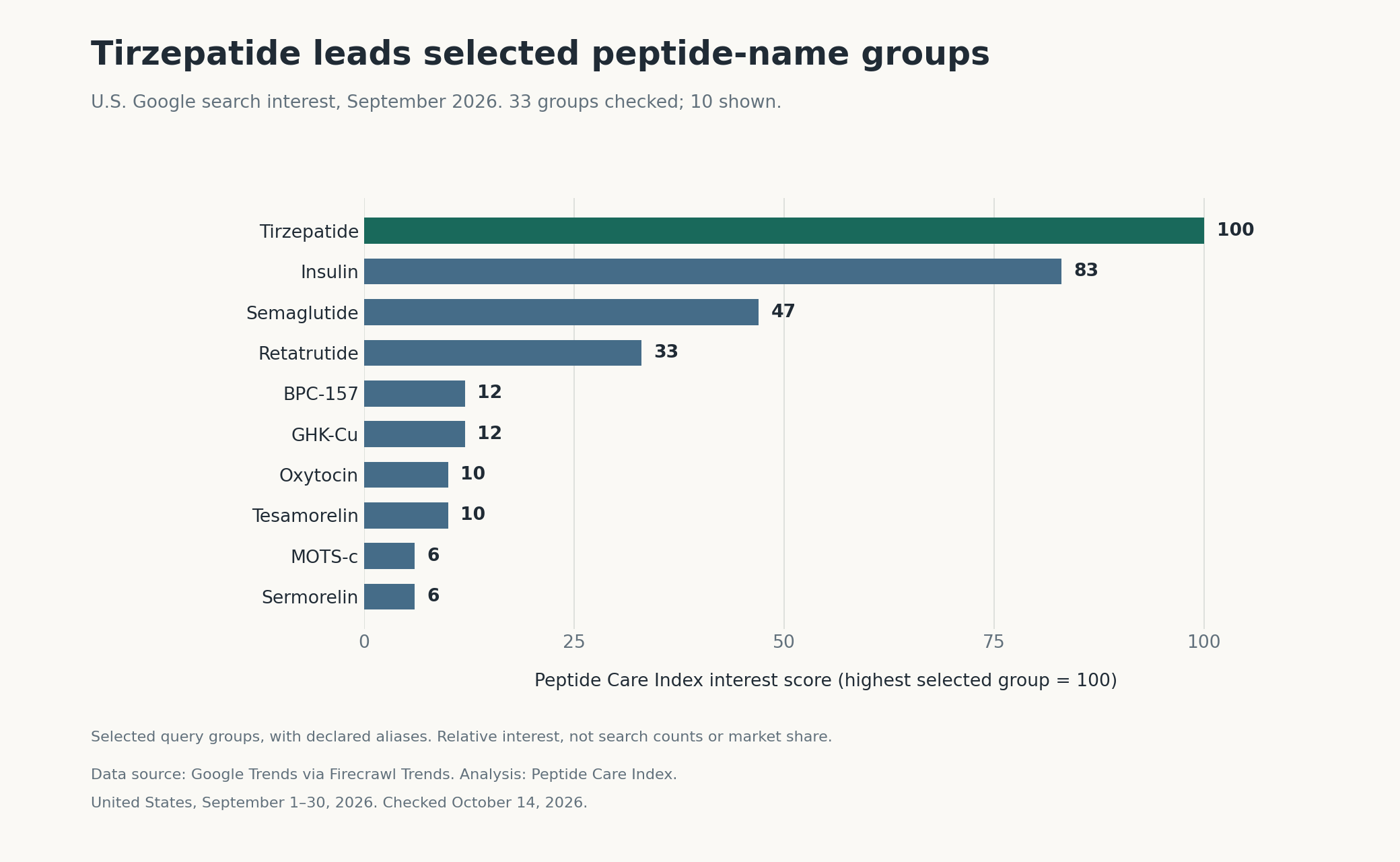
How much more search interest did tirzepatide receive?
Tirzepatide had about 3.0 times retatrutide’s average relative interest and 2.1 times semaglutide’s in the September 2026 U.S. comparison. It also had about 1.2 times insulin’s. All four values came from one Google Trends panel, so these leading comparisons do not depend on joining separate scales.
| Search term | Mean daily native Trends score | Tirzepatide divided by this term |
|---|---|---|
| tirzepatide | 38.1 | 1.0 |
| insulin | 31.6 | About 1.2 |
| semaglutide | 17.8 | About 2.1 |
| retatrutide | 12.6 | About 3.0 |
Source: Google Trends data panel P01, retrieved through Firecrawl Trends, checked October 14, 2026. Means use all 30 returned September daily scores; displayed means are rounded. Ratios use the unrounded sums in the dataset.
Think of this as a comparison of attention. On this measure, tirzepatide drew roughly three units of relative interest for each one drawn by retatrutide. It does not tell us that three times as many people used it, bought it or benefited from it.
Where do BPC-157, GHK-Cu and TB-500 rank?
BPC-157 and GHK-Cu share rank 5 at the shown precision, each with a score of 12. TB-500 scores 4 and shares rank 13 with CJC-1295 and the bremelanotide/PT-141 group. These are name-search groups in the selected September 2026 U.S. index, not treatment ratings. Source panel for BPC-157, GHK-Cu and TB-500
The two leading groups here are close: the source panel returns score sums of 666 for the BPC-157 group and 686 for the GHK-Cu group. That small gap is not a strong basis for declaring one the more popular molecule. We show their common rounded score instead.
GHK-Cu interest can include skin-care questions. TB-500 interest does not identify a particular substance in a seller’s vial. CJC-1295 searches do not tell us which formulation the person meant. This dataset cannot sort interest by route, dose or product quality.
For those separate questions, use our peptide comparison chart. If the practical question is access, our BPC-157 access guide explains what to check. Our BPC-157 cost page keeps published prices tied to their package and fees.
Which peptide searches rose from August to September 2026?
Among the five groups checked over both months, semaglutide’s average relative interest rose about 21% and tirzepatide’s rose about 14%. Retatrutide, BPC-157 and GHK-Cu fell on the same measure. This is a two-month comparison of five selected groups, not a claim about the fastest-growing peptide overall.
| Name group | August mean daily native score | September mean daily native score | Change in average relative interest |
|---|---|---|---|
| Tirzepatide | 33.4 | 38.1 | +14% |
| Semaglutide | 14.7 | 17.8 | +21% |
| Retatrutide | 16.3 | 12.6 | −23% |
| BPC-157 | 5.4 | 4.6 | −15% |
| GHK-Cu | 5.6 | 4.7 | −16% |
Source: Peptide Care Index calculation from one Google Trends data panel covering August 1–September 30, 2026, via Firecrawl Trends. United States; Web Search; all categories; checked October 14, 2026. August has 31 daily records and September has 30. Changes use unrounded monthly means, not the rounded values printed in the table.
 Download PNG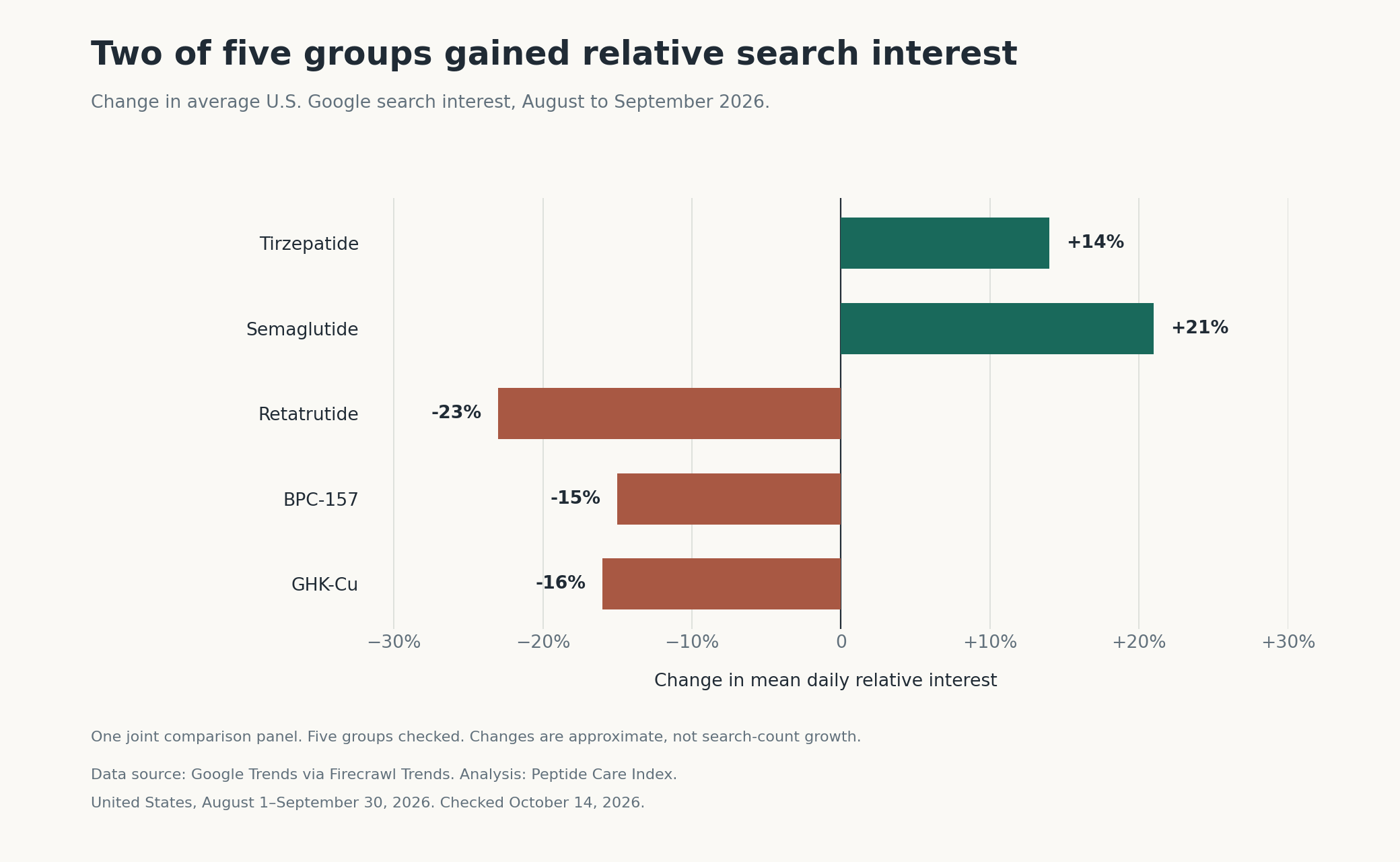
A monthly increase can coexist with a lower position in the ranking. Semaglutide gained more on this measure than tirzepatide, but tirzepatide still had the higher September average. These data do not establish what caused either change.
What does this peptide search ranking measure?
The index compares 33 selected peptide-name search groups. It covers drug names, natural hormone names and names used in research or wellness discussions. Each group measures matching searches in Google Trends; it does not identify the searcher’s purpose.
We included insulin, oxytocin and glucagon to avoid making a broad peptide-name comparison look like a list of newer research compounds alone. Those broad terms can include questions about the body and disease as well as medicines. Insulin is itself a peptide hormone, as FDA describes.
This is a selected inventory. It does not cover all peptide medicines, all cosmetic peptide ingredients or every spelling and nickname. Brand names such as Ozempic, Wegovy, Mounjaro and Zepbound are outside this release. So are category phrases such as “collagen peptides,” supplier names and blend names. “Reta” and “reta peptide” are not included in the retatrutide group.
How are spelling variants and aliases handled?
We used Google Trends’ + operator to combine listed alternatives in one request. We did not add separate volume estimates for each spelling. Google’s search syntax guide explains that + matches alternatives and that quoted phrases can appear inside longer searches.
| Displayed name | Exact query expression or rule |
|---|---|
| BPC-157 | "BPC-157" + "BPC 157" + BPC157 |
| GHK-Cu | "GHK-Cu" + "GHK Cu" + GHKCu |
| TB-500 | "TB-500" + "TB 500" + TB500; thymosin beta-4 not added |
| CJC-1295 | "CJC-1295" + "CJC 1295" + CJC1295 |
| MOTS-c | "MOTS-c" + "MOTS c" + MOTSc |
| Bremelanotide / PT-141 | bremelanotide + "PT-141" + "PT 141" + PT141 |
| Epitalon / epithalon | epitalon + epithalon |
| KPV | "KPV peptide"; the qualifying word narrows coverage |
| Elamipretide / SS-31 | "SS-31 peptide" + "SS31 peptide" + elamipretide; bare SS31 excluded |
| Retatrutide | retatrutide; informal “reta” forms excluded |
Source: Exact expressions submitted for this analysis, preserved in the ranking CSV. Alias identity checks: National Library of Medicine’s bremelanotide/PT-141 record, elamipretide/SS-31 original report and FDA epitalon briefing. Checked October 14, 2026.
Every group’s full query expression is printed in the dataset. The two peptide-qualified groups capture a narrower set of searches than a bare acronym would. Read their scores with that rule attached.
How we built this
We collected and processed the records on October 14, 2026. The main period was the complete month of September 2026. The monthly-change panel covered August and September together.
- Select the names. We assembled the 33-name inventory from peptide medicine, hormone and research-name contexts. The exact final inventory is the full table, not an assumed census of the market. A broad SS-31 pilot query was replaced with peptide-qualified phrases and elamipretide to reduce unrelated acronym matches. The discarded query remains labeled in the raw data.
- Hold the settings steady. Every September panel used United States, Web Search, all categories and September 1–30, 2026. All returned 30 daily records marked complete. These are search terms and expressions, not Google topic entities.
- Collect the source records. We retrieved Google Trends data through Firecrawl Trends’ structured data service. Its records include exact terms, dates, scores, source-panel URLs and collection times. Google’s direct Explore interface was rate-limited during collection, so we did not obtain a second direct-interface export to independently confirm the provider-delivered records.
- Join the comparison scales. Retatrutide was the common reference term, or “anchor,” in the main panels. For each group, we divided its sum of daily scores by the anchor’s sum in that same panel. Tirzepatide, insulin, semaglutide and retatrutide were measured together.
- Check smaller groups. We collected two panels with sermorelin as a smaller anchor. Its ratio to retatrutide was 315 ÷ 1,817 in the calibration panel. We used that ratio to bring eight small-group results onto the common scale. A same-panel consistency check returned repeated values; we treat it as a consistency check, not independent replication.
- Show only useful precision. We set the highest selected group to 100, round other scores to whole points and tie equal displayed scores. We leave values below 1 unranked. We retain the calculations and the raw zero and data flags in the CSVs.
The calculation is:
Relative to retatrutide = group’s daily-score sum ÷ retatrutide’s daily-score sum in the same panel.
Our interest index = 100 × relative-to-retatrutide value ÷ the largest selected relative-to-retatrutide value.
For the smaller sermorelin panels, first multiply the group-to-sermorelin ratio by 315 ÷ 1,817. This converts it to the shared retatrutide reference before the final rescaling.
For example, tirzepatide’s daily-score sum was 1,143 and retatrutide’s was 377 in panel P01. Their ratio is 1,143 ÷ 377 = about 3.0. Tirzepatide becomes 100 on our index; retatrutide becomes 100 ÷ (1,143 ÷ 377) = about 33.
Month-to-month change uses a different calculation on one joint panel:
Change = [(September daily-score sum ÷ 30) ÷ (August daily-score sum ÷ 31) − 1] × 100.
For semaglutide, that is [(534 ÷ 30) ÷ (456 ÷ 31) − 1] × 100 = about 21%. Comparing means gives each day the same weight despite the different month lengths.
This is our own, simple anchor calculation. It is not Google’s native 0–100 series and does not implement the full Google Trends Anchor Bank method. Robert West’s calibration research explains why joining scales and checking low-interest terms matter.
To repeat the leading comparison, open the same terms and dates in Google Trends. This is a reproduction query, not a second export used in this release. The downloads retain the records used for our calculations.
What can this data tell us—and what can’t it?
The data show relative attention to the selected query groups in one place and period. They do not give absolute search counts, unique searchers, use rates or sales. Google Trends uses sampled searches, normalizes them and adds privacy-related noise. Google’s data explanation
- A zero is not proof of no searches. Low-volume terms can be returned as zero. Some small groups have few nonzero days even after the smaller-anchor check.
- Close scores do not prove a stable ordering. BPC-157/GHK-Cu, MOTS-c/sermorelin and several other groups are similar at the precision this release can support.
- The ratios describe relative interest. Each day’s Trends score depends on that day’s total searches. A ratio of daily-score averages is not an exact ratio of the month’s raw search counts.
- Groups can overlap. A longer query naming two peptides can match both groups. Adding the scores would not produce a market size or a share of all peptide searches.
- The names do not identify a treatment. Broad hormone queries can reflect biology questions. GHK-Cu queries can reflect cosmetics. Search names do not establish route, product, patient demand, safety or effectiveness.
- A fresh extraction can differ. Sampling, noise and rounding can change small values. The downloadable record preserves the version used for this analysis.
For a separate view of documented market activity, see our peptide statistics and drug-sales data.
If you are deciding what to check before contacting a clinic, Find My Peptide Path organizes access evidence, provider questions and costs. It is free and needs no account or email.
How to cite this page
Publication: Peptide Care Index
Title: Most Searched Peptides: 33-Name U.S. Ranking (2026)
Version: 2026-10-14
Data period: September 1–30, 2026; monthly-change panel August 1–September 30, 2026
Permanent URL: https://peptidecareindex.com/research/most-searched-peptides/
Peptide Care Index. (2026, October 14). Most Searched Peptides: 33-Name U.S. Ranking (2026) (Version 2026-10-14). Analysis of Google Trends data for September 2026. https://peptidecareindex.com/research/most-searched-peptides/
For a single finding, preserve its scope: “Tirzepatide led 33 selected peptide-name groups in U.S. Google search interest in September 2026, according to Peptide Care Index’s analysis of Google Trends.”
You may reuse Peptide Care Index’s original analysis and chart design with credit to Peptide Care Index; preserve Google Trends attribution and the underlying Google terms. No link is required.
Download the data and charts
All downloads are free and open without an account or email.
- 33-name ranking, exact queries and calculation inputs — CSV
- September daily source scores, including calibration and checks — CSV
- Five-group month-to-month calculation — CSV
- August–September daily source scores — CSV
- Source-panel settings and retrieval dates — CSV
- Ranking chart — PNG · SVG
- Monthly-change chart — PNG · SVG
Questions about the most searched peptides
Is BPC-157 the most searched peptide?
BPC-157 shares rank 5 at the shown precision in this selected U.S. September 2026 comparison. Tirzepatide leads it. That answer applies to the declared query groups and relative-interest measure; a different geography, period or list can produce another ranking.
Does a score of 100 mean 100 searches?
No. On this page, 100 is the score assigned to the leading selected group, tirzepatide. Google’s original daily scores and our rescaled monthly comparison are separate fields in the download.
Which peptide was growing fastest?
Semaglutide had the largest increase among the five groups in the August-to-September check, about 21% in average relative interest. We did not measure monthly growth for all 33 groups, so this does not establish the fastest-growing peptide overall.
Why can a peptide have a low score despite an approved medicine using it?
This release measures the declared name expression, not every brand name or all discussion of a molecule. A low generic-name score cannot establish low medicine use. Search interest, approval records and prescribing data answer separate questions.
Which state searches for peptides the most?
This dataset compares the United States as a whole and does not rank states. State-level Google Trends scores measure relative interest within a state, not the total number of searches. A count ranking would need a source that reports comparable state search counts.
Sources and check dates
- Google Trends data via Firecrawl Trends. Leading-name panel; BPC-157/GHK-Cu/TB-500/sermorelin panel; joint August–September panel. Full panel list in
google-trends-panels.csv. Collected October 14, 2026. These are the source records for the original calculations, not published estimates borrowed from another peptide ranking. - Google. FAQ about Google Trends data. Sampling, normalization, zeroes, noise and the difference from absolute volumes. Checked October 14, 2026.
- Google. Search tips for Trends. Phrase matching and alternative-name syntax. Checked October 14, 2026.
- Google. Export, embed, and cite Trends data. Attribution and reuse under Google’s terms. Checked October 14, 2026.
- West, Robert. Calibration of Google Trends Time Series. Original calibration research, first submitted 2020 and revised 2021. Checked October 14, 2026. Used for method context; this release does not claim to implement the full paper’s method.
- U.S. Food and Drug Administration. Establishment and validation of an in vitro cell-based assay to assess the biological activity of insulin products. Peptide-hormone identity of insulin. Checked October 14, 2026.
- National Library of Medicine. Bremelanotide MeSH record. PT-141 appears as an entry term. Used only to verify the name pair. Checked October 14, 2026.
- Pharaoh et al. The mitochondrially targeted peptide elamipretide (SS-31) improves ADP sensitivity in aged mitochondria. Original report, 2023. Used only to verify the name pair. Checked October 14, 2026.
- U.S. Food and Drug Administration. Epitalon briefing for the July 23–24, 2026 Pharmacy Compounding Advisory Committee meeting. Used only for the epitalon/epithalon name context. Checked October 14, 2026.
What changed: October 14, 2026 — Initial 33-name release, with a separate five-group August-to-September comparison.
Peptide Care Index Research is the research and reference section of peptidecareindex.com.