BPC 157 human studies: results and trial tracker (2026)
By Peptide Care Index · Updated October 2026
The four full clinical journal reports in our BPC 157 human studies ledger cover 33 participant records; none has a control group. Peptide Care Index’s October 2026 audit also separates older trial abstracts, commercial reports and a 1,039-user preprint. They answer different questions. The tables below show which numbers can support a claim—and which cannot.
What are the key BPC-157 human-study numbers?
- 4 full clinical journal reports, 33 participant records, no control groups: Peptide Care Index’s October 2026 audit totals the reported follow-up/sample counts for knee pain, bladder symptoms, IV safety and a dental nerve case series. See the four-report table.
- 26 of those 33 records involved BPC-157 as the only study peptide; 7 involved peptide combinations. This is our report-level count, not a count of verified unique people or isolated monotherapy. Count details.
- 17 people were treated and 16 reached for follow-up in Lee and Padgett’s 2021 knee report; 12 of the 16 received BPC-157 without TB4. Original report.
- 32 healthy volunteers and 53 ulcerative-colitis patients were randomized in two older placebo-controlled cohorts summarized by FDA. Their findings were reported in meeting abstracts, not full trial papers retrieved for this audit. FDA Appendix 1.
- 1,039 documented users appear in a September 2026 clinical-note preprint. Response direction was missing for 685, or 65.9%. It is not a randomized treatment study. Original preprint.
- 78.8% applies to 279 of 354 users with a documented response, not all 1,039 users. Our calculation puts documented improvement at 26.9% of the full cohort; the rest include missing outcomes, unchanged symptoms and worsening. Neither share measures efficacy. Denominator table.
- 101 people supplied paired outcomes in a 2024 commercial oral-capsule summary. That number is not verified total enrollment, and the summary is not a full peer-reviewed clinical paper. Original summary.
- 4 ClinicalTrials.gov records, none with posted results: that is the result of our BPC-157 and development-name search on October 14, 2026. Registry-only records are separate from published outcomes. Registry table.
Which full clinical reports have tested BPC-157 in people?
The four full journal reports reviewed here describe knee pain, interstitial cystitis, short-term IV safety and dental nerve symptoms. Their reported follow-up/sample counts add to 33, but they do not form one trial. None compares a BPC-157 group with a placebo or untreated group.
| Report | People reported | Design and route | What it can tell us |
|---|---|---|---|
| Knee pain, 2021 | 17 treated; 16 reached; 12 BPC-only and 4 BPC + TB4 | Retrospective records and phone follow-up; knee-joint injection | Describes reported pain changes; cannot show that damaged tissue healed because of BPC-157 |
| Interstitial cystitis, 2024 | 12 women | Retrospective chart review; bladder-wall injection | Describes reported bladder-symptom changes in a small selected group |
| IV safety, 2025 | 2 adults with previous IV BPC-157 exposure | Prospective uncontrolled pilot; IV infusion | Describes selected markers and symptoms through day 3; does not test injury healing |
| Dental nerve injury, September 2026 | 3 cases, all on a combined protocol | Uncontrolled case report; local treatment with several peptides and other medicines | Describes sensory recovery; cannot isolate BPC-157 from other treatment or natural recovery |
Sources: linked original reports. Counts and classifications checked October 14, 2026. “Retrospective” means looking back at care already given. A control group gives a study a comparison that these reports lack.
How does the 33-participant count break down?
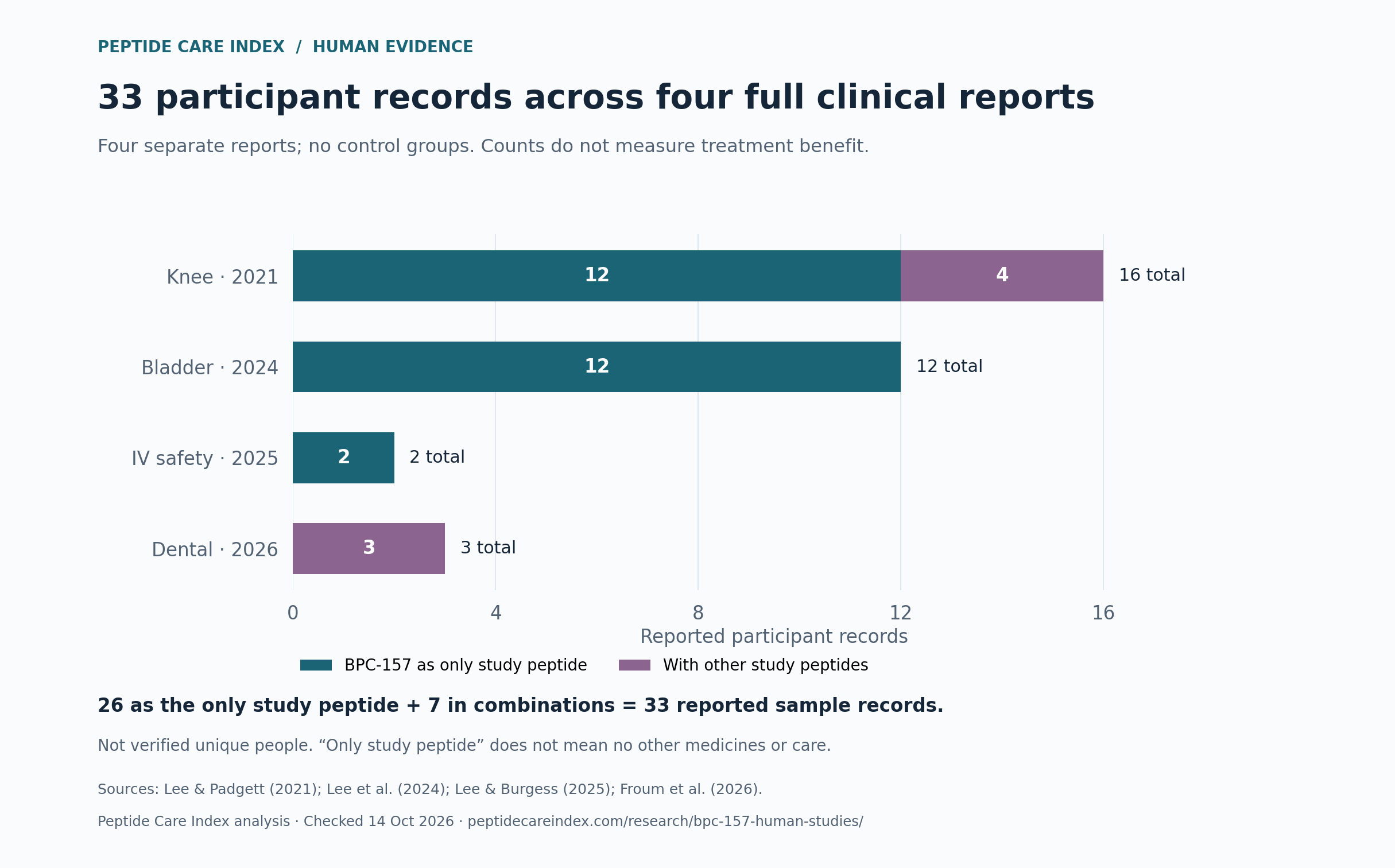
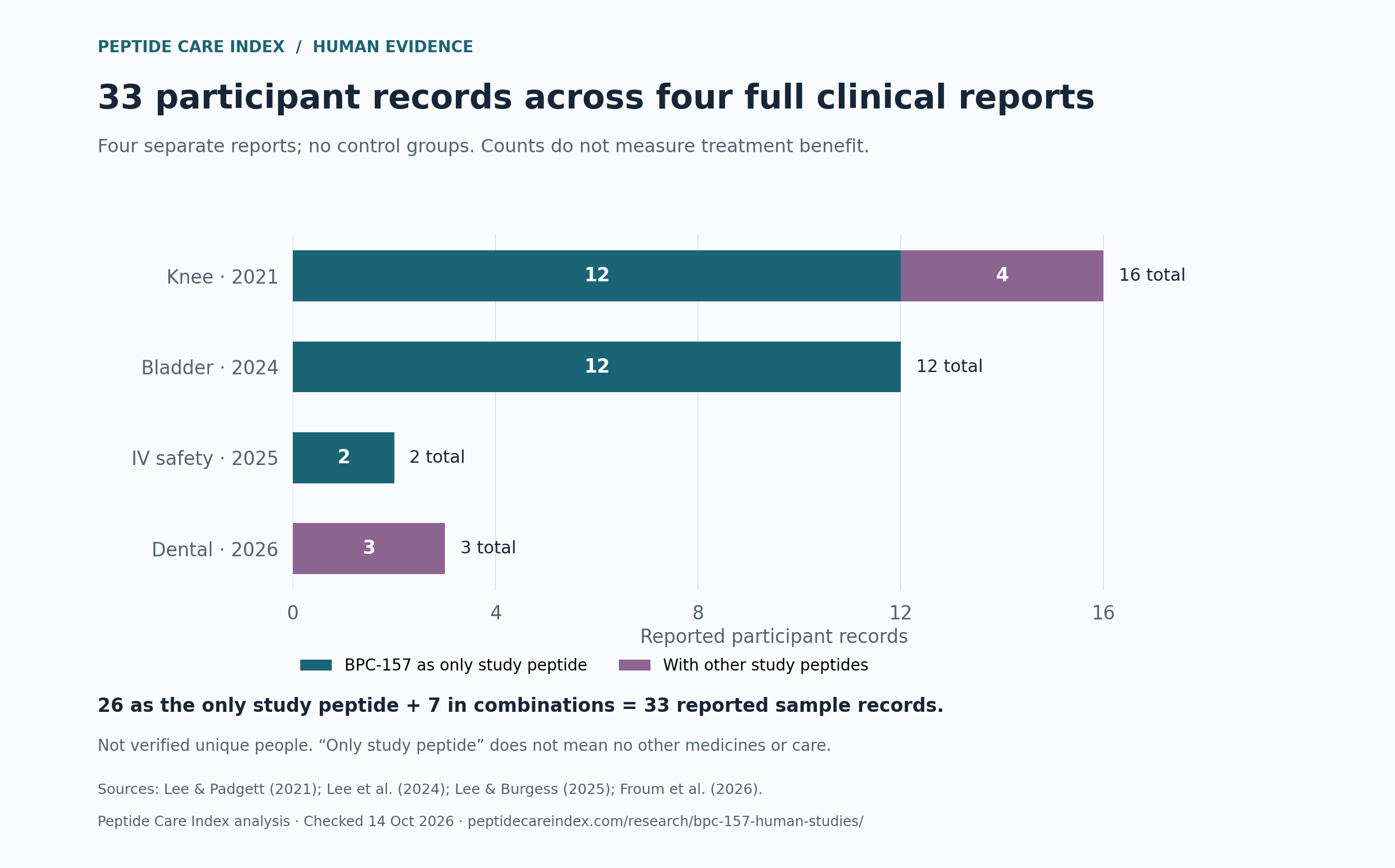
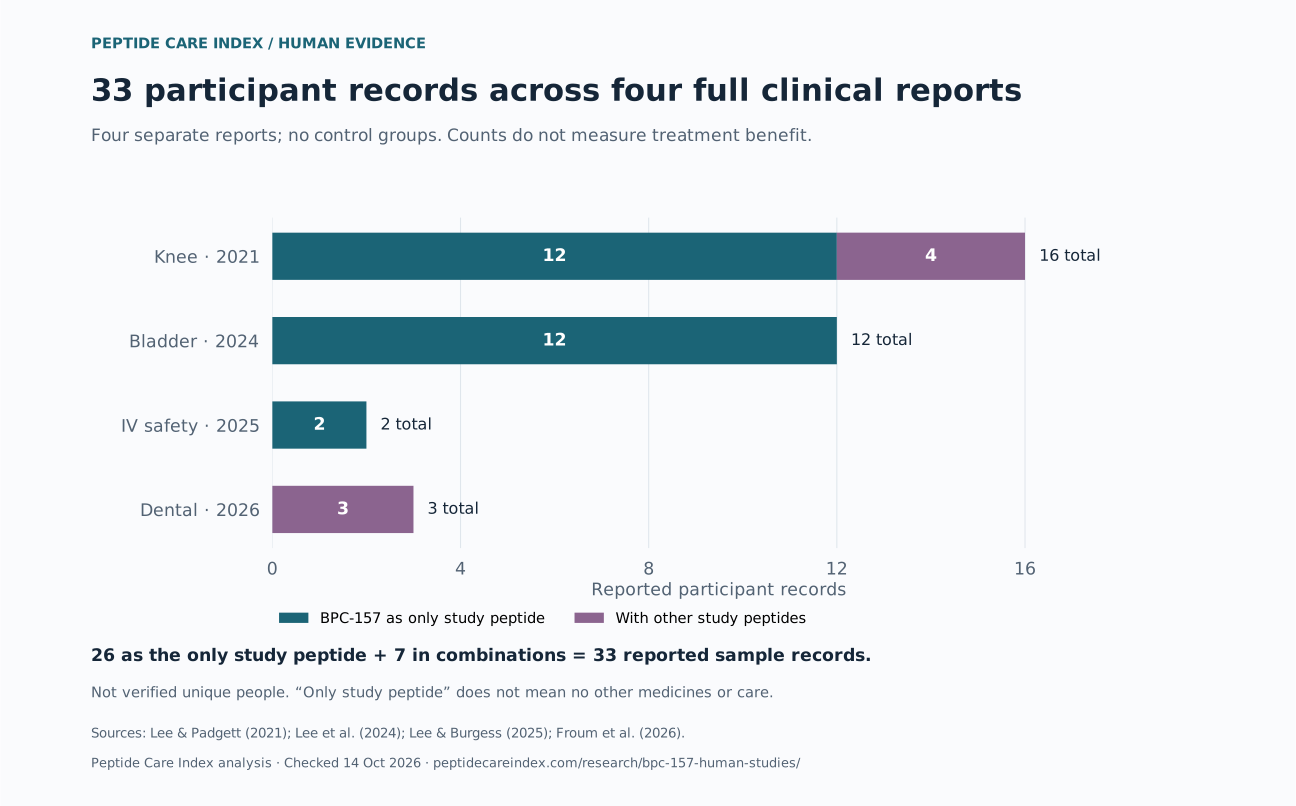
Our scoped total is 16 + 12 + 2 + 3 = 33 participant records. It uses the knee report’s 16 reachable patients, not all 17 treated. Of the 33 records, 26 involved BPC-157 as the only study peptide and 7 involved other study peptides too.
| Full report | BPC-157 as the only study peptide | BPC-157 with other study peptides | Total reported sample |
|---|---|---|---|
| Knee pain, 2021 | 12 | 4 | 16 |
| Bladder symptoms, 2024 | 12 | 0 | 12 |
| IV safety, 2025 | 2 | 0 | 2 |
| Dental nerve cases, 2026 | 0 | 3 | 3 |
| Total within these four reports | 26 | 7 | 33 |
Source: Peptide Care Index extraction and calculations from the four original reports above. This is not a count of all people ever studied. Overlap between reports cannot be ruled out. “Only study peptide” does not mean no other medicines or care.
What did the knee-pain study actually find?
11 of 12 BPC-only patients reported improvement; 7 of 12 were in the six-month-to-one-year relief category. Those are different findings. The paper does not show that all 11 had relief beyond six months.
The other four reachable patients received BPC-157 with thymosin beta-4, called TB4 in the paper; three reported improvement. The study used records and phone follow-up rather than a randomized comparison. Pain relief is not proof of repaired tendons, cartilage or ligaments. Original tables 1–5.
What did the bladder study find?
The retrospective bladder report included 12 women: 10 reported complete symptom resolution, and 2 reported 80% improvement. These were reported symptom changes in interstitial cystitis, a bladder-pain condition. There was no control group to separate a treatment effect from other explanations. Original report.
Did the two-person IV study establish safety or a human half-life?
No. The IV pilot followed two previously exposed adults through day 3. It reported no symptoms or clinically relevant changes in the selected monitored markers. It did not measure BPC-157 concentrations to establish a human half-life, meaning the time for its blood level to fall by half. Original report.
What changed with the September 2026 dental case report?
A September 30, 2026 paper adds three dental nerve-injury cases to this ledger. All received BPC-157 with ARA-290, TB-500 and other medicines. Symptoms improved, but the authors present the cases as ideas for further testing, not proof that BPC-157 caused the recovery. Froum and colleagues.
What human evidence sits outside those four full reports?
Two older placebo-controlled trial cohorts were reported as meeting abstracts. Newer conference, commercial and survey reports also describe human use. Leaving them out entirely would be misleading; treating them as full clinical trial papers would be misleading too.
| Record | Exact denominator | Publication type | What to keep in view |
|---|---|---|---|
| Healthy-volunteer PL 14736 trial, 2002/2003 | 32 randomized; 24 received active treatment | Two meeting abstracts describing one cohort, as grouped by FDA | Rectal-enema tolerability work; count the cohort once |
| Ulcerative-colitis PL 14736 trial, 2005 | 53 randomized; 46 completed | Meeting abstract, summarized by FDA | Placebo-controlled; limited methods and no full trial paper retrieved |
| Musculoskeletal-pain poster, presented in 2025/2026 | 11 treated; 10 analyzed | Conference poster | Four-week uncontrolled series; matching earlier presentation treated as one report family |
| Oral-capsule summary, August 2024 | 101 with paired baseline/end outcomes; total enrollment not verified | Commercial results summary | Four-week before-and-after report; no placebo; formulation-specific |
| Peptide Safety Initiative, April 2026 | 613 self-users + 6 clinicians = 619 completed responses | Self-published online survey | Self-selected respondents, unverified products and no comparison group |
| Clinical-note preprint, September 2026 | 1,039 documented users; response direction for 354 | Observational preprint, not peer reviewed | Records use and reported changes; cannot establish efficacy |
| Carpal-tunnel safety case, February 2026 | One reported case | Conference case abstract | Describes symptoms after reported use; does not establish BPC-specific causation |
Sources: original reports linked in each row; historical abstracts extracted from FDA’s May 11, 2026 evaluation prepared for the July meeting. Checked October 14, 2026. The original historical abstracts were not directly retrieved.
Have there really been no randomized human trials?
That claim is too broad. FDA describes a 32-person healthy-volunteer trial and a 53-person ulcerative-colitis trial with placebo controls. The ulcerative-colitis abstract reported a between-group confidence interval that crossed zero, so it did not establish a clear treatment advantage; FDA judged its evidence inadequate to support efficacy and safety. FDA evaluation.
The more accurate distinction is that no full randomized, controlled efficacy report was verified in this ledger. An older rectal-enema abstract also cannot establish that capsules, skin injections or a peptide blend heal an injury.
Does the 101-person oral report prove capsules work?
No. The 101 figure counts people who supplied paired outcomes in a commercial summary. It reports changes during four weeks of a particular capsule formulation, without a placebo group or a full peer-reviewed paper identified in this audit. It cannot establish a general effect for all oral BPC-157 products. Results summary.
For the formulation and absorption questions this raises, see our BPC-157 capsule evidence review.
Did BPC-157 work for 79% of people in the 2026 preprint?
The 79% claim refers to 279 of 354 users with a documented response direction—not all 1,039 users. For 685 users, or 65.9%, response direction was missing. The paper is a preprint, and medical-note observations cannot show how much change was caused by BPC-157.
The authors searched clinical notes in a network of 15.2 million patients. A BPC-157 mention appeared for 1,536 patients; model-assisted curation identified 1,039 documented users. A mention, documented use and a documented outcome are three different counts. Original methods and results.
| Recorded response | Users | Share of all 1,039 users | Share of the 354 with a response |
|---|---|---|---|
| Improved | 279 | 26.9% | 78.8% |
| No change | 58 | 5.6% | 16.4% |
| Worse | 17 | 1.6% | 4.8% |
| Response not documented | 685 | 65.9% | Not part of this denominator |
| Total | 1,039 | 100.0% | 354 response-known users |
Source: Venkatakrishnan and colleagues, September 7, 2026 preprint, Table 2 and abstract; all-user percentages calculated by Peptide Care Index. Checked October 14, 2026. Percentages describe documentation, not a treatment success rate.
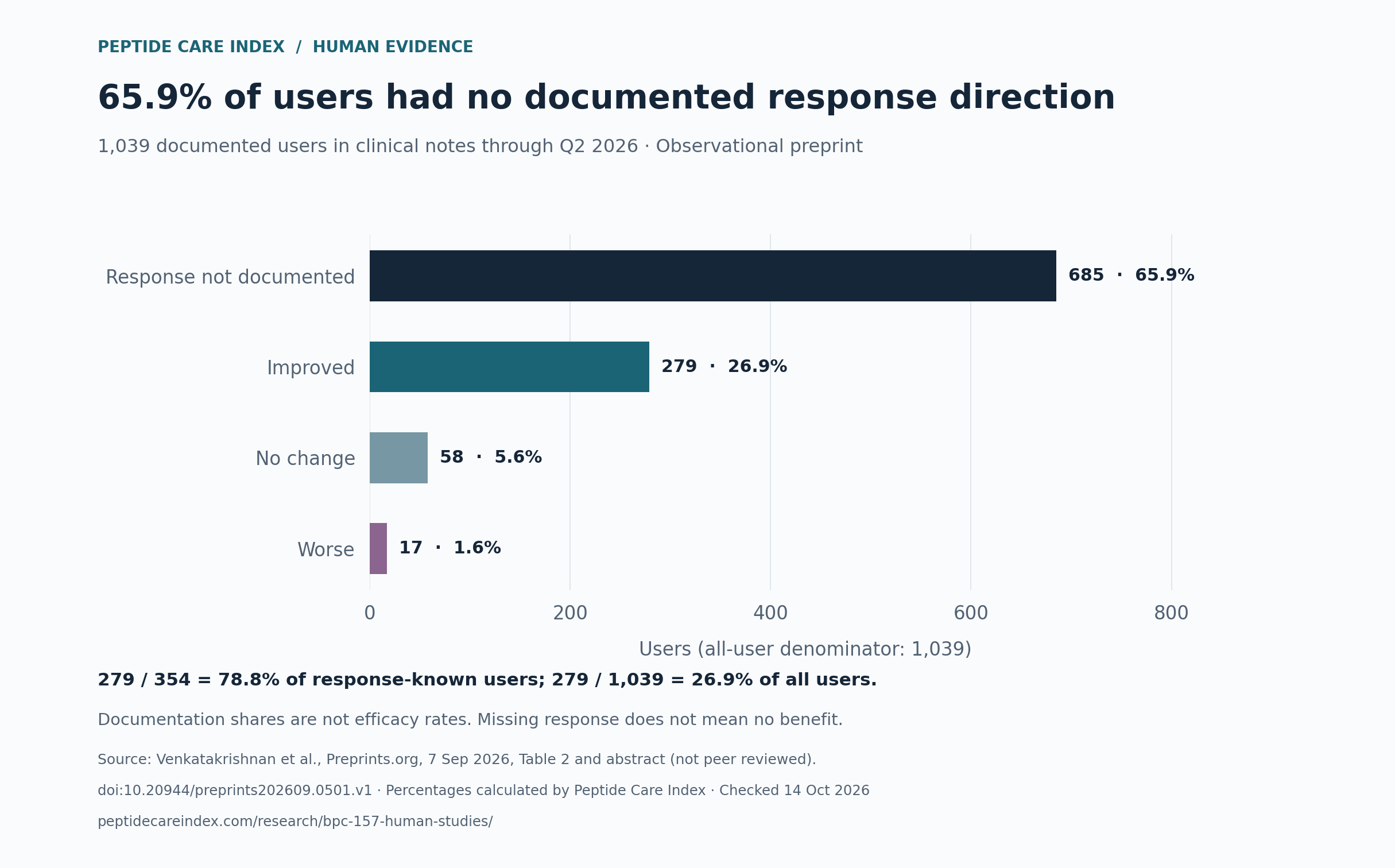
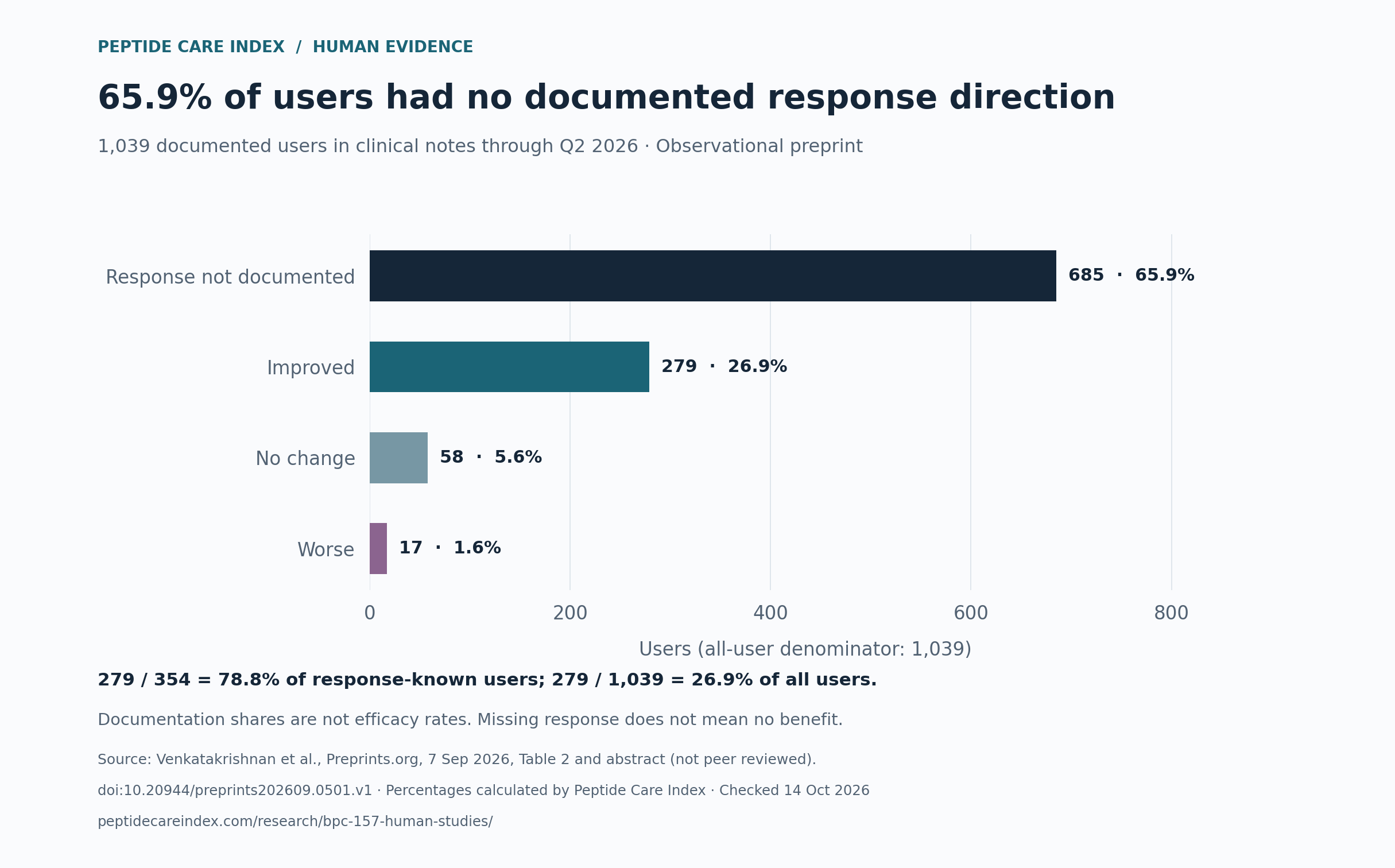
Our calculation gives two useful, clearly named figures: 78.8% of response-known users had improvement documented; 26.9% of all documented users had improvement documented. Neither tells us the true chance of benefit. Missing records do not become either successes or failures.
The paper also records other therapeutic-agent use in 525 of 1,039 users, or 50.5%. That includes other drugs and peptides. Treatment combinations, natural recovery, expectations and uneven records make it impossible to isolate a BPC-157 effect from this dataset.
Which BPC-157 clinical trials are registered now?
Our October 14, 2026 ClinicalTrials.gov search found four records for BPC-157 and the development names checked. None had posted results. A registry entry is a description supplied to a registry; its status and enrollment fields do not independently verify treatment, outcomes or benefit.
| Record | Sponsor | Registry status | Enrollment field | Last update posted | Results and caveats |
|---|---|---|---|---|---|
| PCO-02 / Bepecin, NCT02637284 | PharmaCotherapia d.o.o. | Unknown; last known active, not recruiting | 42 estimated | December 22, 2015 | No results; old oral safety/pharmacokinetic protocol |
| Hamstring strain, NCT07437547 | Hudson Biotech | Lists recruiting | 120 estimated | February 27, 2026 | No results; trial conduct not independently verified; see credibility concern below |
| Peptide gummies, NCT07752381 | Parlay Wellness | Completed | 40 actual, as reported in the registry | August 7, 2026 | No results; single-group product study; first registered after its listed completion |
| Rotator-cuff repair, NCT07803250 | University of Arkansas | Not yet recruiting | 30 estimated in structured field; narrative says 20 | September 3, 2026 | No results; estimated start January 2027; enrollment and comparator descriptions conflict |
Source: linked ClinicalTrials.gov records and their API v2 data, retrieved October 14, 2026. “Estimated” is a plan. “Actual” is the sponsor-reported enrollment type; it is not an audited published outcome count.
Why does the hamstring record need an extra caution?
The BPC-157 hamstring record lists recruiting, but two other records under the same sponsor explicitly label themselves as fictional or mock. Those words appear in NCT07487363 and NCT07481734. The BPC-157 record itself does not carry that label.
That is a concrete reason to question whether its listed activity reflects a real enrolling trial. Our inference is limited to a credibility concern: this audit has not independently confirmed the conduct of the BPC-157 trial. We do not count its 120 planned participants as people studied or describe its benefits as established.
Was the old PCO-02 trial canceled?
Its canceled results submission does not establish that the trial was canceled. The PCO-02 results tab lists a May 23, 2016 submission as canceled, while the overall study status is unknown. No public results are posted.
What should readers make of the rotator-cuff record?
Its own fields disagree: 30 participants in the structured enrollment field and 20 in the narrative. Its descriptions also differ on saline-placebo injections versus no injections. The record lists an estimated January 2027 start and no results, so it cannot support a current healing claim. Original registry record.
Our BPC-157 news and regulatory tracker follows the related agency and registry developments.
Do these human studies prove healing or long-term safety?
They do not establish either claim. The four full clinical reports lack control groups, and the large preprint has missing outcomes and common co-treatment. The evidence can describe reported experiences; it cannot tell a reader how much BPC-157 improves healing, how it compares with standard care or how safe repeated use is.
| Claim | What the evidence here actually supports |
|---|---|
| “It heals tendons or ligaments in people.” | Reported symptom changes and planned trials are not proof of faster structural healing caused by BPC-157. |
| “The two-person IV study proved it safe.” | A brief observation of two previously exposed adults cannot establish long-term or population safety. |
| “No side effects were reported, so there are no risks.” | Small uncontrolled reports and voluntary records can miss uncommon harms and cannot provide a reliable risk rate. |
| “An oral or rectal finding validates every route.” | Different routes, formulations and combinations need their own evidence. |
| “A paper using human tissue is a human treatment trial.” | An isolated artery or cell experiment does not mean a person received BPC-157. |
Sources: the clinical reports and preprint above; FDA’s human-safety assessment. These are evidence judgments, not estimates of a treatment effect or risk.
The February 2026 conference safety case describes forearm symptoms and abnormal liver tests after reported BPC-157 injections. It does not establish which substance or process caused the event, or how often an event might occur. FDA likewise explains why adverse-event reports alone cannot prove causation or supply a reliable rate.
For a medical decision, take the exact paper and your question to a licensed clinician. The site's BPC-157 access guide covers the separate questions an advertised care offer raises.
How did we build this evidence ledger?
We checked sources on October 14, 2026. This is a source-based editorial audit of identifiable human reports and registry records, not a new clinical trial, a patient survey or a preregistered systematic review.
- Find reports and development names. We searched for BPC-157 human studies, clinical trials, knee pain, bladder symptoms, IV safety, oral studies, recent cases and conference reports. We used BPC-157/BPC 157 and the development names PL 14736, Bepecin and PCO-02. We used reviews and news as leads, then checked the result-bearing sources.
- Read and classify each source. We read the four full clinical reports, the preprint, the commercial capsule summary, the survey report and the accessible conference records. The historical phase I and ulcerative-colitis rows come from FDA’s detailed evaluation; their original abstracts were not directly retrieved.
- Check registries separately. We retrieved the four ClinicalTrials.gov API records and checked status, enrollment type, dates and posted-result availability. We also read the same-sponsor records behind the hamstring credibility concern. The search expression was
BPC-157 OR Bepecin OR PL14736 OR PCO-02. - Keep denominators intact. We separate treated people, reachable patients, paired-outcome respondents, randomized participants, documented users and planned enrollment. A blank CSV cell means unknown or not applicable, not zero.
- Avoid counting the same report twice. FDA groups the 2002/2003 phase I abstracts as one cohort. Matching authors, title and design suggest the 2025/2026 musculoskeletal poster is a repeat presentation; we retain one report family without claiming that linkage is proved.
- Calculate only what the data supports. The 33-record subtotal covers four full clinical journal reports. The preprint percentages use either 354 response-known users or all 1,039 users, with the denominator printed beside the result. We do not pool benefit or safety rates.
The downloaded ledger includes the source and check date for every row. The methodology and editorial standards explain our source checks and AI assistance. No clinician or pharmacist is credited with reviewing this release.
What does this ledger leave out or leave unresolved?
It cannot verify every person’s product, reproduce private patient records or rule out overlap across reports. Unpublished studies, inaccessible historical material, unregistered work and records under other names may exist. Counts here describe the records reviewed, not every experiment ever conducted.
Reviews are useful guides, but they are not new patient cohorts. A review published in October may still have a June search cutoff. That is why this page checks original later reports rather than treating a review’s study count as current by default.
We exclude animal, cell and isolated-tissue experiments from clinical participant counts. For example, the 2026 human internal mammary artery paper tested isolated artery tissue, not BPC-157 treatment in living participants. Narrative clinical commentary without a BPC-specific research cohort is also outside the full-report subtotal.
The year in this page’s title identifies the audit edition. It does not turn the 2021 knee observations or the 2024 capsule summary into 2026 patient data. For a broader evidence comparison, see the peptide comparison chart.
How can you cite this page and use the data?
Publication: Peptide Care Index. Title: BPC 157 human studies: results and trial tracker (2026). Version and source check: October 14, 2026.
Suggested citation:
Peptide Care Index. (2026, October 14). BPC 157 human studies: results and trial tracker (2026) (October 14, 2026 evidence ledger). https://peptidecareindex.com/research/bpc-157-human-studies/
For our original count, the precise wording is:
Peptide Care Index’s October 2026 audit counted 33 participant records across four full clinical journal reports of BPC-157 administration; none of those reports had a control group.
For a particular clinical finding, cite its original paper. For the extraction, classification, denominator audit or chart, identify Peptide Care Index’s analysis. Our original tables, charts and editorial dataset are available under CC BY 4.0; credit Peptide Care Index by name and preserve underlying source attribution and rights. This permission does not license the original papers, source figures or patient-level data.
Where can you download the evidence and chart data?
All files are free to download without an account:
- Human-evidence ledger, CSV
- ClinicalTrials.gov snapshot, CSV
- Four-report participant counts, CSV
- Preprint response denominators, CSV
- Participant-count chart, PNG · SVG
- Preprint response chart, PNG · SVG
If you are weighing a care offer, Find My Peptide Path helps you inspect the site's access summary and prepare questions before paying. It does not establish that a peptide is effective or safe.
What else do people ask about BPC-157 human studies?
Has BPC-157 been studied in humans?
Yes. This ledger includes four full clinical journal reports, older placebo-controlled abstracts, conference reports and observational or commercial records. Evidence that people received or reported using a substance is different from proof that it works.
How many people have been in BPC-157 studies?
There is no single verified total across these records. The four full clinical journal reports reviewed here cover 33 reported follow-up/sample records, while a separate preprint describes 1,039 documented users. Adding abstracts, survey respondents and planned trial enrollment would mix different groups and may double-count people.
Is there a randomized BPC-157 trial for tendon healing with results?
No completed, full randomized tendon-healing result was verified in this audit. The registered rotator-cuff study lists a future start and no results; the hamstring record has no results and an unresolved conduct concern. The older placebo-controlled abstracts concern rectal administration in healthy volunteers or ulcerative colitis.
Is the 2026 study with 1,039 users peer reviewed?
The version checked on October 14, 2026 was a September 7 preprint explicitly labeled not peer reviewed. It uses clinical notes to identify use and reported outcomes. Response direction was missing for 685 users, so the 79% response-known figure is not an overall success rate.
Are there oral BPC-157 human studies?
Oral human records exist, including a commercial 101-paired-outcome capsule summary and registered oral studies without posted results. That is more precise than saying there are none. These records do not establish that an oral product heals injuries or that different formulations work the same way.
Why do some reviews still say three studies and 30 people?
That matches the knee, bladder and IV reports: 16 + 12 + 2 = 30. It is a scoped count, not a complete current human-evidence total. The September 2026 dental case report adds three clinical records, while abstracts, commercial reports and the large preprint belong in separate evidence categories.
Which sources were checked?
Every source below was checked October 14, 2026. ClinicalTrials.gov dates in the table are the record's posted-update dates, not our check date.
- Lee and Padgett: knee-pain report, 2021. Alternative Therapies in Health and Medicine, 27(4), 8–13. Original full report; especially tables 1–5.
- Lee, Walker and Ayadi: interstitial-cystitis pilot, 2024. Alternative Therapies in Health and Medicine, 30(10), 12–17. Original full report.
- Lee and Burgess: intravenous safety pilot, 2025. Alternative Therapies in Health and Medicine, 31(5), 20–24. Original full report.
- Froum and colleagues: three dental nerve cases, 2026. Frontiers in Oral Health. DOI: 10.3389/froh.2026.1907109. Published September 30, 2026.
- FDA BPC-157 evaluation for the July 2026 compounding meeting. Evaluation dated May 11, 2026; historical trial details in Appendix 1, PDF pages 54–55; efficacy discussion at page 27 and human safety at pages 40–44. Agency extraction used where original older abstracts were not retrieved.
- FDA July 23–24, 2026 presentation. Corroborates the historical cohorts; this is an advisory-meeting document, not a trial result or drug approval.
- Samad, Nafees and Munir: musculoskeletal-pain poster. ASRA Spring 2026. Original poster PDF; matching earlier presentation in the 2025 Ohio Physiological Society program.
- OvationLab oral BPC-157 results summary. Dated August 22, 2024. Commercial summary; OvationLab/Infiniwell relationship.
- Peptide Safety Initiative survey report. April 13, 2026. Self-published report.
- Venkatakrishnan and colleagues: clinical-note preprint. Posted September 7, 2026, version 1. DOI: 10.20944/preprints202609.0501.v1. Not peer reviewed in the version checked.
- Physiatry '26 carpal-tunnel case abstract. Poster 1701, February 19, 2026. Case report, not causal proof.
- NCT02637284, NCT07437547, NCT07752381 and NCT07803250. Primary registry records; API fields checked directly.
- NCT07487363 and NCT07481734. Same-sponsor primary records containing the fictional/mock labels discussed above.
- Human internal mammary artery experiment, 2026. Journal of Clinical Medicine, 15(9), 3488. DOI: 10.3390/jcm15093488. Ex vivo study; excluded from clinical counts.
What changed in this edition?
October 14, 2026: First ledger edition; separates the September dental report and clinical-note preprint from older clinical reports, abstracts, commercial material and registry-only records.
Peptide Care Index Research is the research and reference section of peptidecareindex.com.