BPC 157 news: FDA status, trial results and what changed
BPC-157 is not FDA-approved as of October 14, 2026. Peptide Care Index’s October 14, 2026 search of ClinicalTrials.gov found four BPC-157-related records, none with results posted to the registry. This BPC 157 news tracker separates reported plans, FDA records and human research—and shows where the records leave questions open.
What are the key BPC-157 news facts?
- October 13, 2026: new reporting on harm. KFF Health News published patients’ accounts involving experimental peptides, including BPC-157. This was reporting, not a measured risk per user. KFF Health News.
- Four records; no posted registry results. Peptide Care Index’s stated name search returned four BPC-157-related ClinicalTrials.gov records on October 14, 2026. This is not a count of all human research. Registry search.
- Three of the four BPC-157-related registry records found in Peptide Care Index’s October 14, 2026 search were first posted in 2026. That is a count of registrations, not trials completed this year. Peptide Care Index’s calculation from the registry dates.
- July 23, 2026: 8 votes in favor, 6 against and 1 abstention. ABC News reported the BPC-157 advisory recommendation. It was not FDA drug approval. ABC News; FDA meeting record.
- 65.9% lacked a recorded response direction. In the September 2026 preprint, 685 of 1,039 documented BPC-157 users had no assessable symptom-response direction. The records cover 2020 through the second quarter of 2026 in a U.S. care network. Venkatakrishnan and colleagues.
What is the latest BPC-157 news?
The newest substantive report found in our October 14 check was KFF Health News’ October 13 story about patients who reported harm after using experimental peptides. It adds reported experiences to the debate, not a new FDA decision or a side-effect rate. Read the original reporting.
| Date | Kind of record | What changed | What it does not establish |
|---|---|---|---|
| October 13, 2026 | Original reporting | KFF Health News published patients’ accounts of harm involving experimental peptides. | How often BPC-157 causes harm, or what caused an individual’s symptoms. |
| October 7, 2026 | Original reporting | The Washington Post reported a temporary-access plan under consideration. | An effective FDA policy. |
| September 21, 2026 | Rule publication | WADA published its 2027 list, retaining BPC-157. | A rule already in force; the effective date is January 1, 2027. |
| September 7, 2026 | Research posted | A clinical-note analysis was posted as a preprint. | Peer review or proof of a treatment effect. |
| September 3, 2026 | Trial record posted | The Arkansas rotator-cuff record first appeared in the registry. | Active enrollment; it was still listed as not yet recruiting. |
| August 7, 2026 | Trial record posted | A gummy-product study record was posted after its stated November 2025 completion. | Publicly posted registry results. |
| July 23, 2026 | Reported advisory vote | ABC News reported support for adding BPC-157 to a compounding list. | Drug approval or a final-list amendment. |
| April 16, 2026 | Official notice | FDA announced the July meeting. | A treatment authorization. |
| February 27, 2026 | Trial record posted | A hamstring-strain record first appeared, listing a site in China. | Independent confirmation that recruitment or treatment occurred. |
| January 1, 2026 | Rule takes effect | WADA’s 2026 list took effect. | The date BPC-157 was first prohibited. |
Sources: the original records linked in each row. Checked October 14, 2026. This is a selected timeline of relevant developments, not a list of every article mentioning BPC-157.
Download the complete dated timeline. It also preserves FDA document-version dates, our source-check date and the future WADA effective date as separate record types.
A fresh check is not fresh news. Our October 14 review is a source check. It is not an October 14 FDA announcement. The same rule applies to a newly posted study record: its posting date may come long after the study dates it reports.
Is BPC-157 FDA-approved now?
No. FDA’s 2026 briefing says neither of the two forms it evaluated—free base and acetate—is an ingredient in an approved drug. Those are chemical forms of BPC-157, not two approved products. FDA briefing, page 9.
Approval is also different from compounding: preparing a medicine to meet a patient’s needs. FDA says compounded drugs are not FDA-approved. A decision about an ingredient used in compounding does not turn a finished product into an approved drug. FDA compounding questions and answers.
| Question | What the checked record says | Date or limit that must stay with the answer |
|---|---|---|
| Is BPC-157 part of an FDA-approved drug? | Neither evaluated form is, according to FDA’s staff briefing. | The memo is dated May 11, 2026. No newer approval was established in this check. |
| Is it on the final 503A bulk-ingredient list? | No BPC-157 entry appears in 21 CFR 216.23(a). | The displayed code was current through October 9, 2026, not our October 14 check date. |
| Is it on the published Category 1 nomination list? | No BPC-157 entry appears in the checked Category 1 list. | The published PDF is marked updated May 14, 2026. |
| Where does FDA’s safety page place it? | In the withdrawn-nomination section, with safety concerns retained. | Withdrawal is not approval or a safety clearance. The exact withdrawal date was not established. |
Sources: FDA and the Electronic Code of Federal Regulations, linked by row. Check date: October 14, 2026. These are separate record checks, not a legal opinion on a particular pharmacy, product or transaction.
What did the July vote change?
ABC News reported an 8–6 recommendation, with one abstention, on July 23. FDA describes advisory-committee recommendations as nonbinding. The vote was advice to the agency, not the agency’s final action. FDA meeting materials.
The review concerned the two BPC-157 forms for ulcerative colitis, a disease that causes inflammation in the large intestine. It was not a finding that BPC-157 heals tendons. FDA staff had argued against adding the substances; the committee recommendation was a later, separate step. FDA notice; staff evaluation.
Was the BPC-157 ban lifted?
That phrase collapses several questions into one. FDA’s current safety page puts BPC-157 among substances whose nominations were withdrawn, while still warning about possible immune responses, impurities and limited safety information. FDA’s BPC-157 entry.
503A is the U.S. law governing a route for patient-specific pharmacy compounding. Category 1 is part of FDA’s interim policy for nominated bulk ingredients. A move out of one category does not, by itself, show entry into another. FDA’s explanation of the lists.
The list checks above do not establish a lawful supply route for every advertised product. For the documents behind an offer, see the current peptide access overview.
Which BPC-157 trial records have results?
Our stated ClinicalTrials.gov search returned four related records on October 14, 2026. None had results posted to that registry. A registry is a database of study information submitted by sponsors; it is not a catalog of every human research paper. Exact search.
Showing 4 of 4 records in this snapshot.
No matching records in this snapshot.
| Record and topic | Sponsor; listed country | Reported status | Enrollment field | First posted | Results posted to registry? |
|---|---|---|---|---|---|
| NCT07803250: rotator-cuff repair | University of Arkansas; United States | Not yet recruiting | 30 estimated; summary says 20 | September 3, 2026 | No |
| NCT07752381: peptide gummies | Parlay Wellness; United States | Completed | 40 actual, as reported | August 7, 2026 | No |
| NCT07437547: hamstring strain | Hudson Biotech; China | Recruiting | 120 estimated | February 27, 2026 | No |
| NCT02637284: PCO-02 safety and drug movement through the body | PharmaCotherapia d.o.o.; Mexico | Unknown; status last verified October 2015 | 42 estimated | December 22, 2015* | No |
Source: ClinicalTrials.gov sponsor-submitted records, accessed through the linked public data records. Checked October 14, 2026. “Actual” and “estimated” are the registry’s labels. *The older record’s posting date is itself tagged estimated in the public data. Do not add these enrollments together as “people tested.”
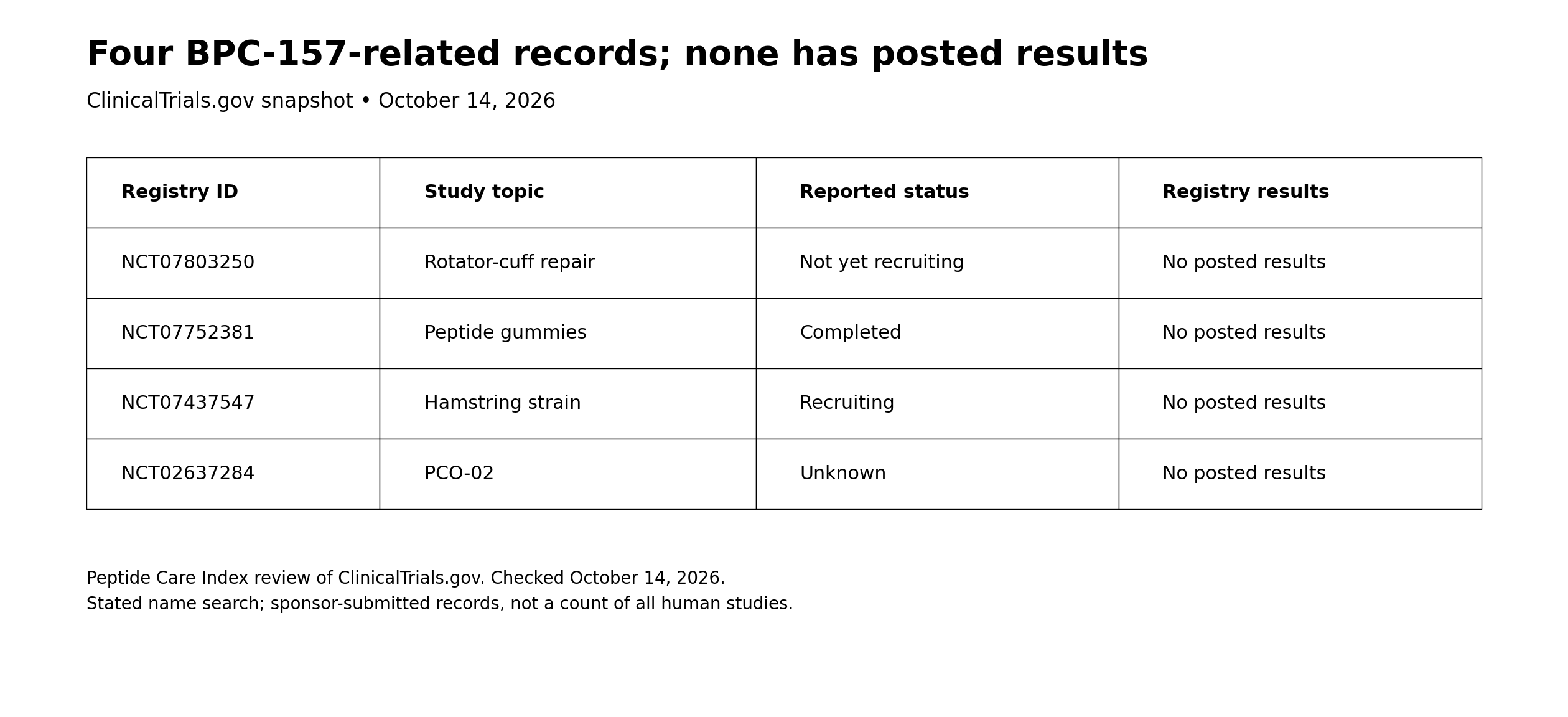
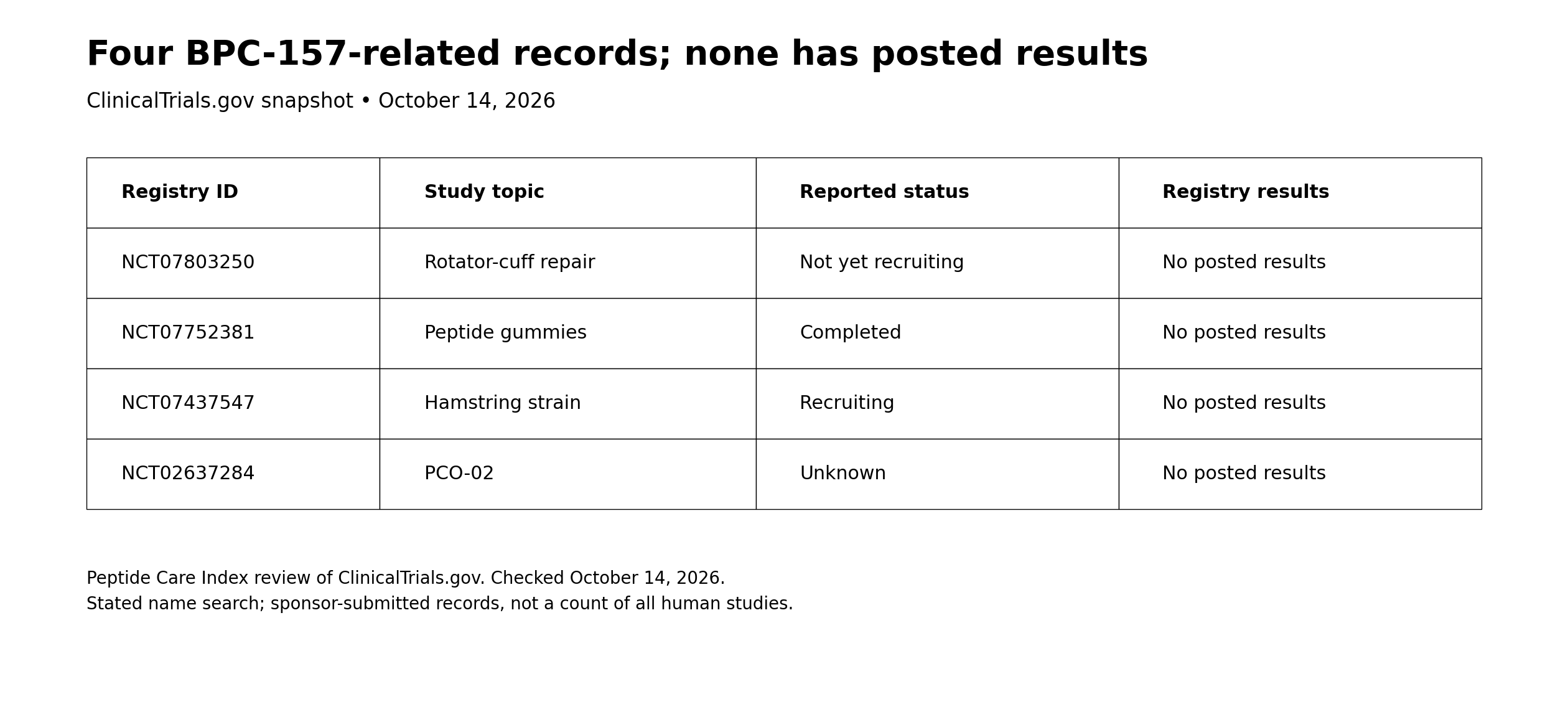
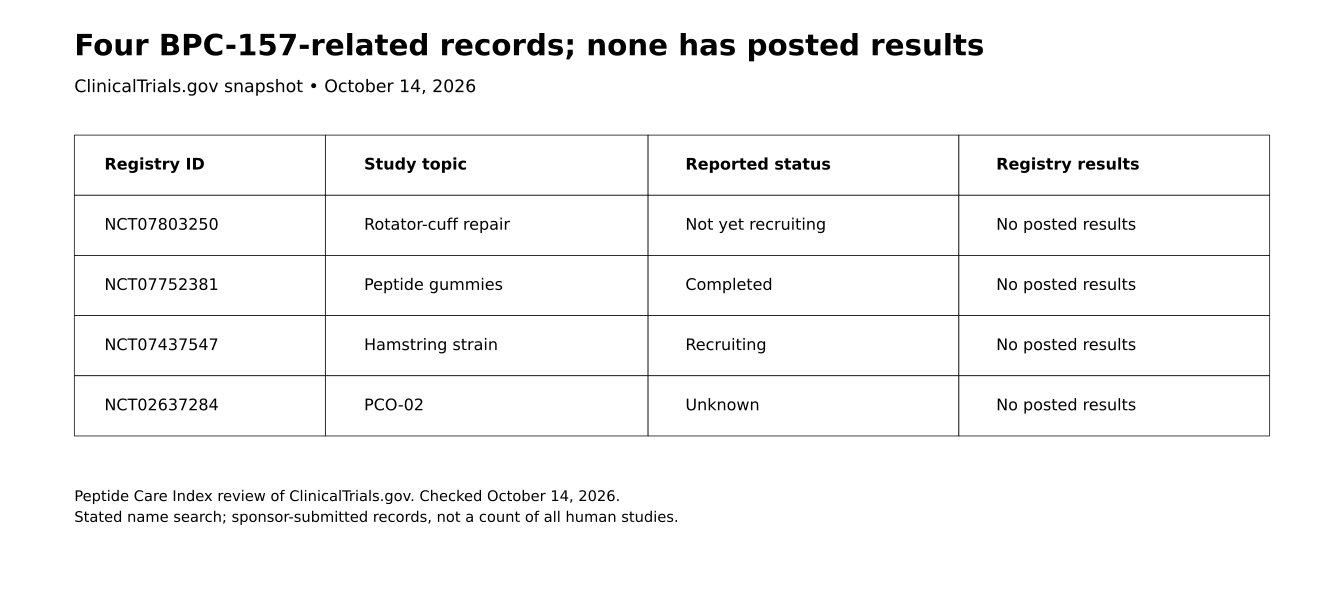
Download the registry table or the chart as SVG.
Does “completed” mean the results are available?
Not in the gummy-product record. It reports 40 actual participants and a November 1, 2025 completion date, but no posted registry results. It describes one group with no masking, meaning people were not kept unaware of the treatment assignment. NCT07752381.
Its registry posting came later, on August 7, 2026. The completion date is a sponsor-reported field, not our confirmation that the study ran. The registry’s “dietary supplement” label also does not establish the product’s legal status.
Why does the Arkansas trial list both 20 and 30 patients?
The Arkansas record says 20 patients in its summary and 30 estimated in its enrollment field. Its control-treatment descriptions also conflict. We kept both versions rather than picking the one that made a cleaner headline.
| Field | One part of the record | Another part | Our reading |
|---|---|---|---|
| Enrollment | Summary: 20 patients | Enrollment: 30, estimated | Conflicting counts; neither is treated as settled enrollment. |
| Control treatment | Sham arm describes normal saline. | Intervention description says no active treatment or placebo injections. | Conflicting treatment descriptions. |
| Masking—who knows the assignment | Summary says double-blind. | Structured field lists quadruple masking, naming four masked roles. | A wording difference. The labels alone do not prove incompatible study conduct. |
Source: NCT07803250, summary, design and intervention fields. Record last updated September 3, 2026; checked October 14, 2026. Peptide Care Index compared these fields. We did not contact the study team.
The record was not yet recruiting, with an estimated January 1, 2027 start. A future start date is a plan, not proof that enrollment is open. Only the study team can confirm current recruitment and eligibility. Registry status and dates.
For the other records, the listed recruiting hamstring site is in China, and the PCO-02 status has not been verified since October 2015. Neither is a confirmed U.S. enrollment option from this check. Hamstring record; PCO-02 record.
What does the new BPC-157 study show?
The September 7 preprint describes 1,039 documented users in a U.S. care network, using clinical notes from 2020 through the second quarter of 2026. A preprint is a paper shared before peer review; this version was still unreviewed when checked. It describes records, not a trial that assigned people to treatment. Original paper, version 1.
The authors used AI to pull information from the notes, and a clinician checked samples of that work. Methods, sections 2.2–2.5.
Does “79% improved” mean BPC-157 works?
No. The rounded headline uses only users whose records contained a response direction. The denominator—the group divided by—changes the percentage, so both groups are shown below.
| Recorded category | People | Share of all 1,039 documented users | Share of 354 users with a recorded response |
|---|---|---|---|
| Documented improvement | 279 | 26.9% | 78.8% |
| Documented no change | 58 | 5.6% | 16.4% |
| Documented worsening | 17 | 1.6% | 4.8% |
| Response direction unavailable | 685 | 65.9% | Not part of this subgroup |
Source: AJ Venkatakrishnan and colleagues, preprint v1, Table 2 and full-group response reporting. Posted September 7, 2026; checked October 14, 2026. Percentages reproduced by Peptide Care Index. Period: 2020–second quarter 2026. These are documentation shares, not treatment-success or side-effect rates.
The same 279 is divided by 354 in one column and 1,039 in the other. Neither calculation proves a drug effect. A missing response is unknown—not a treatment failure, a success or a clean bill of health.
How much response information is missing?
Missing response records outnumbered recorded responses 1.94 to 1, according to Peptide Care Index’s calculation from the preprint. The math is 685 ÷ 354 = 1.94, rounded to two decimal places. Source counts.
That is nearly two people with no recorded response direction for each person with one. Think of a stack of feedback forms: the returned forms do not tell you what the missing ones would say.
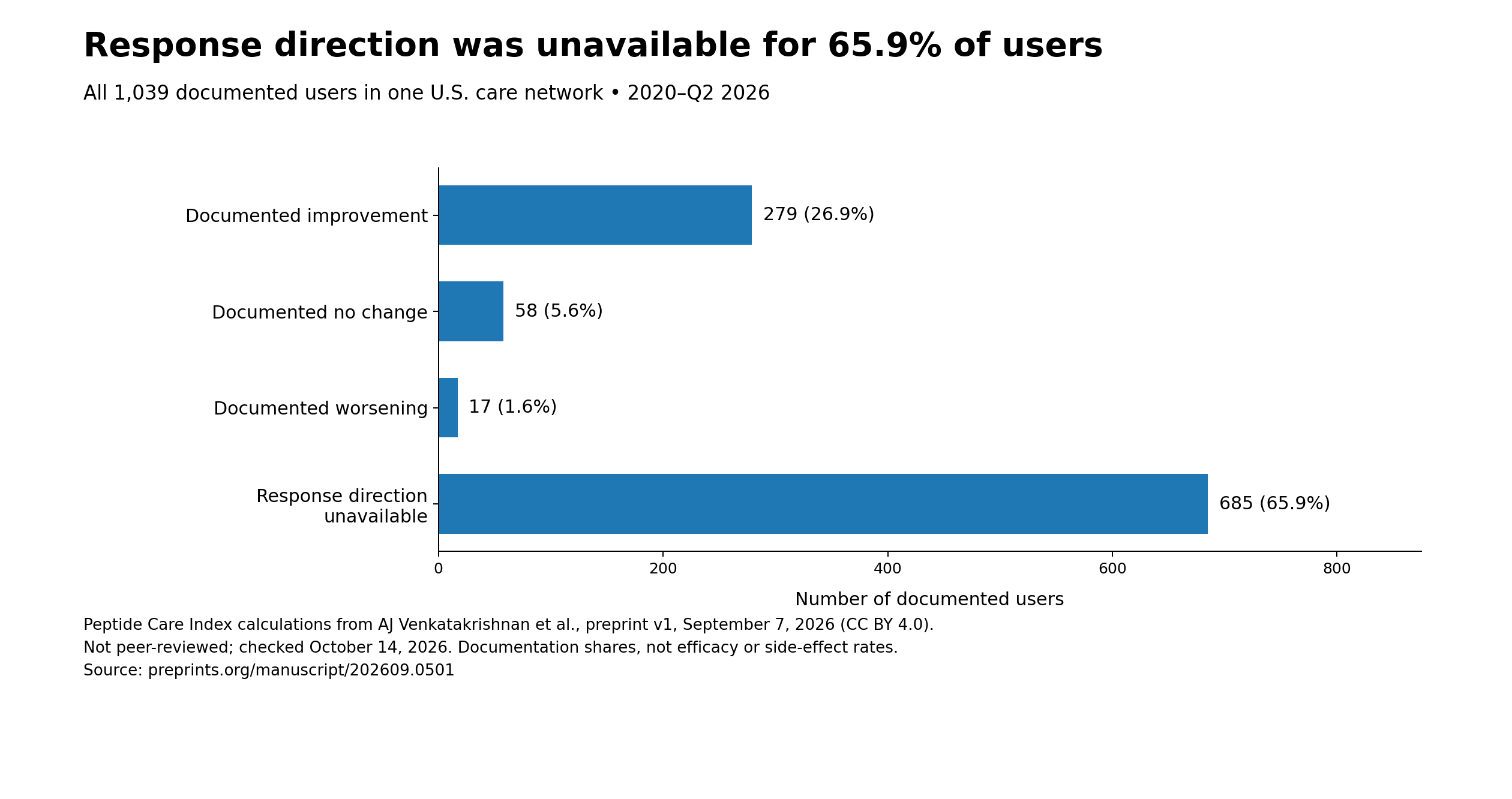
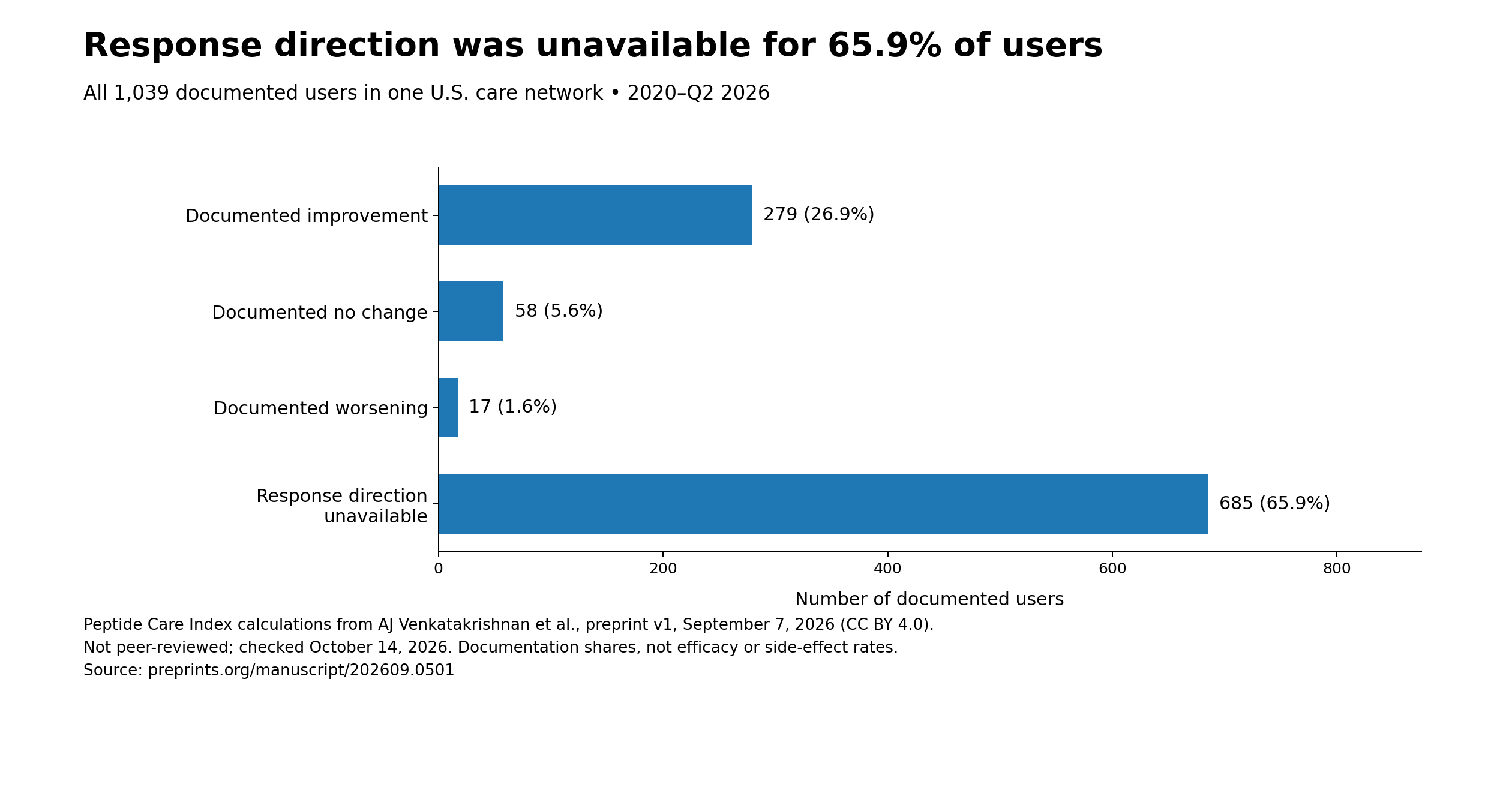
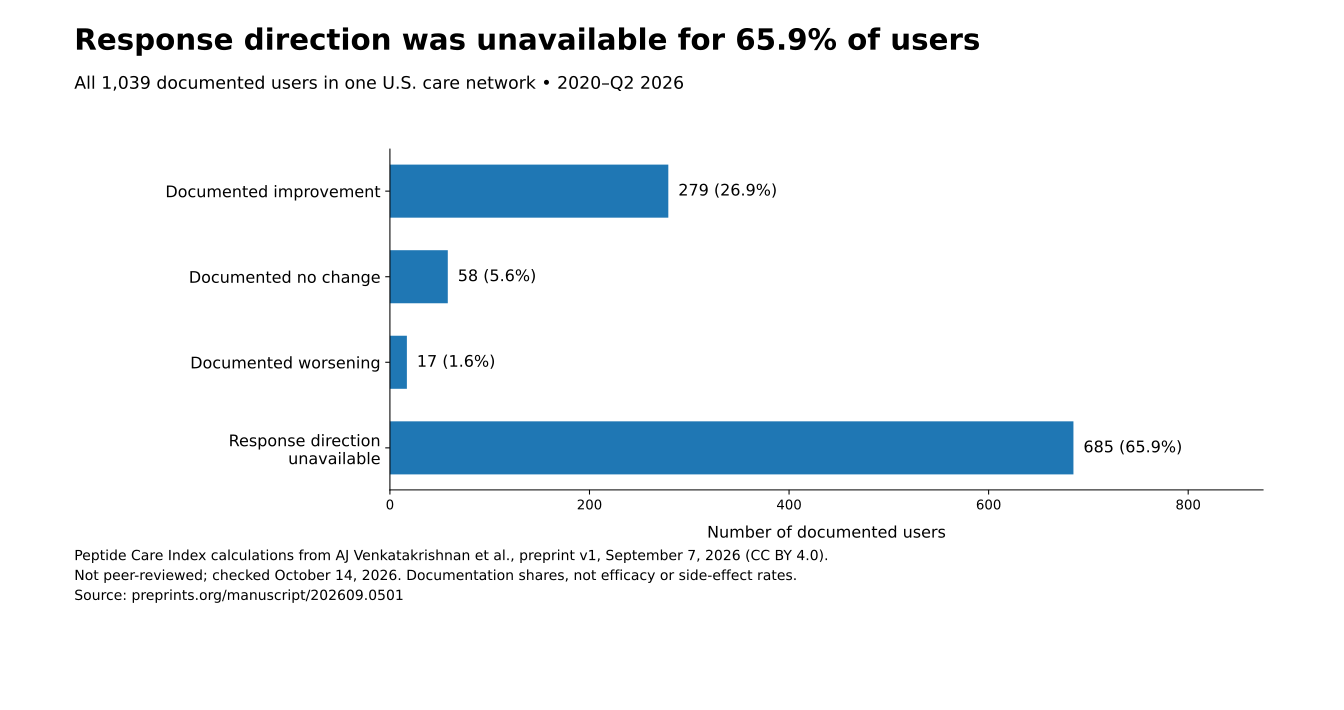
Download the outcome table or the chart as SVG.
Where did the “33-fold increase” come from?
It comes from newly documented users in the study’s network, not a count of everyone taking BPC-157 in the United States. The two reported quarterly counts give a 33.5-fold ratio. Preprint Results and Figure 1.
| Period | Newly documented BPC-157 users in the network |
|---|---|
| First quarter of 2020 | 4 |
| First quarter of 2026 | 134 |
Source: Venkatakrishnan and colleagues, preprint v1, Results. Checked October 14, 2026. Peptide Care Index calculation: 134 ÷ 4 = 33.5. These are documentation counts; no national total is calculated.
The paper’s “about 33-fold” headline is a rounded description of that comparison. It is not evidence that use rose by the same amount in every place or group.
Has BPC-157 been studied in humans before?
Yes. FDA’s May 2026 review describes five earlier human-study cohorts, including work available only as meeting abstracts. No posted results in our registry search does not mean no human research exists. FDA briefing, Appendix 1.
| Report | Design | What the sample number means | Source depth used here |
|---|---|---|---|
| Veljaca and colleagues, 2002/2003 | Placebo-controlled early safety study; two meeting abstracts from one cohort | 32 randomized; 24 received BPC-157 | FDA’s account of the abstracts, page 54. Original abstracts not independently inspected. |
| Ruenzi and colleagues, 2005 | Randomized placebo-controlled ulcerative-colitis study; meeting abstract | 53 randomized; 46 completed | FDA’s account of the abstract, page 54. Original abstract not independently inspected. |
| Lee and Padgett, 2021 | Retrospective knee-pain report | 17 identified; 16 contacted | Original paper’s abstract and methods, checked against FDA’s table. |
| Lee, Walker and Ayadi, 2024 | Single-group bladder-pain pilot | 12 women participated | Original abstract, checked against FDA’s table. |
| Lee and Burgess, 2025 | Single-group intravenous pilot | 2 adults participated | Original journal abstract, checked against FDA’s table. |
Sources: FDA’s May 11, 2026 briefing, Appendix 1, pages 54–55, and the original sources linked in the table. All checked October 14, 2026. This table covers those five earlier cohorts; it is not a fresh census of all human research worldwide.
“Randomized,” “received treatment,” “completed” and “reached at follow-up” describe different groups. Adding them would create a total with no clear meaning. Two abstracts describing one cohort also do not become two trials.
These reports answer different questions about different conditions. A bowel-disease study is not tendon-healing evidence, and a small safety pilot cannot establish safety for everyone. FDA’s clinical review.
Is BPC-157 still banned in sport?
Yes, for athletes subject to WADA’s rules, BPC-157 is prohibited at all times in 2026. The published 2027 list retains it. That next list takes effect on January 1, 2027—a future date at this check. WADA’s 2026 list; 2027 publication notice.
| Edition | BPC-157 entry | Effective date | Position on October 14, 2026 |
|---|---|---|---|
| 2026 Prohibited List | S0: non-approved substances; prohibited at all times | January 1, 2026 | In effect |
| 2027 Prohibited List | S0: non-approved substances; prohibited at all times | January 1, 2027 | Published; not yet in effect |
Sources: WADA’s official lists, S0 section, and its September 21, 2026 publication notice. Checked October 14, 2026. “At all times” includes both in and out of competition.
An FDA pharmacy decision would not, by itself, rewrite these sports rules. Athletes should check the rules and guidance of their own anti-doping organization, not use a clinic’s access claim as clearance.
What update would actually change the answer?
A published FDA action could change a compounding-list or policy answer. Posted results could change the registry table. Neither a headline nor an estimated 2027 trial start can stand in for those records. FDA’s policy framework; trial record.
| Question | Record that could change the answer |
|---|---|
| Has FDA approved a BPC-157 drug? | An FDA approval record naming the exact product. |
| Has the compounding position changed? | Issued FDA policy or a final rule, with the substances, conditions and effective date stated. |
| Are trial results now public? | Posted registry results or an identifiable research report, with its study and review status. |
| Has a trial opened or corrected its design? | An updated registry record; confirmation from the study team for actual recruitment. |
| Has the evidence changed? | A new or revised primary report, checked against its methods and full results. |
Sources: FDA’s 503A framework, meeting explanation and the checked registry records. This is Peptide Care Index’s update rule, not a forecast of an agency decision.
Before paying a clinic, ask which exact record supports the product it advertises. Our questions to ask before booking cover that gap between an offer and its supporting documents.
When this news affects a care offer you are weighing, Find My Peptide Path gives you the access record and questions to ask before paying. It is free and needs no account or email.
How did we build this tracker?
We checked the listed public records on October 14, 2026. We kept agency documents, sponsor-submitted study records, research reports and original news reporting separate. We then compared fields and recalculated the displayed percentages and ratios.
How was the registry search run?
We used this name search in ClinicalTrials.gov:
"BPC-157" OR "BPC 157" OR "Bepecin" OR "PL 14736"
The public data response returned four records, with no further page of results. We counted unique NCT identifiers, used each record’s posted-results field, and made no manual exclusions. All four had that field set to false.
This is a search-defined snapshot. It can miss research registered under other names, reports without a matching registration, and work outside this registry. “No posted registry results” is narrower than “no results anywhere.”
Which sources did we inspect directly?
We read FDA’s documents, the displayed federal list, WADA’s lists and the four registry records. For the preprint, we checked the published counts and version; we did not access private clinical notes or reproduce the authors’ extraction system.
For the older human reports, source depth varies and is stated beside each row. The two meeting-abstract cohorts were checked through FDA’s review. The knee paper’s abstract and methods, bladder pilot abstract and intravenous pilot journal abstract were read directly.
The July tally comes from ABC News’ original reporting. We did not retrieve an official roll-call transcript that independently establishes it. The memo date, article date, registry posting date, effective date and our check date each mean something different; the dataset preserves those labels.
How can the calculations be repeated?
The outcome categories total 1,039. The three recorded-response categories total 354. All-user percentages divide each category by 1,039; recorded-response percentages divide only the three known categories by 354. We round percentages to one decimal place.
The missing-to-recorded ratio divides 685 by 354 and rounds to two decimals. The growth ratio divides 134 by 4. The calculation file includes these inputs and rules, along with the registry counts.
The preprint already reports the missing-response count. Our work is the joined reference, source checks, field comparison and open arithmetic—not a new clinical trial or a claim to have discovered those patients.
What can’t these records tell us?
They cannot tell us whether BPC-157 will help an individual or how often it causes harm. The four registry entries do not independently verify trial conduct, and the clinical-note analysis cannot separate drug effects from other treatment or bias. Registry records; preprint.
A missing symptom response is not evidence of no harm. A reported improvement is not proof of benefit. The preprint covers a particular care network, not a representative sample of the United States.
The regulatory records also have dates and limits. The final list displayed a currency date of October 9, while we checked it on October 14. This page does not decide whether any specific pharmacy may supply a product to you.
We have not tested products, inspected pharmacies, contacted study teams or obtained clinical or legal review for this page. Medical choices belong with a qualified clinician; product-specific legal questions need the relevant regulator or a qualified professional. The publisher’s role and limits are public.
How can you cite or reuse this page?
For Peptide Care Index’s compilation or calculations, cite this dated edition. For a fact taken directly from an agency or paper, the original source is linked beside it.
Ready-to-copy citation
Peptide Care Index. “BPC 157 news: FDA status, trial results and what changed.” BPC-157 News and Evidence Tracker. October 2026 edition; sources checked October 14, 2026. https://peptidecareindex.com/research/bpc-157-news/
Use the section address for a specific finding: registry count, trial-field comparison or missing response direction. Keep the check date and scope with copied text or charts.
You may reuse Peptide Care Index’s original tables, calculations and chart layouts with Peptide Care Index credit. Underlying material keeps its own attribution and license terms.
This page-specific permission is an exception to our general content-use terms and does not require advance permission or a link.
The response table and chart adapt data from AJ Venkatakrishnan and colleagues’ preprint, version 1, under CC BY 4.0. Our changes are the table layout, recalculated shares, ratio and chart layout. Keep the original authors, source and license when reusing that material. This permission does not cover third-party news articles or their photographs.
Where can you download the source tables?
The seven CSV files contain 45 rows of source-linked records, checks and calculations. Every row has a source and an October 14, 2026 check date. They contain public aggregate information, not patient-level records.
Download all seven tables as a ZIP.
| File | Rows | Contents |
|---|---|---|
| News timeline | 14 | Events, document versions, our check and a future effective date, each labeled. |
| Trial records | 4 | Reported status, enrollment labels, dates, results fields and sources. |
| FDA and WADA status checks | 5 | The exact question, source version and limit on each answer. |
| Arkansas field checks | 3 | Two content conflicts and one masking-wording difference. |
| Recorded symptom responses | 4 | Each category with both relevant denominators and formulas. |
| Earlier human evidence | 5 | The five cohorts in FDA’s review, with sample definitions and source depth. |
| Calculations | 10 | Inputs, formulas, results and the scope of each calculation. |
Source: Peptide Care Index’s files for this October 14, 2026 snapshot. Blank fields mean not supplied or not applicable, not zero. These tables describe different kinds of records; 45 rows does not mean 45 studies.
What else do readers ask about BPC-157 news?
Does no posted registry result mean no human research?
No. FDA’s earlier review describes five human-study cohorts, including meeting abstracts. A journal paper, an abstract and a ClinicalTrials.gov results submission are different records. FDA briefing, Appendix 1.
Is January 1, 2027 an FDA approval date?
No. It is the estimated start in the Arkansas trial record and, separately, the effective date of WADA’s published 2027 list. Neither source gives an FDA approval date. Trial record; WADA notice.
Can I join the new U.S. rotator-cuff trial now?
The record was not yet recruiting when checked on October 14, 2026. Its estimated start is not confirmation that enrollment has opened. Check the record and its study-team contact for current recruitment and eligibility. NCT07803250.
Do the new harm reports show a side-effect rate?
No. Reported patient experiences do not provide the complete, defined group needed to calculate a reliable rate. The October 13 KFF story is original reporting, not a controlled risk study. KFF Health News.
Does the gummy study’s “dietary supplement” label establish approval?
No. That is a sponsor-submitted field in the registry, not FDA approval or validation of a product’s legal status. The record reports 40 actual participants and completion, but it has no posted registry results. NCT07752381.
Which sources support this page?
All sources below were checked October 14, 2026. The source date and the part used are listed separately so an older document does not look like a new event.
- FDA: BPC-157 advisory briefing. Full document. Staff memo dated May 11, 2026. Approval and monograph statement: printed page 9. Clinical review and Appendix 1: printed pages 40 and 54–55. Staff analysis, not final action.
- FDA: July 23–24, 2026 Pharmacy Compounding Advisory Committee meeting. Meeting and materials. July 23 discussion and explanation that advice is nonbinding. We did not retrieve an official roll-call transcript.
- Electronic Code of Federal Regulations: 21 CFR 216.23. Final 503A list, subsection (a). Displayed as current through October 9, 2026.
- FDA: nominated bulk substances and interim-policy categories. Published PDF. Updated May 14, 2026; Category 1 list on printed page 2.
- FDA: substances that may present significant safety risks. Safety page. BPC-157 row under withdrawn nominations. No exact withdrawal day established here.
- FDA: Compounding and the FDA—Questions and Answers. Official explanation. Definition of compounding and distinction from FDA approval.
- FDA: bulk substances used under section 503A. Official framework. Ingredient conditions and interim-policy categories.
- ClinicalTrials.gov: stated BPC-157 name search. Exact public data request. Four returned records; all posted-results fields false; no further page returned.
- ClinicalTrials.gov: NCT07803250. Arkansas record. Last update posted September 3, 2026. Status, estimated dates, enrollment, summary, masking and control descriptions.
- ClinicalTrials.gov: NCT07752381. Parlay Wellness record. Last update posted August 7, 2026. Sponsor-reported completed status, 40 actual enrollment, single-group design, no masking and no posted results.
- ClinicalTrials.gov: NCT07437547. Hudson Biotech record. Last update posted February 27, 2026. Reported recruiting status, estimated enrollment and China location.
- ClinicalTrials.gov: NCT02637284. PCO-02 record. Last update posted December 22, 2015; status verified October 2015. Unknown current status, estimated enrollment and no posted results.
- AJ Venkatakrishnan and colleagues: Rising Use of Unapproved BPC-157 (“Wolverine Peptide”) and Associated Patient-Reported Outcomes Curated from Clinical Notes. Preprint v1. Posted September 7, 2026; not peer-reviewed at check. Methods, Results, Table 2 and Figures 1 and 4. CC BY 4.0.
- WADA: 2026 Prohibited List. Official list. S0 section; effective January 1, 2026.
- WADA: publication of the 2027 Prohibited List. September 21, 2026 notice. Confirms January 1, 2027 effective date.
- WADA: 2027 Prohibited List. Official published list. S0 section; BPC-157 retained. Future-effective at this check.
- Amy Maxmen, KFF Health News. October 13, 2026 original reporting. Patients’ accounts of harm; not a causal risk estimate.
- The Washington Post. October 7, 2026 report. Reporting of a possible temporary-access plan, not issued policy text.
- Sony Salzman and Mary Kekatos, ABC News. July 23, 2026 original report. Source for the attributed 8–6 tally and one abstention.
- FDA/Federal Register: meeting notice. April 16, 2026 notice. Meeting dates and substances proposed for discussion.
- Lee and Padgett, 2021. Original knee-pain paper. Abstract and methods, printed page 8/PDF page 1. Sample identified and contacted, not a controlled comparison.
- Lee, Walker and Ayadi, 2024. Original bladder-pain pilot abstract. Participant and design information; abstract-level access.
- Lee and Burgess, 2025. Original intravenous pilot journal abstract. Two-participant sample and design; abstract-level access.