Peptide storage chart: 20 entries for solids, liquids and medicines
By Peptide Care Index · Updated October 2026
Store a peptide by its exact product instructions, not its name. Peptide Care Index’s October 2026 peptide storage chart checks 20 entries: eight research materials and 12 selected U.S. medicine entries. Six research inserts advise against keeping the water-based solution beyond one day. Those supplier limits do not establish safe human use.
What are the key peptide storage facts?
- Eight exact research materials: Cayman Chemical specifies −20°C (−4°F) storage and at least four years of stability for the supplied solid in each of the eight inserts below. These are supplier specifications for those products, not expiry dates for all peptides with the same names. See all eight source rows.
- Six solution warnings: Six of the eight inserts advise against storing an aqueous, or water-based, solution for more than one day. The inserts do not state a temperature alongside that time recommendation. This is not proof of a one-day sterile shelf life. See the research chart.
- Two missing solution periods: The checked BPC-157 acetate and CJC-1295 no-DAC inserts do not give a solution storage duration. A solid’s four-year specification cannot fill that gap. BPC-157 insert; CJC-1295 insert.
- One ingredient, different mixing limits: Egrifta WR’s label permits seven days at 20–25°C (68–77°F) after mixing. Egrifta SV’s label requires immediate use and says not to refrigerate or freeze the mixed solution. Both contain tesamorelin. WR label, §2.2; SV label, §2.2.
- The 28-day rule has a scope: CDC describes a 28-day default for opened, manufacturer-labeled multidose medication vials unless the manufacturer states another period. It is not a stability test for a research peptide mixed with water. CDC guidance.
What does the peptide storage chart say for research materials?
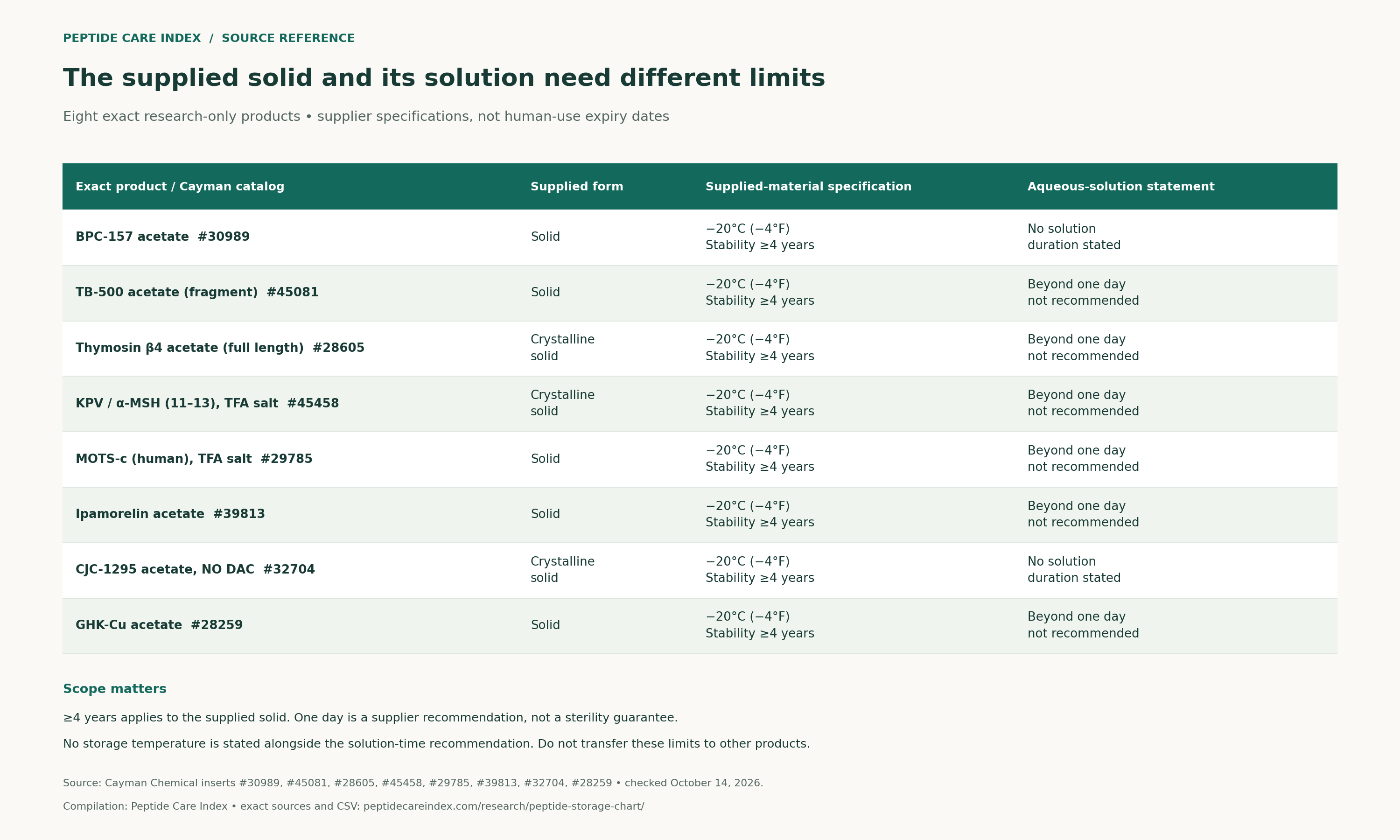
The eight supplier inserts below specify −20°C storage for the supplied solid. Six also advise against keeping an aqueous solution beyond one day; two give no solution storage period. Each row applies to the exact catalog product shown.
These materials are labeled for laboratory research, not human or veterinary diagnostic or therapeutic use. This table records their supplier specifications. It does not turn a research vial into a medicine or give it an injection expiry date.
Optional local lookup
Find an exact storage entry
The complete HTML tables remain on the page. Filtering only changes which existing rows are displayed; this lookup does not calculate an expiry.
Showing all 20 sourced entries in the tables below.
| Material and catalog number | Form supplied | Supplied-material specification | Aqueous-solution instruction | Exact source; printed date |
|---|---|---|---|---|
| BPC-157 acetate · #30989 | Solid | −20°C; stability ≥4 years | No solution storage duration stated | Product insert, Dec. 16, 2022 |
| TB-500 acetate · #45081 | Solid | −20°C; stability ≥4 years | Storage beyond one day not recommended | Product insert, Mar. 10, 2026 |
| Full-length thymosin β4 acetate · #28605 | Crystalline solid | −20°C; stability ≥4 years | Storage beyond one day not recommended | Product insert, Apr. 6, 2026 |
| KPV / α-MSH (11–13), trifluoroacetate salt · #45458 | Crystalline solid | −20°C; stability ≥4 years | Storage beyond one day not recommended | Product insert, May 5, 2026 |
| MOTS-c (human), trifluoroacetate salt · #29785 | Solid | −20°C; stability ≥4 years | Storage beyond one day not recommended | Product insert, Dec. 15, 2022 |
| Ipamorelin acetate · #39813 | Solid | −20°C; stability ≥4 years | Storage beyond one day not recommended | Product insert, Oct. 30, 2023 |
| CJC-1295 acetate, no DAC · #32704 | Crystalline solid | −20°C; stability ≥4 years | No solution storage duration stated | Product insert, July 31, 2026 |
| GHK-Cu acetate · #28259 | Solid | −20°C; stability ≥4 years | Storage beyond one day not recommended | Product insert, Dec. 6, 2022 |
Source: Cayman Chemical product specifications and laboratory-procedure sections. All eight inserts checked October 14, 2026. ≥4 years means at least four years, as specified for the supplied material. The solution statements above do not specify a storage temperature alongside the time recommendation or establish sterility for one day.
The exact identity matters. Here, TB-500 is the seven-residue fragment Ac-LKKTETQ-OH, not full-length thymosin β4. The CJC-1295 row has no drug affinity complex (DAC). The GHK-Cu row is a copper complex, not copper-free GHK or a finished skin serum. Do not move these rows to a different salt, blend, brand or finished product.
Source: Peptide Care Index compilation · Cayman Chemical inserts #30989, #45081, #28605, #45458, #29785, #39813, #32704, #28259 · checked October 14, 2026.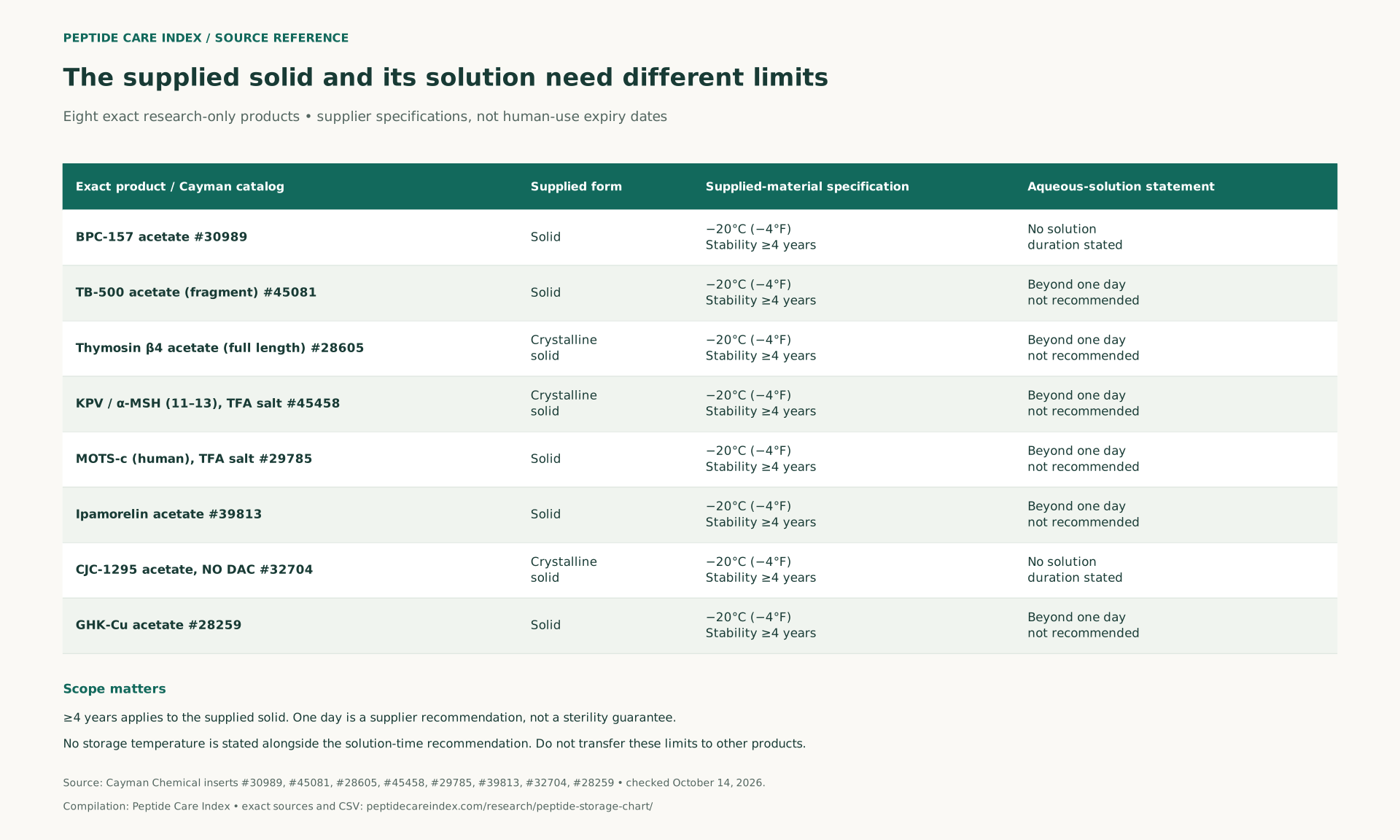
For the wider evidence and naming differences, use our peptide comparison chart. If you are checking a clinic offer, our BPC-157 access guide explains which product and pharmacy details to confirm before paying.
How do storage rules differ for peptide medicines?
The U.S. labels below give different rules for unopened products, time outside a refrigerator and use after opening or mixing. For example, the Ozempic multidose pen has a 56-day period after first use, while the Wegovy single-dose pen has a 28-day allowance before cap removal. Those clocks start at different events.
Find the brand, device, formulation and country on the package before using a row. The table is a storage reference, not the full instructions for taking a medicine. Labels can change; the source linked in each row controls.
| Product and presentation | Unopened storage | Room-temperature allowance before use | After opening or mixing | Freezing and source |
|---|---|---|---|---|
| Ozempic, semaglutide multidose pen | 2–8°C | No separate unopened allowance stated in §16 | 56 days after first use at 15–30°C or 2–8°C | Do not freeze or use if frozen. Label §16, May 2026 |
| Wegovy, semaglutide single-dose pen | 2–8°C | Before cap removal: up to 28 days at 8–30°C | Single use; discard after use | Do not freeze or use if frozen. Label §16, June 2026 |
| Rybelsus, semaglutide tablets in original bottle | 20–25°C; permitted excursions 15–30°C | Ordinary labeled room-temperature storage; no refrigerator countdown | Keep in original closed bottle in a dry place; no separate after-opening day limit stated in §16 | No separate freezing statement in §16; do not infer permission to freeze. Label §16, Jan. 2026 |
| Mounjaro, tirzepatide single-dose pen or vial | 2–8°C | Up to a total of 21 days at no more than 30°C | Single-dose presentation | Do not freeze or use if frozen. Label §16.2, Aug. 2026 |
| Mounjaro, tirzepatide multidose vial or KwikPen | 2–8°C | Unopened: discard after 30 days at room temperature, up to 30°C | 2–8°C or up to 30°C. Discard at total 30 days at room temperature, 30 days after first use, or four weekly doses—whichever comes first | Do not freeze or use if frozen. Label §16.2, Aug. 2026 |
| Zepbound, tirzepatide single-dose pen or vial | 2–8°C | Up to a total of 21 days at no more than 30°C | Single-dose presentation | Do not freeze or use if frozen. Label §16.2, Aug. 2026 |
| Zepbound, tirzepatide multidose vial or KwikPen | 2–8°C | Unopened: discard after 30 days at room temperature, up to 30°C | 2–8°C or up to 30°C. Discard at total 30 days at room temperature, 30 days after first use, or four weekly doses—whichever comes first | Do not freeze or use if frozen. Label §16.2, Aug. 2026 |
| Saxenda, liraglutide prefilled pen | 2–8°C | No separate unopened allowance stated in §16 | 30 days after first use at 15–30°C or 2–8°C | Do not freeze or use if frozen. Label §16, Feb. 2026 |
| Egrifta WR, tesamorelin 11.6 mg vial | 20–25°C; permitted excursions 15–30°C | Ordinary labeled room-temperature storage | After mixing: 20–25°C; discard unused solution seven days after mixing | Do not freeze. Label §§2.2, 16, Mar. 2025 |
| Egrifta SV, tesamorelin 2 mg vial | 20–25°C; permitted excursions 15–30°C | Ordinary labeled room-temperature storage | Use immediately after mixing; discard if not used immediately and discard unused solution | Do not refrigerate or freeze mixed solution. Current DailyMed label §§2.2, 16, July 2026 |
| Gattex, teduglutide 5 mg kit | Before pharmacy dispensing: 2–8°C | After pharmacist dispensing: up to 25°C; use by the pharmacy’s 90-day date or the printed manufacturer expiry, whichever is earlier | Use within three hours after mixing; discard remainder | Do not freeze. Label §§2.6, 16, Sept. 2025 |
| Forteo, teriparatide prefilled delivery device | 2–8°C | No routine room-temperature storage allowance; minimize time out during administration | Continue 2–8°C storage except during administration; discard 28 days after first use | Do not freeze or use if frozen. Label §16.2, Aug. 2026 |
Sources: the linked U.S. prescribing information and current DailyMed labeling, checked October 14, 2026. Keep the product’s light, carton, moisture and device precautions too; the CSV records additional conditions. A permitted storage period never extends a package’s printed expiration date. A named brand may have other presentations that this table does not cover.
Temperature key: 2–8°C ≈36–46°F; 8–30°C ≈46–86°F; 15–30°C =59–86°F; 20–25°C =68–77°F; 25°C =77°F; 30°C =86°F. The ranges above follow the labels’ rounded Fahrenheit equivalents.
Why can two tesamorelin products have different storage rules?
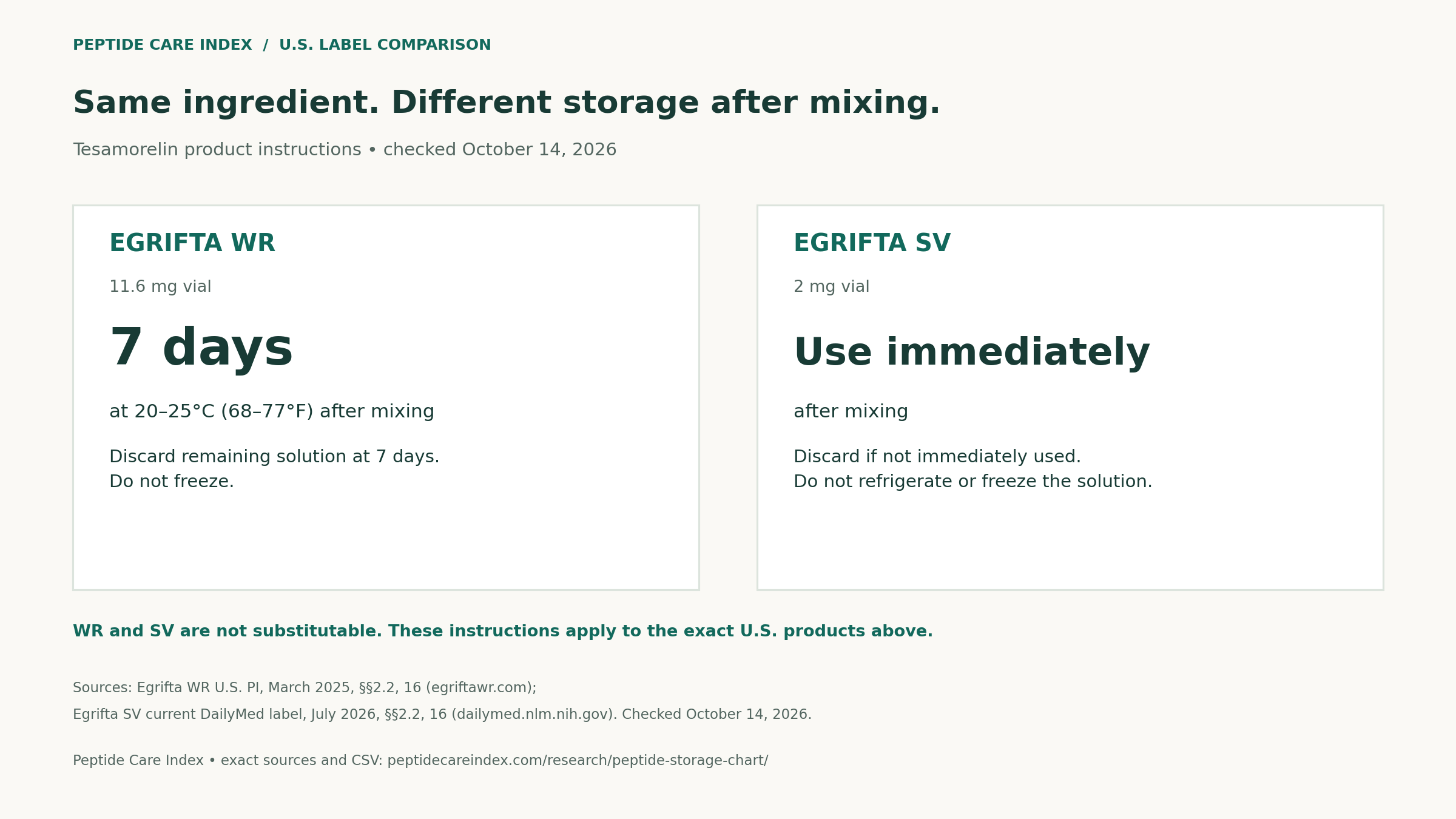
Egrifta WR and Egrifta SV both contain tesamorelin, but their labels give different instructions after mixing. WR permits seven days at 20–25°C; SV requires immediate use and prohibits storing the mixed solution in a refrigerator or freezer. The WR label also states that WR and SV are not substitutable.
This is why “tesamorelin lasts seven days” leaves out a fact the reader needs: which tesamorelin product? The brand suffix and formulation belong beside the time limit. WR label; SV label.
Source: Peptide Care Index · Egrifta WR PI (March 2025), sections 2.2 and 16; Egrifta SV current DailyMed label (July 2026), sections 2.2 and 16 · checked October 14, 2026.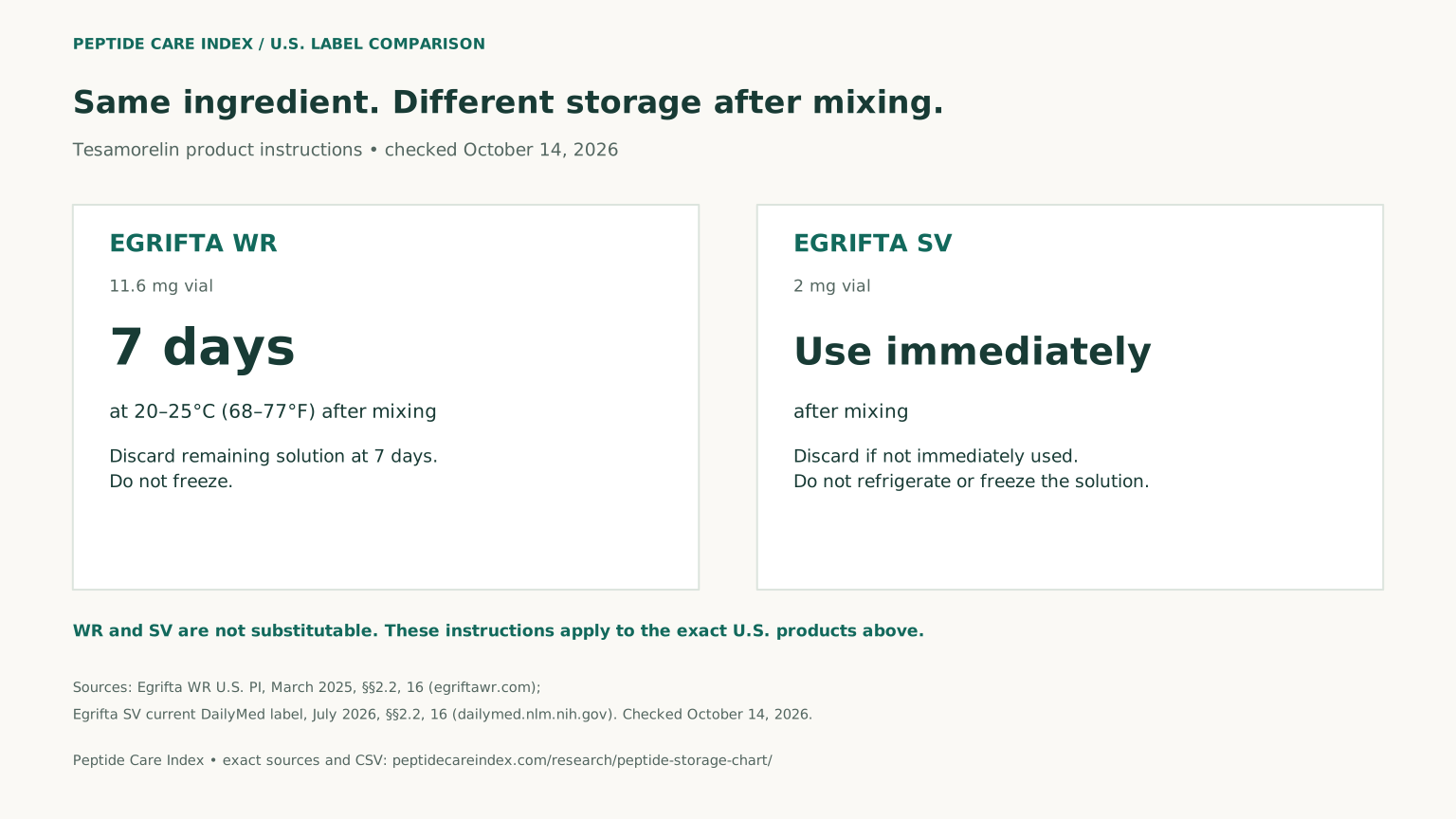
How long do dry and reconstituted peptides last?
A dry-material specification does not tell you how long a solution will last. In the eight checked research inserts, the at-least-four-year specification appears with the supplied solid, while six separately advise against aqueous storage beyond one day. The other two leave the solution period unstated.
“Reconstituted” means a dry product has been dissolved. “Lyophilized” means freeze-dried. Those words are not interchangeable with “solid”: the research inserts above say solid or crystalline solid, so the table keeps those terms.
MilliporeSigma’s peptide stability guidance explains that the peptide’s sequence and composition affect stability, and that dried peptides are generally more stable than peptides in solution. That does not supply a single expiry period for every powder or mixed vial.
For example, the BPC-157 acetate #30989 insert gives the supplied solid a storage specification. It does not give a day limit for its solution. Writing “BPC-157 lasts four years” without the form and supplier would change the meaning of the source.
The same rule applies to oral products. A research solid’s specification does not establish the shelf life of a capsule or liquid from another maker. Our BPC-157 capsule guide explains why the exact finished product matters when checking evidence and labels.
Does the 28-day vial rule prove that a peptide lasts 28 days?
No. CDC describes a 28-day discard default after opening a manufacturer-labeled multidose medication vial, unless the manufacturer states a different period. CDC separately identifies sterility and physical or chemical stability as different concerns. CDC injection safety guidance.
| Question | What it asks | What cannot answer it on its own |
|---|---|---|
| Is the material physically and chemically stable? | Does it retain its intended physical and chemical properties? | A general opened-vial discard convention |
| Is it sterile? | Is it free of microbial contamination? | A purity percentage or an unchanged appearance |
| Is it within the allowed use period? | Does the exact product remain within its label or pharmacy-assigned limit? | Another product’s label, or the expiry date of the water alone |
Source: CDC’s distinction between sterility and physical/chemical stability, and its multidose-vial guidance; checked October 14, 2026. The last column states why those forms of evidence do not resolve a different question.
CDC also says antimicrobial preservatives do not give complete protection against bacterial contamination and do not act against viruses. Adding a preservative does not supply missing stability data for the finished peptide solution. A clear-looking liquid is not a sterility test.
Should peptides go in the fridge or freezer?
The answer depends on the exact product. The research solids above specify −20°C, while the Ozempic multidose pen label says do not freeze. Egrifta WR is another exception to a blanket fridge rule: its mixed solution is stored at 20–25°C for its labeled seven-day period.
For laboratory materials, follow the product insert. General MilliporeSigma handling guidance discusses keeping containers closed, protecting peptides from moisture and light, and avoiding repeated freeze–thaw cycles. It is laboratory guidance; it does not override a medicine’s label.
If a medicine was left out, arrived warm or may have frozen, record the exact product, the temperatures if known, and the time involved. Ask the dispensing pharmacist or manufacturer to assess that event against the product’s instructions. An allowed room-temperature period does not cover every hot-car or freezing exposure. Do not assume that cooling the product again resets its clock.
Which storage instructions apply to a compounded peptide prescription?
Use the dispensing pharmacy’s instructions and the beyond-use date (BUD) assigned to that exact preparation. This chart does not calculate a BUD for compounded BPC-157, sermorelin, semaglutide, tirzepatide or a blend. A manufacturer label for a different finished product cannot supply it.
A BUD is the date or time after which a compounded preparation should not be used. USP’s sterile-compounding FAQs, question 166, define that limit for compounded sterile preparations. FDA explains that compounded drugs are not FDA-approved and that the agency does not verify their safety, effectiveness or quality before marketing. The label for an approved medicine is not an approval or stability record for a compounded version. FDA compounding questions and answers.
For a prescription, ask the pharmacy which instructions control before opening, after first puncture and after mixing, and what to do after a temperature excursion—a period outside the allowed range. Use the storage record checklist to keep those answers with the package.
If you are still checking access or an advertised clinic offer, Find My Peptide Path helps you prepare questions before paying.
How did we build this storage reference?
Peptide Care Index read eight Cayman Chemical research-product inserts and storage sections covering 12 selected U.S. medicine entries on October 14, 2026. We recorded the exact material or presentation, supplied form, storage condition, time limit, source date and source link. We did not test any product.
The research set covers BPC-157, the TB-500 fragment, full-length thymosin β4, KPV, MOTS-c, ipamorelin, CJC-1295 without DAC and GHK-Cu. We selected these as common subjects of peptide-storage questions with accessible, product-specific supplier inserts. This is one supplier’s product set, not a random sample or a survey of the market.
The medicine set illustrates different forms and different clocks. Presentations are grouped in a row only where the cited label gives them the same storage instructions. This is why the 20 entries do not mean 20 distinct peptides or every available presentation.
The research count is reproducible: filter the CSV’s aqueous_storage_status column. Six rows contain supplier_advises_not_beyond_one_day; two contain not_stated. All eight have storage_temperature_c = -20 and supplier_stability_years_minimum = 4, with a greater-than-or-equal-to qualifier.
For medicines, we used the manufacturer’s current U.S. prescribing information. Egrifta SV uses the current DailyMed label. Each row retains the document’s revision or printed date; checked in 2026 does not mean measured in 2026. Our research methodology describes the wider editorial approach.
What does this chart not show?
It does not show measured rates of potency loss, contamination rates, shipping stability, a universal mixed-vial expiry or safe use of research materials in people. Supplier specifications are attributed to the supplier. We did not independently verify those specifications in a laboratory.
“No solution storage duration stated” means the checked insert does not give that duration. It does not mean that no stability information exists anywhere. The one-day statements also do not demonstrate that the material is sterile, safe or unchanged for a full day.
The medicine table covers the named U.S. presentations. It does not cover every insulin, peptide drug, cosmetic, capsule, blend or country’s label. Use the current package instructions and dispensing pharmacist for an individual product.
How can I download or cite this peptide storage chart?
The two free CSVs contain the full eight-row research table and 12-row medicine table, including source URLs and check dates. No account or email is needed.
- Research-material storage CSV
- U.S. medicine storage CSV
- Research storage chart — PNG · SVG
- Tesamorelin storage comparison — PNG · SVG
- Blank product storage record and questions
Suggested citation: Peptide Care Index. “Peptide storage chart: 20 entries for solids, liquids and medicines.” Updated October 2026. Sources checked October 14, 2026. https://peptidecareindex.com/research/peptide-storage-chart/
Reuse: You may reuse our original summaries, charts and compilation with credit to Peptide Care Index. Underlying product documents, names and source materials retain their owners’ rights and terms; preserve their attribution. No link is required.
What changed: October 14, 2026 — first source check and preparation of this 20-entry reference.
What else do people ask about peptide storage?
How long does reconstituted BPC-157 last in the fridge?
The checked Cayman BPC-157 acetate #30989 insert does not state a solution storage duration. Its −20°C and at-least-four-year specification applies to the supplied solid. It does not prove a 28-day refrigerated life for a mixed vial from any supplier or pharmacy. Source insert.
Does bacteriostatic water make every peptide last 28 days?
No. The 28-day opened-multidose-vial convention does not establish a peptide solution’s chemical stability. CDC also says preservatives give incomplete protection against bacterial contamination. The finished product needs its own applicable storage instructions. CDC guidance.
Can reconstituted peptides be frozen?
There is no rule that covers them all. Some laboratory stocks have freezing instructions, while medicine labels can prohibit freezing. For example, mixed Egrifta WR is kept at 20–25°C, and mixed Egrifta SV must be used immediately and must not be refrigerated or frozen. WR label; SV label.
Can I use the Ozempic pen’s 56-day rule for compounded semaglutide?
No. The 56-day rule is for the labeled Ozempic multidose pen after first use, under its stated conditions. It does not establish a BUD for a compounded vial or another semaglutide product. Ask the dispensing pharmacy for the instructions assigned to the exact preparation. Ozempic label §16.
Does a purity certificate prove shelf life?
A purity result alone does not establish how a finished product changes over time or whether it is sterile. CDC treats chemical stability and sterility as separate issues. The source inserts above list purity and storage as separate product specifications; this chart does not turn either into a test of someone else’s vial. CDC guidance; example product insert.
Which sources were checked?
Every source below was checked October 14, 2026. Research-insert dates are the dates printed on the documents, not claimed dates of new experiments.
Cayman Chemical. BPC-157 acetate #30989. Product specifications; full insert checked for a solution period. Printed Dec. 16, 2022.
Cayman Chemical. TB-500 acetate #45081. Product identity, specifications and laboratory procedures. Printed Mar. 10, 2026.
Cayman Chemical. Thymosin β4 acetate #28605. Product specifications and laboratory procedures. Printed Apr. 6, 2026.
Cayman Chemical. KPV / α-MSH (11–13), trifluoroacetate #45458. Product identity, specifications and laboratory procedures. Printed May 5, 2026.
Cayman Chemical. MOTS-c human, trifluoroacetate #29785. Product specifications and laboratory procedures. Printed Dec. 15, 2022.
Cayman Chemical. Ipamorelin acetate #39813. Product specifications and laboratory procedures. Printed Oct. 30, 2023.
Cayman Chemical. CJC-1295 acetate, no DAC #32704. Product identity, specifications and laboratory procedures. Printed July 31, 2026.
Cayman Chemical. GHK-Cu acetate #28259. Product identity, specifications and laboratory procedures. Printed Dec. 6, 2022.
Novo Nordisk. Ozempic U.S. prescribing information. §16. Revised May 2026.
Novo Nordisk. Wegovy U.S. prescribing information. §16; single-dose pen row. Revised June 2026.
Novo Nordisk. Rybelsus/Ozempic tablets U.S. prescribing information. §16; Rybelsus row. Revised January 2026.
Lilly. Mounjaro U.S. prescribing information. §16.2. Revised August 2026.
Lilly. Zepbound U.S. prescribing information. §16.2. Revised August 2026.
Novo Nordisk. Saxenda U.S. prescribing information. §16. Revised February 2026.
Theratechnologies. Egrifta WR prescribing information. §§2.2, 16. Revised March 2025.
DailyMed. Egrifta SV current labeling. §§2.2, 16. Current label revision July 2026.
Takeda. Gattex U.S. prescribing information. §§2.6, 16. Revised September 2025.
Lilly. Forteo U.S. prescribing information. §16.2. Revised August 2026.
CDC. Preventing Unsafe Injection Practices. Medication preparation and multidose-vial sections. March 26, 2024.
MilliporeSigma. Peptide Stability. Sequence, composition and physical form. No publication date shown.
MilliporeSigma. Handling and Storage Guidelines for Peptides and Proteins. Laboratory handling. No publication date shown.
FDA. Compounding and the FDA: Questions and Answers. Compounded drugs and approval oversight.
USP. USP <797> FAQs. Question 166, printed page 32. Updated December 11, 2023.
Peptide Care Index Research is the research and reference section of peptidecareindex.com.