FDA Peptide Hearing 2027: Date & 5 Substances
By Peptide Care Index · Updated October 2026
FDA plans its next peptide hearing before the end of February 2027; its checked notice gives no exact date. Peptide Care Index’s October 2026 cross-check matched all five agenda names to FDA’s withdrawn-nomination table; the GHK-Cu match covers injections only. This FDA peptide hearing 2027 tracker shows each record and its limits. FDA notice · FDA nomination records
What are the key facts?
- 5 of 5 agenda names have a withdrawn-nomination match in Peptide Care Index’s U.S. FDA record comparison, checked October 14, 2026. The GHK-Cu match is for injections only. Sources: FDA agenda and withdrawn-nomination table.
- 2 GHK-Cu records need to stay separate: an injectable withdrawn-nomination entry and a non-injectable Category 1 entry. Category 1 is FDA’s interim-policy category for substances under evaluation. Inventory dated May 14, 2026; both records checked October 14. FDA inventory · FDA safety table.
- 0 substance groups overlap between July’s seven groups and the five in the follow-up announcement. Source: Peptide Care Index’s comparison of both U.S. FDA agendas, October 14, 2026. Follow-up agenda · July agenda.
- 14 named chemical forms appear in July’s agenda: seven groups, each listed as free base and acetate. These are FDA’s form names, not 14 different peptide groups. Source: FDA’s July 23–24, 2026 agenda; count checked October 14. FDA agenda.
Which substances are on the 2027 agenda?
FDA names five substances in its early announcement. GHK-Cu takes two rows below because its injection and non-injection records differ. The route limits belong to the matched records—not to the future agenda, which does not specify detailed routes or uses. FDA announcement
A nomination is a proposal to add an ingredient to the compounding list. Here, withdrawn means the nominator withdrew that proposal. FDA framework · FDA withdrawn entries
Find a name in these two agendas
Showing 6 records across 5 agenda groups.
Cathelicidin (LL-37)
- Meeting group
- Follow-up announcement
- Official agenda name
- Cathelicidin (LL-37)
- Announced window
- Before the end of February 2027
- Exact-date status
- No exact date in checked early notice
- Matched FDA record
- Cathelicidin LL-37
- Matched record kind
withdrawn_nomination_entry- Matched-record route scope
- No route qualifier in row label
- Future-review scope
- Uses and routes not specified in checked early notice
- Source check date
- 2026-10-14
GHK-Cu
- Meeting group
- Follow-up announcement
- Official agenda name
- GHK-Cu
- Announced window
- Before the end of February 2027
- Exact-date status
- No exact date in checked early notice
- Matched FDA record
- GHK-Cu (except for injectable routes of administration)
- Matched record kind
category_1_inventory_entry- Matched-record route scope
- Excludes injectable routes
- Future-review scope
- Uses and routes not specified in checked early notice
- Inventory document date
- 2026-05-14
- Source check date
- 2026-10-14
GHK-Cu
- Meeting group
- Follow-up announcement
- Official agenda name
- GHK-Cu
- Announced window
- Before the end of February 2027
- Exact-date status
- No exact date in checked early notice
- Matched FDA record
- GHK-Cu (for injectable routes of administration)
- Matched record kind
withdrawn_nomination_entry- Matched-record route scope
- Injectable routes only
- Future-review scope
- Uses and routes not specified in checked early notice
- Inventory document date
- 2026-05-14
- Source check date
- 2026-10-14
Agenda sourceMatched FDA record sourceAdditional FDA sourceOpen source-table row
Dihexa acetate
- Meeting group
- Follow-up announcement
- Official agenda name
- Dihexa acetate
- Announced window
- Before the end of February 2027
- Exact-date status
- No exact date in checked early notice
- Matched FDA record
- Dihexa acetate
- Matched record kind
withdrawn_nomination_entry- Matched-record route scope
- No route qualifier in row label
- Future-review scope
- Uses and routes not specified in checked early notice
- Source check date
- 2026-10-14
Melanotan II
- Meeting group
- Follow-up announcement
- Official agenda name
- Melanotan II
- Announced window
- Before the end of February 2027
- Exact-date status
- No exact date in checked early notice
- Matched FDA record
- Melanotan II
- Matched record kind
withdrawn_nomination_entry- Matched-record route scope
- No route qualifier in row label
- Future-review scope
- Uses and routes not specified in checked early notice
- Source check date
- 2026-10-14
PEG-MGF
- Meeting group
- Follow-up announcement
- Official agenda name
- Mechano Growth Factor, Pegylated (PEG-MGF)
- Announced window
- Before the end of February 2027
- Exact-date status
- No exact date in checked early notice
- Matched FDA record
- Mechano growth factor pegylated (PEG-MGF)
- Matched record kind
withdrawn_nomination_entry- Matched-record route scope
- No route qualifier in row label
- Future-review scope
- Uses and routes not specified in checked early notice
- Source check date
- 2026-10-14
| Agenda name | Scope of matched record | What the record says | Source | Checked |
|---|---|---|---|---|
| Cathelicidin (LL-37) | No route qualifier in row label | Nominated but withdrawn | FDA record | 2026-10-14 |
| GHK-Cu | Excludes injectable routes | Category 1 in May 14, 2026 inventory | FDA record | 2026-10-14 |
| GHK-Cu — same agenda name | Injectable routes only | Nominated but withdrawn | FDA record | 2026-10-14 |
| Dihexa acetate | No route qualifier in row label | Nominated but withdrawn | FDA record | 2026-10-14 |
| Melanotan II | No route qualifier in row label | Nominated but withdrawn | FDA record | 2026-10-14 |
| PEG-MGF | No route qualifier in row label | Nominated but withdrawn | FDA record | 2026-10-14 |
Sources: FDA’s follow-up agenda, its withdrawn-nomination table, and its May 14, 2026 inventory, pages 1–2. Every row checked October 14, 2026. “No route qualifier in row label” does not mean every route is permitted.
Compounding means combining or changing ingredients to make a medicine for a patient’s needs. The 503A bulks list is an FDA ingredient list for compounding under section 503A of federal drug law. Category 1 is a separate interim-policy category, not that final list and not drug approval. FDA’s ingredient framework · Compounding explained
To look up a name, use the table above or the July table. The download keeps the official names and their source locations beside each record.
When is the FDA peptide hearing?
The checked notice gives a window before the end of February 2027, not a set day. FDA’s 2027 materials directory still points to an early announcement. Do not turn the end of the window into a February 28 appointment. FDA notice · 2027 directory
Its formal name is the Pharmacy Compounding Advisory Committee meeting, or PCAC. The open public hearing is a part of that meeting. FDA notice
| Field | Posted record | Source |
|---|---|---|
| Timing window | Before the end of February 2027 | FDA notice |
| Exact day, time and location | Not specified in checked early notice | FDA notice |
| Agenda | Five substance names posted | FDA notice |
| Detailed uses and routes | Not specified in checked early notice | FDA notice |
| Comment docket and deadlines | Forthcoming, according to checked early notice | FDA notice |
| Speaking requests | Instructions forthcoming | FDA notice |
| Briefings and webcast URL | Not present in checked notice or directory | FDA notice · Directory |
| Committee outcome | No outcome posted in checked notice or directory | FDA notice · Directory |
Sources: FDA’s early announcement and 2027 meeting-materials directory, checked October 14, 2026. Missing means missing from these checked pages, not proof that no record could exist elsewhere.
The next useful update is the meeting notice with actual dates and participation details. A headline saying “February hearing” is not enough to book travel or plan a presentation.
Why does GHK-Cu need two records?
GHK-Cu has two route-specific records in this tracker. Its non-injectable entry appears in Category 1 in FDA’s May 14, 2026 inventory, while its injectable entry appears in the withdrawn-nomination table. Neither record tells us which routes the next meeting will cover. FDA inventory · FDA safety table
A route is how a product is given, such as by injection or on the skin. A claim about one route cannot be used as evidence about the other.
| Date | Record | What FDA reports |
|---|---|---|
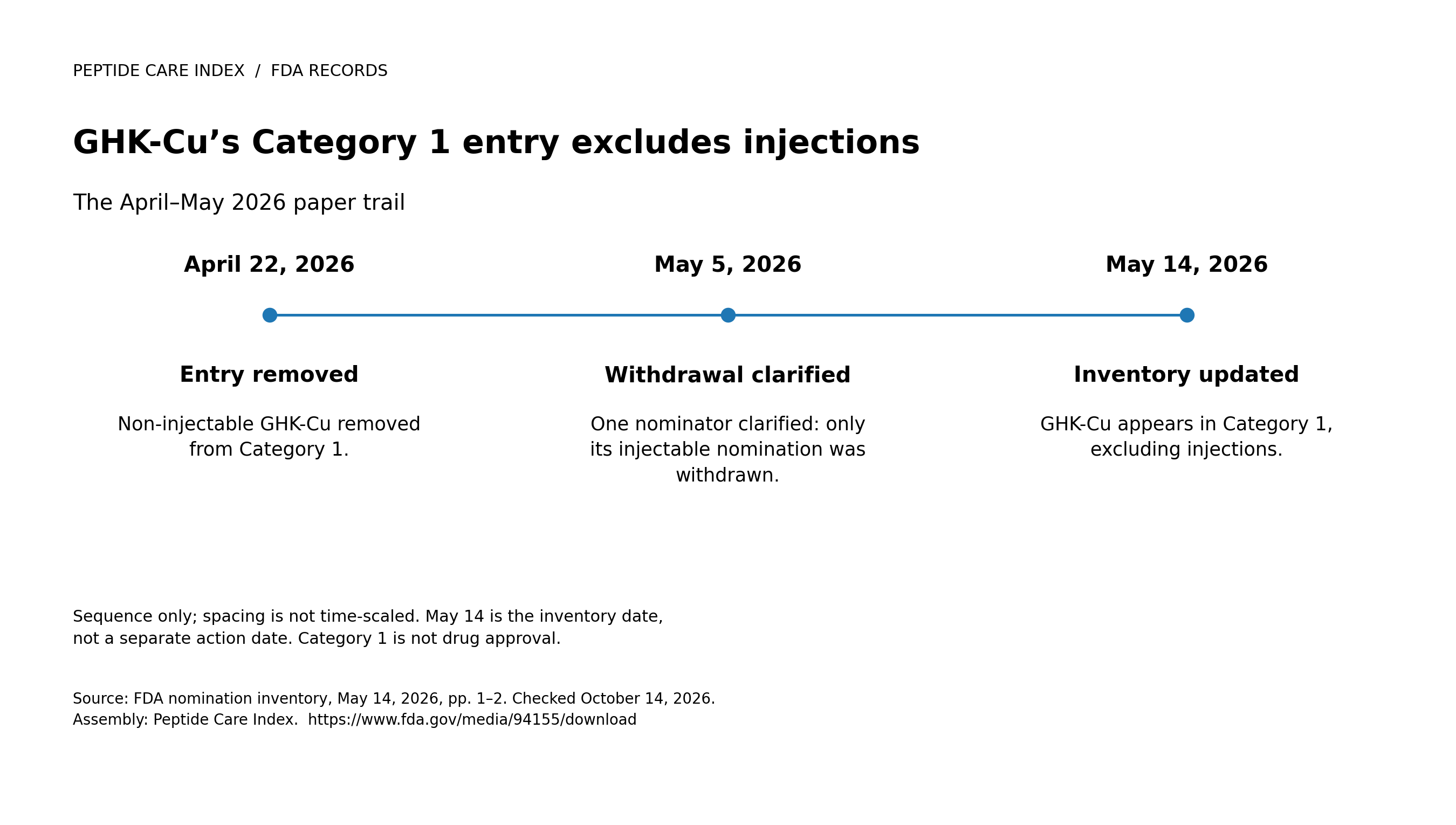
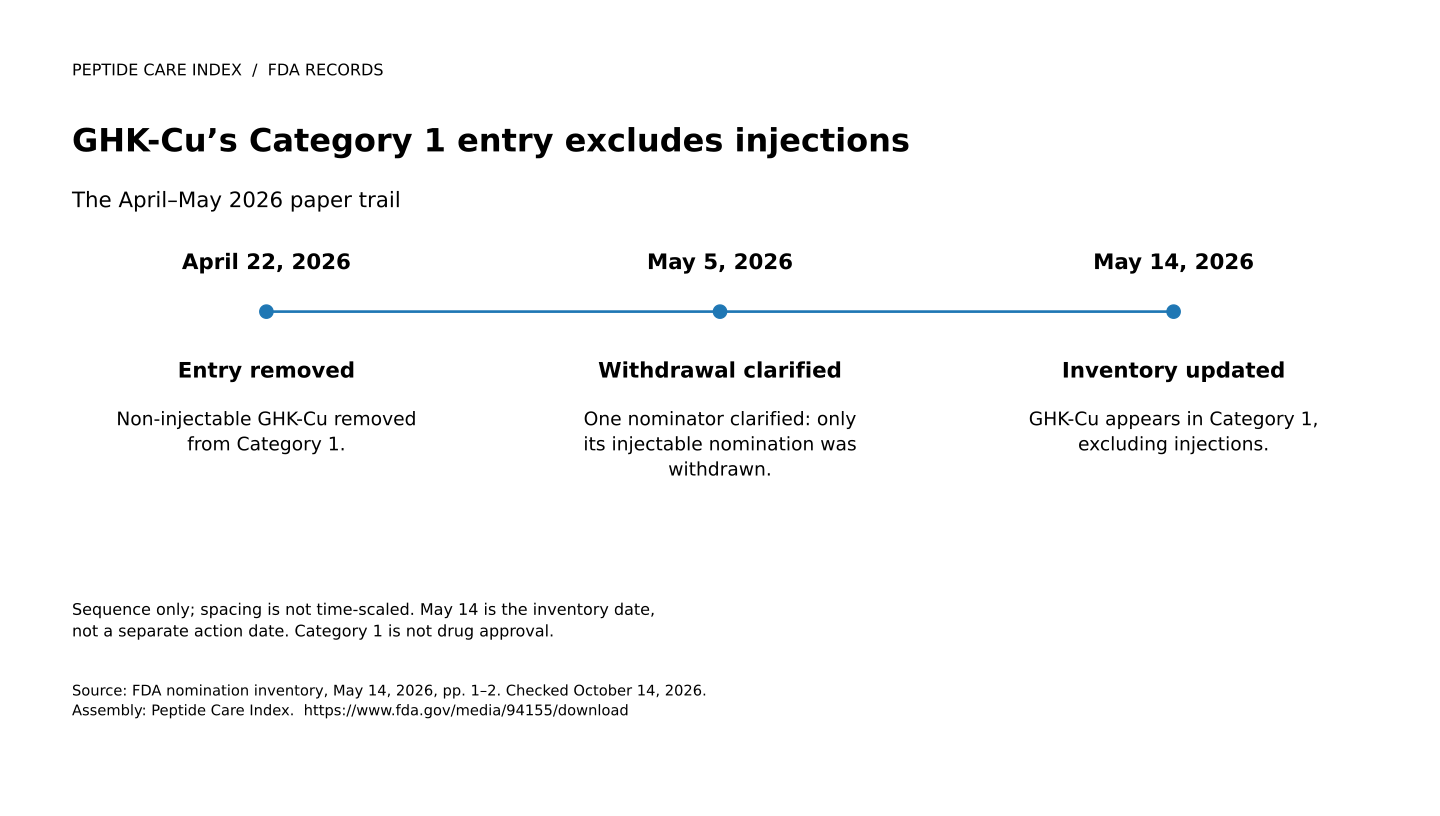
| April 22, 2026 | Entry removed | Non-injectable GHK-Cu removed from Category 1. |
| May 5, 2026 | Withdrawal clarified | One nominator clarified: only its injectable nomination was withdrawn. |
| May 14, 2026 | Inventory updated | GHK-Cu appears in Category 1, excluding injections. |
Source: FDA nomination inventory, pages 1–2, updated May 14, 2026 and checked October 14, 2026. The last date is the inventory’s update date, not a separately established date of agency action.
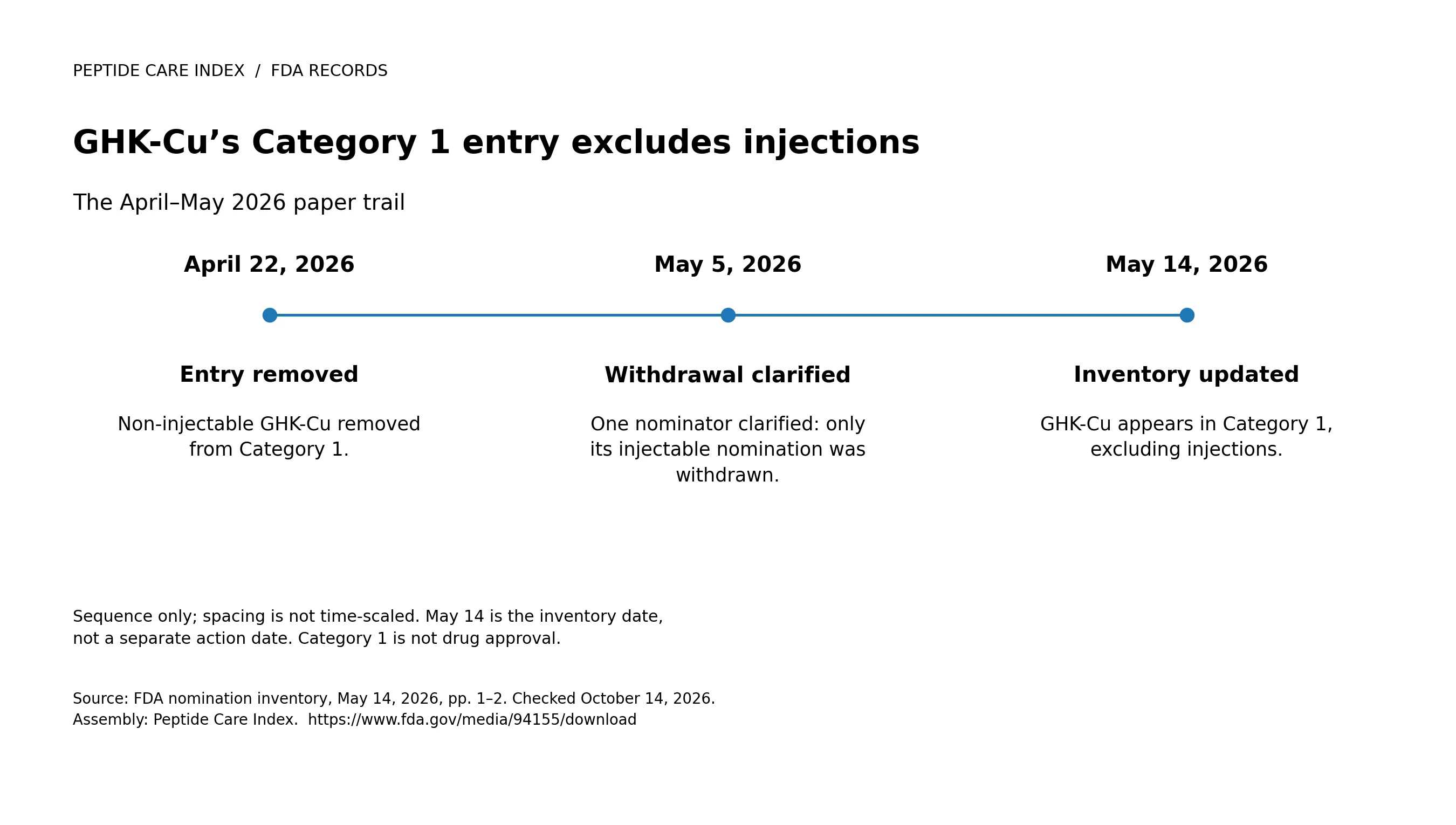
Source: FDA nomination inventory, May 14, 2026, pp. 1–2. Checked October 14, 2026. Assembly: Peptide Care Index.
Say a clinic cites “GHK-Cu in Category 1” while offering an injection. The missing words—excluding injections—change what that record supports. Ask for evidence about the exact product and route, not just a familiar name.
What do FDA’s safety entries say?
For two of the five follow-up groups—Dihexa acetate and PEG-MGF—FDA’s entries say the agency has not identified human-exposure data for drug products containing them via any route. That is FDA’s stated finding in those entries, not a new search of all human research by us. The other entries raise different questions. FDA safety table
| Substance and scope | Short account of FDA’s entry |
|---|---|
| Cathelicidin (LL-37) | FDA says it lacks enough safety information to know whether use could harm people. |
| GHK-Cu, injections | FDA notes limited human safety data and possible unwanted immune responses and peptide-related impurities. |
| Dihexa acetate | FDA says it has not identified human-exposure data for drug products containing it via any route. |
| Melanotan II | FDA cites published case reports of serious adverse events. |
| PEG-MGF | FDA says it has not identified human-exposure data for drug products containing it via any route. |
Source: Each named row in FDA’s withdrawn-nomination safety table, checked October 14, 2026. These are short summaries, not complete safety reviews. Case reports do not provide an event rate or, by themselves, establish cause and effect.
A place on a meeting agenda does not cancel these entries. A lack of data is also not proof that a substance is harmless. A qualified clinician is the right person to discuss evidence, risks, and alternatives for your care.
Is BPC-157 on this agenda, or the July one?
BPC-157 is on the July 2026 agenda, not the five-name follow-up announcement checked here. Across those two agendas, we counted 12 distinct substance groups: seven in July plus five in the follow-up, with none shared. July agenda · Follow-up agenda
FDA’s July page also names the uses it evaluated. That matters: a review of one use is not a review of every claim made about that substance.
| Substance group | Review day | Uses FDA evaluated | Named forms |
|---|---|---|---|
| BPC-157 | July 23, 2026 | Ulcerative colitis | Free base; acetate |
| KPV | July 23, 2026 | Wound healing; inflammatory conditions | Free base; acetate |
| TB-500 | July 23, 2026 | Wound healing | Free base; acetate |
| MOTs-C | July 23, 2026 | Obesity; osteoporosis | Free base; acetate |
| Emideltide (DSIP) | July 24, 2026 | Opioid withdrawal; chronic insomnia; narcolepsy | Free base; acetate |
| Semax | July 24, 2026 | Cerebral ischemia; migraine; trigeminal neuralgia | Free base; acetate |
| Epitalon | July 24, 2026 | Insomnia | Free base; acetate |
Source: FDA’s July 23–24, 2026 agenda and “Uses evaluated” tables, checked October 14, 2026. Both free-base and acetate forms are named for every group. The CSV preserves all 14 names; the table groups them by substance.
For example, FDA’s listed BPC-157 use was ulcerative colitis, not tendon recovery. A general statement that “FDA reviewed BPC-157” leaves out that scope. FDA July table
For a separate look at the site’s current coverage, see our peptide access summaries. Those summaries are not a substitute for the exact FDA meeting record.
Does the hearing mean FDA approval?
No. The committee gives advice to FDA; its recommendations do not bind the agency or approve a finished drug. FDA also states that compounded drugs are not FDA-approved. FDA advisory-committee explanation · FDA compounding questions and answers
| Record | What it tells you | What it does not establish |
|---|---|---|
| Nomination | Someone proposed a substance for evaluation. | That FDA accepted the case for using it. |
| Category 1 entry | The substance is listed under a conditional interim compounding policy. | Approval of a particular product or unrestricted use. |
| Meeting agenda | What the committee plans to discuss. | The vote or FDA’s later decision. |
| Committee recommendation | The panel’s advice. | A binding agency action. |
| FDA rule or policy | The agency’s action within the document’s stated scope and dates. | Permission beyond its terms. |
| Drug approval | FDA’s approval of a specific drug product. | Approval of a separate compounded version. |
Sources: FDA’s 503A framework, advisory-committee explanation, and compounding questions and answers, checked October 14, 2026.
FDA’s posted framework describes a conditional enforcement policy for certain compounding with Category 1 substances. That policy is not the same thing as adding an ingredient to the final 503A list. Read the operative source, including its scope and date, before drawing an access conclusion. FDA framework
A clinic’s offer is another kind of record. Our comparison of published provider terms helps with fees and booking conditions; it is not a supplier list for these five agenda substances.
Checking an offer before you pay? Find My Peptide Path has free questions about the exact product, pharmacy, access claim, and fees.
How can I watch or send a comment?
The checked announcement does not give a webcast URL, comment docket, or speaking-request deadline. FDA says a later Federal Register notice will give participation details. A docket is the public record where an agency collects documents and comments. FDA announcement
Use the official meeting page and 2027 materials directory as the starting points. Written comments and a request to speak are separate steps; follow the instructions for this meeting when they appear.
FDA aims to post the materials and webcast link at least two business days before the meeting. If the materials cannot be posted ahead of time, FDA says it will make them available on its website at the meeting and provide copies at the location. This is its stated plan, not a guaranteed release time. FDA materials and webcast sections
Before sending a public comment, read the notice’s privacy instructions. Do not assume that attachments or personal medical details will stay private. FDA’s July notice explains how comments can become public; the next notice must be checked for its own instructions. July public-participation notice
How did we build this tracker?
We matched names across two FDA agendas and the agency’s nomination records. The result is 13 source-match rows covering 12 substance groups, with an extra GHK-Cu row to preserve its route split. Every included record was checked against its linked primary source on October 14, 2026.
We used the full five-name follow-up agenda and all seven July groups. We kept FDA’s July form names and evaluated uses. We then matched those names to the withdrawn-nomination table and added the separate non-injectable GHK-Cu entry from the May 14 inventory. We inspected pages 1–2 of that PDF visually as well as reading its text. Follow-up agenda · July agenda · Safety table · Inventory
What counts as one group or one row?
A group is one substance heading in this comparison. A row is a match to a particular FDA record. GHK-Cu therefore counts once in the agenda but twice in the download.
The counts can be reproduced from the CSV:
- Five matched names: filter to
follow_upandwithdrawn_nomination_entry; count distinctagenda_group_idvalues. - Twelve groups, thirteen rows: seven July groups + five follow-up groups − zero shared groups = 12; add GHK-Cu’s second record = 13 rows.
- Fourteen July forms: add
named_form_countfor the seven July rows: 7 × 2 = 14. Blank future form counts mean unspecified, not zero. - Two follow-up human-exposure statements: filter the five follow-up groups for
stated_in_matched_FDA_entry. Only Dihexa acetate and PEG-MGF match that wording; a different label does not mean human evidence exists.
To reproduce a row, open its agenda source and named source location, then its matched FDA record. Retain the route limit and document date. The CSV’s check date records when we inspected it—not when FDA issued the underlying document.
What does this tracker leave open?
It does not establish that a treatment works, predict a vote, or determine what a particular pharmacy may dispense. It does not cover every peptide, FDA review, state rule, or marketed use. The early agenda can change, and a posted inventory may lag a later agency action.
We did not survey patients, test products, contact FDA, or independently review all human studies. We did not verify July vote tallies from primary recordings or minutes, so they are not part of this dataset. Our methodology and editorial standards explain the source and authorship limits.
What changed in this edition?
October 14, 2026: First source snapshot assembled. It joins the follow-up agenda, July’s dates and evaluated uses, and the separate GHK-Cu route records. A later source check without changed findings will not reset the substantive update date.
How can I cite or download this tracker?
Cite FDA for its announcement and individual entries. Cite Peptide Care Index for this matched-record table and the calculations built from it.
Peptide Care Index. FDA Peptide Hearing 2027: Date & 5 Substances. October 2026 edition. Sources checked October 14, 2026. https://peptidecareindex.com/research/fda-peptide-hearing/
The five-name finding, GHK-Cu comparison, and each substance row have their own links. Keep the route and source date with a copied finding.
Reuse: You may reuse our original tables, analysis, and chart with Peptide Care Index named as the source. Keep the FDA source details and check dates. This permission does not cover third-party material or marks. Any underlying source terms still apply.
What is in each download?
The files are free and require no account or email. The main file is a CSV, a plain-text table that opens in a spreadsheet. Empty future-date, use, and form-count cells mean the checked notice did not specify them.
| File | Contents |
|---|---|
| FDA Peptide Review Tracker — CSV | 13 source-match rows, 12 substance groups, 27 columns; sources and a check date on every row. |
| Meeting status — CSV | 8 checked meeting-detail fields, their scope, and source links. |
| GHK-Cu paper trail — CSV | 3 dated records, including the distinction between action dates and the inventory date. |
| GHK-Cu chart — PNG or SVG | The same three-date timeline, with its source line inside the image. |
Source: Peptide Care Index’s October 14, 2026 compilation of the FDA records listed below. The CSVs retain the underlying source URLs.
| Field | Meaning |
|---|---|
record_id | Unique source-match row ID; also the row permalink. |
agenda_group_id | Stable group ID. Both GHK-Cu rows share one group ID. |
display_name | Short name used in the page. |
search_aliases | Explicit lookup spellings, separated by semicolons. No silent chemical-name substitutions. |
meeting_group | follow_up or july_2026; a group label, not a future exact date. |
official_agenda_name | Name or group wording in the FDA agenda. |
announced_window | FDA’s stated future window or the July meeting date range. |
review_date | July agenda date in YYYY-MM-DD form; blank when no exact future date is specified. |
exact_date_status | Explains whether the agenda supplies an exact date. |
named_forms | FDA’s named July forms, separated by semicolons; blank for unspecified future forms. |
named_form_count | Count of named July forms; blank is unspecified, not zero. |
evaluated_uses | Uses listed on July’s agenda, not approved indications. Blank for unspecified future uses. |
upcoming_review_scope | What the early agenda does or does not state about uses and routes. |
matched_record_name | Exact substance label in the matched FDA inventory or safety row. |
matched_record_kind | withdrawn_nomination_entry or category_1_inventory_entry; not a product-approval status. |
matched_record_route_scope | Scope of the matched source entry, not an assigned future-review route. |
inventory_document_date | May 14, 2026 for the GHK-Cu inventory record; blank where not applicable. |
fda_safety_note | A short account of the matched FDA entry, not a complete safety review. |
fda_no_human_exposure_statement | Whether the matched entry expressly uses the no-identified-human-exposure finding. not_stated_in_matched_FDA_entry does not mean human evidence exists; not_applicable_to_inventory_record identifies the separate non-safety record. |
agenda_source_url | Exact FDA agenda URL. |
agenda_source_location | Heading or row within the agenda. |
matched_source_url | Exact URL for the matched nomination or inventory record. |
matched_source_location | Row or PDF page for that match. |
additional_source_url | An additional primary record when needed; blank otherwise. |
additional_source_location | Location within the additional record. |
source_check_date | Date the relevant sources were checked, in YYYY-MM-DD form. |
limitations | Row-specific boundaries; not a legal or clinical determination. |
Source: Peptide Care Index’s definitions for this October 14, 2026 compilation; each data row retains its FDA evidence.
| Field | Meaning |
|---|---|
record_id | Stable meeting-field ID. |
field | Meeting detail checked. |
posted_value | What the checked notice or directory supplies. |
scope | Boundary of the observation. |
source_url | Exact primary notice URL. |
source_location | Relevant source section. |
additional_source_url | Additional directory URL when used; blank otherwise. |
source_check_date | Date of the check, not the event date. |
Source: Peptide Care Index’s definitions for this October 14, 2026 compilation; each data row retains its FDA evidence.
| Field | Meaning |
|---|---|
event_id | Stable timeline-record ID. |
event_date | Date reported by FDA or the inventory date. |
event_label | Short event label. |
event_detail | Exact text used in the article table and chart. |
date_type | Distinguishes an action or clarification date from a document date. |
source_url | Exact FDA inventory URL. |
source_location | PDF page and relevant statement. |
document_date | Date printed on the inventory. |
source_check_date | Date the relevant record was checked. |
Source: Peptide Care Index’s definitions for this October 14, 2026 compilation; each data row retains its FDA evidence.
What else do readers ask?
Does February 2027 mean an approval deadline?
No. The announcement describes a meeting window, not a promised approval or final agency decision. A committee recommendation and a drug approval are separate records. FDA announcement · FDA advisory explanation
Can I use the July meeting’s comment docket?
Not for the new meeting unless its own notice expressly directs you there. Docket FDA-2025-N-6895 and the July 22, 2026 comment deadline belong to the July event. The follow-up announcement says its docket details will come later. July notice · Follow-up notice
Does this cover every peptide FDA has reviewed?
No. It covers 12 substance groups from two specified agendas. A name missing from this tracker is outside its scope; that does not establish approval, a ban, or a lack of research.
Does the future agenda specify conditions or routes for each substance?
No. The checked early notice supplies five substance names, without detailed evaluated uses or routes. Do not carry a route from an older nomination—or a use from a clinic’s advertisement—into the future agenda. FDA agenda
Which sources did we check?
All records below were checked October 14, 2026. A document date is shown where it is established in the record; it is not replaced with the check date.
- FDA, Meeting of the Pharmacy Compounding Advisory Committee. Early announcement: timing, agenda, public participation, materials and webcast sections. The timing is a window, not an exact event date.
- FDA, 2027 Meeting Materials, Pharmacy Compounding Advisory Committee. Directory entry linking to the early announcement; used to check for posted event materials.
- FDA, Certain Bulk Drug Substances for Use in Compounding that May Present Significant Safety Risks. “Bulk drug substances nominated but withdrawn” table; each matched row is identified in the main CSV. This is not a final product-approval list.
- FDA, Bulk Drug Substances Nominated for Use in Compounding Under Section 503A. Updated May 14, 2026. Page 1 explains the GHK-Cu change; page 2 lists the non-injectable Category 1 entry. Both pages were visually checked.
- FDA, July 23–24, 2026 Pharmacy Compounding Advisory Committee meeting. July 23 and July 24 agendas, named chemical forms, evaluated uses, and public-comment information. These uses are review subjects, not approved indications.
- FDA, Bulk Drug Substances Used in Compounding Under Section 503A. Explains the ingredient framework and conditional interim policy; not a case-specific legal opinion.
- FDA, Compounding and the FDA: Questions and Answers. Defines compounding and explains the difference between compounded drugs and FDA-approved products.
- FDA, Advisory Committees Give FDA Critical Advice and the Public a Voice. Explains nonbinding recommendations, meeting materials and public participation.